Showing posts with label novel writing. Show all posts

Friday, May 5, 2017

William Faulkner's Rowan Oak--

    I lived over half my life in Mississippi. When I tell people where I'm from "originally," (I was born in Washington, D.C.), I get one of two reactions. One--"You don't sound like you're from Mississippi."(An Two--"You lived in Mississippi? WHY?"

It's complicated.

One of the most wonderful features of my adopted home state, is it's fertile ground for the artist. Even better, Mississippi honors and reveres it's artists and writers. Pulitzer winner Eudora Welty lived in a couple of blocks from my elementary school in Jackson. It wasn't unusual to see her in the supermarket or ensconced in a oversized leather chair at my favorite bookstore, a tower of "to-be-browsed" books at her feet. All the customers knew her, and let "our Miss Eudora" read in peace. Richard Wright, National Award winner Ellen Gilchrist and Newbery winner Mildred D Taylor are all Mississippi natives. Oh and don't forget Barry Hannah, Willie Morris and of course, John Grisham (who wasn't born there and doesn't live there now, but still claims the place as a home.)


OK, having dropped enough names, let's get to the subject of the post...a visit to an author's home. You might have noticed, William Faulkner was not on my list. IMHO, is The Man of American literature. Faulkner must surely occupy an honored corner of Heaven, where he is sipping whiskey with the likes of Flannery O'Connor. Pat Conroy and Carson McCullers, most of whom were also "sippers."

I first met Mr. Faulkner in a high school American novel course, when we were assigned The Sound and the Fury. Talk about a whack on the side of the head. I had never read a multiple POV non-linear novel, the narrators' voice each so distinct, you didn't need to check the chapter headings to know who was speaking. I had never had an author all but say, "Hey, I wrote this. You figure out who these people are and what's going on." I loved his utter disregard for sentence construction (the master of the run-on sentence) and punctuation. Although when I tried it, my teacher said, "When you win the Nobel Prize for Literature, you can leave out all the commas you want."

That particular lit teacher had attended Ole Miss (the University of Mississippi) while Faulkner still lived in Oxford. She told us stories of him pacing the town, mumbling to himself, or talking to invisible people. ("Probably drunk," she sniffed. Obviously he was talking to his characters. Duh!) He was not a popular figure in Oxford since he based his characters on people everyone knew and recognized. (He's still not too popular with some in Mississippi for that reason.)

I knew that his home, Rowan Oak still existed somewhere in Oxford, but back in the day (1977) interstates were all but non-existent in Mississippi and none of them ran near Oxford. 162 miles of rotten two-lane roads running through jungles of kudzu was not an expedition to be taken lightly. However, when college friends showed up to visit, I gathered my courage (along with the two males who knew how to change a tire) and headed north.

Once in Oxford, we couldn't find Rowan Oak. I knew that any house in Mississippi with a name would be too big to miss. There were no signs, "Faulkner's home this way", nothing named "Faulkner Lane." We asked students, we asked gas station attendants, we asked storekeepers.  It is no credit to the University that not only did the students not know where or what Rowan Oak was, some of them didn't know who Faulkner was either. Everyone else gave us blank stares (remember, not a popular guy, Faulkner.)

After bumbling around the town square multiple times and meandering through likely-looking neighborhoods, we found it. Although it was a scorching August day, the house seemed to rise out of a mist, at the end of a lane of cedars. A long lane. Mysterious. Only later did I learn that it is alleged to be haunted.

At a distance, it looked like any other antebellum home but as we came closer I could see that it was not as elaborate as the mansions of Natchez. Low brick porch in place of a sweeping veranda. Plain old square columns.  The once-white paint peeled in some spots and was mossy in others.

Once inside, the caretaker took our money, handed us a brochure and said "Take your time folks" and disappeared. I'd never been in a historical site where there wasn't a guide talking a mile a minute about this or that doodad, pausing only to say "Don't touch anything" and "Remember to visit out gift shop." (There wasn't one.)

The brochure informed us that 1) the house was built in 1844 2) on 49 acres of mostly timberland 3) "rowan oak" is a tree from Celtic mythology  4)Faulkner bought it during the Great Depression, living there until after he won the Nobel, where upon he moved to Charlottesville, Virginia.  The end.

My first impression was of being somewhere timeless, like a forest floor. I don't know if the walls were pale green or not, but in my mind they were. Timeless, like Faulkner's stories.

As I went from room to room, I was surprised by the sparseness of the furnishings. Every other house of this vintage I'd seen was wall to wall with fainting couches, grand pianos and dining rooms with Old Paris porcelain service for twenty. These rooms weren't empty, but they felt that way. Totally uncluttered (again, like Faulkner's prose.) I had heard that Mrs. Faulkner was something of a shopaholic. If she was, somebody with a Spartan sense of decor had come after her and re-furnished it.

I've never been anywhere so large, so uncluttered, yet so full of life. Dilsey, Benjy, Caddy, Luster and Quentin of The Sound and the Fury seemed to be just around the next corner, watching us, maybe wondering what we found so fascinating.

Because Faulkner bought in the 1930's, it looked a lot like my grandmother's house. Straight back, no-nonsense chairs. The world tiniest desk, just large enough for his portable Underwood.  A bag of golf clubs propped in a corner.A tall pedestal floor fan. Moth eaten rugs here and there. Some seriously uncomfortable looking Adirondack chairs (which I would've put on the porch). Yet even though I recognized the chairs and tables and couches as being of my grandparents' era, I didn't feel as if I were in a Great Depression time capsule.
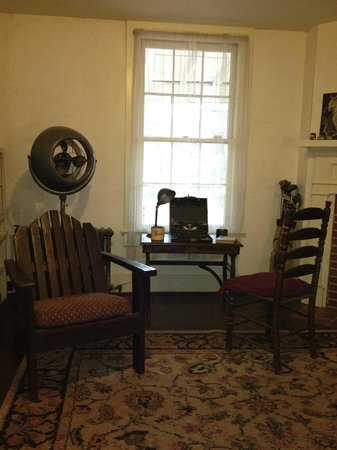
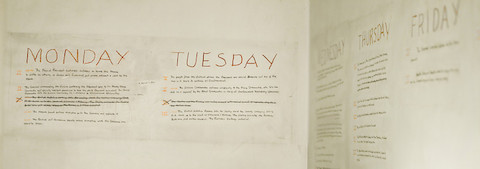
I was in the world of Faulkner's mind--utilitarian, but taking unexpected turns (the Adirondack chairs, the golf clubs) But what drew me most out of this tranquil room, and into the true mind of Faulkner, was the penciled outline for his Pulitzer/National Book Award WWI novel (and Faulkner's personal favorite) A Fable. Penciled outline on his wall. He could glance up and see where he was in his time line. Oh, for a house where you could outline your stories on the wall!
This picture of William and Estelle Faulkner was for A Fable's publication. Notice the somewhat scruffy exterior of  the house.  That's pretty much how it looked when I was there in 1977. In the ensuing years, all of those grand pianos and fancy furnishings (that would befit a Nobel Laureate) have been added in the restoration.  Faulkner himself never lived at Rowan Oak full time from the late 1950's until his death in 1962, splitting his time between Oxford, and the University of Virginia where he was the Writer-in-Residence and Lecturer in American Literature.
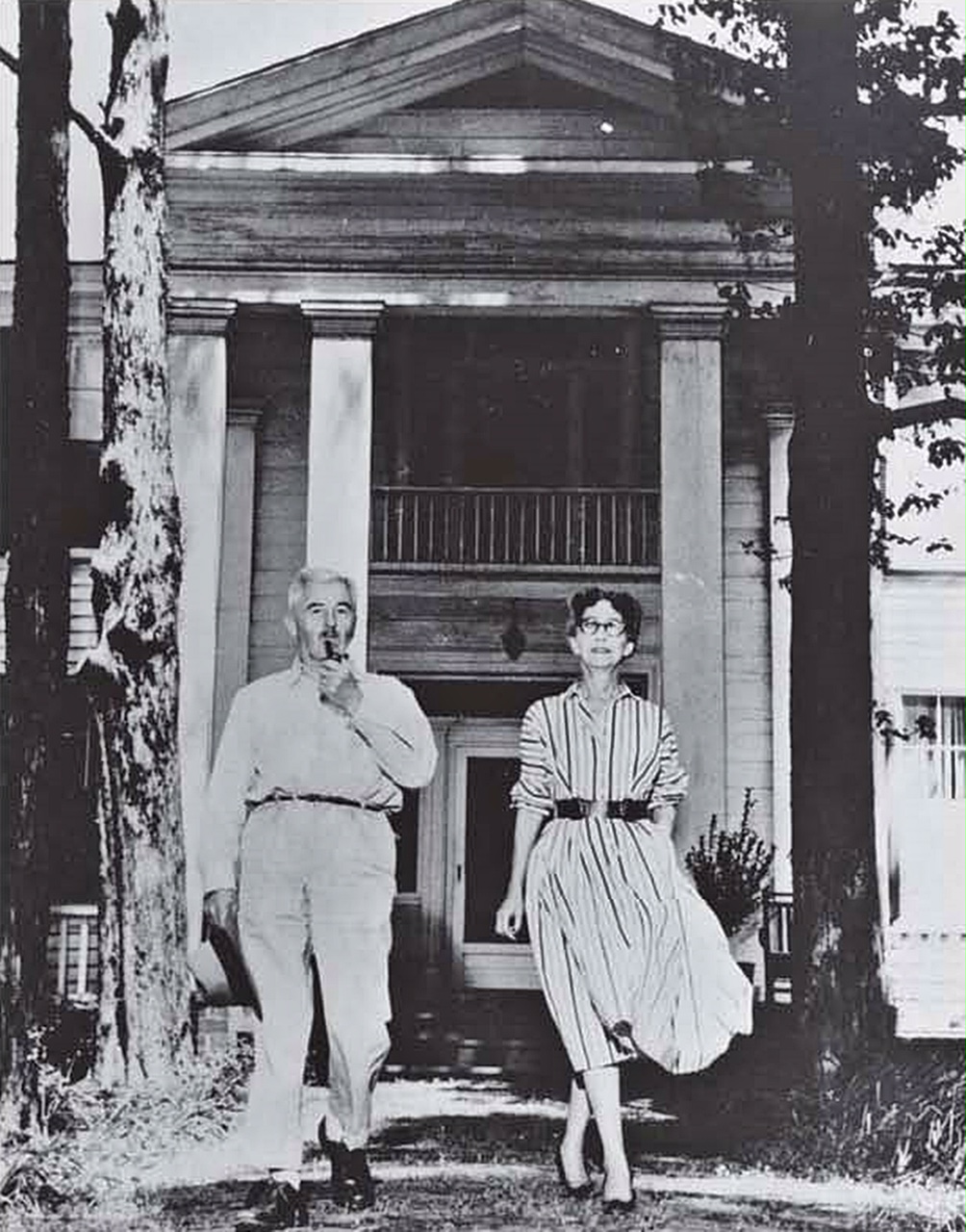

Having seen the pictures of the finely restored Rowan Oak, I will never go back. I prefer my memory of a mystically green place on a hot August morning, curiously empty, yet bursting with the world of Faulkner's Yoknapatawpha County.

Don't forget, today is your last chance to enter our Blogiversary Book Giveaway, Lisa Cron's, STORY GENIUS.  For details, link back to Esther's post for details.

Posted by Mary Ann Rodman
P.S. Dear devoted TA readers;  I am taking a summer sabbatical so this will be my last post until fall. Transitioning my 94-year-old dad (who lives 500 miles away) and Young Authors' Camps will pretty well usurp my writing time.  But I'll be back.  See y'all in the fall, as we say in the South.

Friday, May 27, 2011

Really? Do we have to talk about revision AGAIN? Happy Poetry Friday!--now rewrite that poem...

This week's Poetry Friday is hosted by the delicious poet
Heidi Mordhorst over at My Juicy Little Universe

So...rewriting.  Can't we just skip it?  Can't we just write something brilliant and then jump to that thick-carpeted Hollywood office where we're signing the movie contract based on our book?

I've been feeling discouraged this week, so here's a poem about my work-in-progress, another novel-in-poems which I'd hoped would be finished when I turned in the April 14th draft in my novel writing class.

Finished?  Heaven's no!  Now that I have notes on this draft, I'm messing with it again.  My book clearly needs a little more curry or cumin or molasses or heaven-knows-what.  *Sigh*  

NOVEL THOUGHT
by April Halprin Wayland

I'm walking quickly on this path
I edit words I see are chaff
I'm making characters three-dimensional
I've integrated the high school staff
(the stereotypes were unintentional)

I've cut the zoo scene and giraffe
though it was beautifully unconventional
I'm trying not to be inflexible—
and keeping it was indefensible
(though parts of it were quite exceptional)

If only I can reach that raft
and climb aboard, untie the rope—
I'll sail off with the final draft...
at least I hope!
x
2011 April Halprin Wayland, all rights reserved 

My novel writing teacher's shorthand for "I like this part" is a check mark at the end of the line or sentence.  It's an effective and easy way to compliment someone.  No need to put a smiley face or write, "nice"--just a simple check mark and move on.  It also allows the person who is critiquing the book to keep reading...to stay in the flow of the book while still commenting on it along the way.
x
.

When my eight fellow classmates and my instructor had read my novel, I lugged the manuscripts home and read everyone's notes. Then I tossed the notes that were complimentary, the ones with lots of check marks and comments about how fabulous the book was. 
x
I mean, yes, yes--thank you, glad you like it--SO DO I--that's why I WROTE it, I want to say.  Let's get to the meat, the real nitty gritty, the stuff you couldn't stand, the poems that should be cut.  Isn't that why we're here?

But I was feeling pretty low.  So I reached into the recycling box and took out a handful of the compliments--the ones I'd so blithely dismissed.  I read them slowly.  I tried to keep my getting-ready-to-be-defensive voice from yelling back at them.  I just. Let them. Like. My words.

WRITING WORKOUT: What to do with the compliments

So what's your writing workout today? Simply this: Listen to the good stuff, too.

Monday, January 31, 2011

Full-Body Workout

To quote April Halprin Wayland's wonderful Friday post about clutter-busting:

Before we get started, run over and read the dynamite interview with Cynthia Leitich Smith by Teaching Author Carmela Martino and enter our latest book give-away! Note that the deadline for entry is 11 pm (CST) Wednesday, February 2, 2011. Make sure you follow the rules by posting a comment at the bottom of that blog post and include your contact information. And you must have a USA mailing address.


Teaching Author Esther Hershenhorn kicked off our current topic with a great intro to 6 + 1 Trait Writing: Organization. Teaching Author JoAnn Early Macken followed with Getting Your Ducks in a Row. Teaching Author Mary Ann Rodman's It Just Looks Disorganized came next. All include practical and inspiring Writing Workouts, so check them out.


As the absolutely least organized of the Teaching Authors (the one who took my son to preschool on Friday when there was no school; the one who this week mailed our new church registration to my mom and a handmade card from my daughter to the church; the one who "ran" to amazon and purchased my copy of Clutter Busting as soon as I read April's post) -- it is my pleasure to tackle this topic last.

In fact, my college classes this week (when they haven't been canceled due to snow) have been learning about essay and paragraph organization.  Our text suggests the most obvious methods: chronological; spatial; most to least important or, conversely, least to most important.  We have also been stressing the use of appropriate transitions. 

To illustrate how writing instruction is similar across the grades, my daughter brought home the following exercise from kindergarten on Friday:


(She did not quite have time to finish, but you get the idea.)

It took me a long time to realize that, as a writer, I crave the structure that I lack in my real life.  Even as a kid, I loved the predictability of the series books that I read voraciously.  My favorite genre is the mystery.  If actual life is rarely neat and tidy, I want pretend life to be perfectly so!

The three-act screenplay format is widely applicable to nearly every form of fiction.  Extrapolating on this concept, I feel exceedingly comfortable with the teaser-plus-seven-acts format of Days of Our Lives, the predictable mid-break (Act 3) cliffhanger, the end-of-day "tags" (hooks), and all of the soapy norms for handling recap and flashbacks.  I also wrote Nancy Drews tailored to a very specific word count, structure, and, of course, the rules of Nancyland.

When it came time to write a novel of "my own," I decided to hang it on the structure of a science fair project report.  The big plus to this method was that the general plot trajectory was laid out for me from the outset.  Of course there were obvious drawbacks.  The book started to drag quite a bit in the 'methodology' section, and it wasn't until a brilliant critiquer suggested that I add interstitial chapters that it really began to come together.
 
Since I began writing MIND GAMES, I've sought out children's books written in 'nontraditional' (i.e., nonlinear formats): Walter Dean Myers (screenplay), Lauren Myracle (instant messages) Paul Fleischman's multi-POV wonders, novels in verse.  As ebooks and apps become increasingly popular, interactive elements will certainly become more widely used, as in the Choose-Your-Own adventure books that were beloved in my youth.

Picture book writers have both the structure and the stricture of the 32-page format.  Novelists have the privilege (and the curse) of a wide-open world of possibilities! --Jeanne Marie


Writing Workout

For the busy multitaskers among us, we must often choose between finding time to do a "writing workout" or a more traditional workout of the full-body sort.  I have devised a semi-solution to this dilemma by converting my workspace to look like this:


What changes can you make to the organization of your life to make your work easier, more dynamic, or more productive?  Please share!

Wednesday, January 19, 2011

6 + 1 Trait Writing: Organization

This is the second January our TeachingAuthors posts address 6 + 1 Trait Writing.
Last January we focused on the first trait, Ideas, each of us sharing the generation of a particular work.
This January we focus on Organization.

Brainstorming this post, though, I wondered, “Are all of our readers familiar with 6 + 1 Trait Writing?”
Many of our readers are classroom teachers, reading our posts to help them grow writers; many, however, are first-and-foremost writers, specifically children’s book writers.
6 + 1 Trait Writing – or Six Traits Writing as it’s often called - may mean little, if anything.

So, I’ll organize my post as most writers would organize their work – i.e. structure its movement forward and create its shape, then begin by grounding my readers in this singular Language Arts approach.

Essentially, the Six Traits approach offers an analytical model for assessing and teaching writing based on six identifiable key qualities of strong writing:

• IDEAS, the main message;

• ORGANIZATION, the internal structure of the piece;

• VOICE, the personal tone and flavor of the author's message;

• WORD CHOICE, the vocabulary a writer chooses to convey meaning;

• SENTENCE FLUENCY, the rhythm and flow of the language;

• CONVENTIONS, the mechanical correctness;

• PRESENTATION, how the writing actually looks on the page.

I like the Six Traits connection children’s book author and teacher Anastasia Suen shares on her website:

“I like to teach with the six traits because this is how I write! I start with ideas, and then I organize them. Once I have a plan, I begin to write. I say things the way I want to say them, with my voice. I choose words and make the sentences flow. Then I clean it up by focusing on the conventions (grammar, punctuation and spelling). I work in this order, so that ideas come first and conventions are last.”

Ruth Culham is the SixTraits Guru.                                           
I’ll be sitting at her feet soon, learning-learning-learning, at the upcoming February CCIRA Conference (Colorado Council International Reading Association) in Denver – and – March Illinois Reading Council Conference in Springfield.
Dr. Culham was formerly the Unit Manager of the Assessment Program at Northwest Regional Educational Laboratory in Portland, Oregon.
Many educators I know turn to Northwest Regional Educational Laboratory Education for resources, lesson plans and books.

Aurora, Illinois first-grade teacher and national literacy consultant Dr. Maria Walter authored a series of articles in Book Links that showcase picture books representative of strong trait writing.
Scholastic published Maria’s book Literature Is Back! Using the Best Books to Teach Readers and Writers Across Genres in 2007.

To ensure we’re all on the same page for the posts that follow, here’s Northwest Regional Education’s definition of Organization:

“Organization is the internal structure of a piece of writing, the thread of central meaning, the pattern and sequence, so long as it fits the central idea. Organizational structure can be based on comparison-contrast, deductive logic, point-by-point analysis, development of a central theme, chronological history of an event, or any of a dozen other identifiable patterns. When the organization is strong, the piece begins meaningfully and creates in the writer a sense of anticipation that is, ultimately, systematically fulfilled. Events proceed logically; information is given to the reader in the right doses at the right times so that the reader never loses interest. Connections are strong, which is another way of saying that bridges from one idea to the next hold up. The piece closes with a sense of resolution, tying up loose ends, bringing things to a satisfying closure, answering important questions while still leaving the reader something to think about.”

I look forward to learning how my fellow TeachingAuthors come at organizing their stories, with hopes readers will comment as to how they do the same.

Esther Hershenhorn


Writing Workout

Writing Workout


I began my career writing picture books, a singular art form if ever there was. It wasn’t until I wrote my first novel, however, that I truly understood how a picture book worked, how the format demands the essence of a story. A picture book offers - in 14 to 15 double-page spreads -the bare bones of a story. The 14 to 15 chapters of a middle grade novel? Why, those chapters total a fleshed-out picture book story!

Choose a favorite novel. Summarize each chapter in one or two sentences, focusing on the character, his actions and re-actions. Note the question each chapter leaves the reader asking. Note the plot structure – episodic, circular, scenes that build to a climax? How might the novel play out as a picture book? How might you tell the story to accommodate the format, ordering those chapter summaries within double-page spreads?

Now choose a favorite picture book. Summarize each double-page spread, again focusing on the character, his actions and re-actions. Note the pacing, the tension, the page-turn. Determine the plot structure. How might the picture book become a novel? Which scenes need to be rendered more fully, expanded and amplified, to give heft to the storyline? Which characters would assume a greater role?

Wednesday, November 17, 2010

Taking My Gluteus Maximus for a Walk

Reading Mary Ann's post on Monday reminded me of something Madeleine L'Engle says in Walking on Water: Reflections on Faith and Art:
"If the artist works only when he feels like it, he’s not apt to build up much of a body of work.  Inspiration far more often comes during the work than before it, because the largest part of the job of the artist is to listen to the work and to go where it tells him to go.  Ultimately, when you are writing, you stop thinking and write what you hear."
For my pseudo-NaNoWriMo project, I've been spending lots of time with Butt in Chair, or BIC, as Mary Ann calls it. I've discovered something interesting. Often, when I first sit down at the computer, I have no idea what I'm going to write about next or where the story will go. Those days usually start with me tweaking what I did the day before, trying to add sensory details to make the scene come alive. Then, somewhere along the way, inspiration kicks in and I'm soon typing away. As L'Engle says, the story starts telling me where to go. I know the inspiration wouldn't have come along if I hadn't been sitting there, listening, Butt in Chair.

Unfortunately, there's no magic formula. As Mary Ann said in her post, some days, even when we glue our butts to the chair, the words don't come. That's when I usually try taking the old gluteus maximus for a walk. As Julia Cameron says in The Artist's Way: "A brisk twenty-minute walk can dramatically alter consciousness." That altered consciousness often helps me hear what I couldn't when I was sitting in my chair.

Over the last few days, I've fallen behind in my word count goals for my project, and no matter how I tried, the words just wouldn't come. When that happened again today, I took a walk and thought about my story. As I walked, it occurred to me that much of the tension had leaked out of the story. Why? Because I'd made things too easy for my character. I needed to go back and change events so that she'd have to work harder to get what she wanted. Aha!

I know from experience that taking a walk doesn't always yield dramatic "aha" moments. But at least it helps keep my gluteus maximus from getting too big for the chair. :-)

I'm keeping this post short so I can get back to my novel-writing now.
Happy writing, all!
Carmela

P.S: I forgot to mention: there's a great book giveaway going on over at the MotherReader blog. Enter to win one of two sets of 25 books!

Wednesday, November 10, 2010

A Savage-soothing Tip for Novelists Pseudo, Real and/or Lost

I know first-hand: writing a novel can easily overwhelm – both the writer and the writer’s life.
I liken the experience to Alice’s, when she fell down that hole and left behind the world she knew.
By necessity, the writer becomes schizophrenic, a citizen of two countries – one fictive, one real.
Advil helps.
A lot.
The best cure for me, though, to keep me present to both worlds?
Hands down, it’s music.
It soothes the savage beast.

Your writer’s circumstances matter little.
You could be lost, like Mary Ann, in the fog with faulty headlights.
You could be over-tasked like Jeanne Marie or time-strapped like Carmela.
If you surround yourself with music that sings of your story - its heart, its soul, the characters who grabbed yours - you’ll be living your story 24-7.
Driving the carpool.
Shopping for groceries.
Washing dishes or scrubbing the bathtub.

I discovered this cure when writing my first novel,When They Only Had ‘til Monday, a never-sold middle grade – one part historical fiction, one part mystery - set in 1897 in St. Charles, Missouri. My peripatetic orphaned characters had but three days to uncover their beloved patriotic benefactor’s will or else... all six would be sent down river!
Reading about composer Scott Joplin’s Missouri hometown had indirectly led me to the story line. It seemed natural to surround myself with Joplin’s rags and operas.
Before long, I was assigning each Chapter a particular Joplin rag. An action-packed scene? "Cascades." A moment of poignancy? "Bethena." For the glorious resolution I chose the "Gladiolus Rag." 
The syncopation. The thrumping base line. The flurrying high notes.
Each time I listened I was scoring my novel.
Ironically, Joplin composed his rags in 4 prescribed movements, utilizing variations on a theme. Soon the scenes of my chapters mimicked Joplin’s style.


I played two Patti Page songs – “How Much is That Doggie in the Window?” and “The Tennessee Waltz” – while writing my middle grade novel The Confe$$ion$ and $ecret$ of Howard J. Fingerhut. Both 1950’s songs captured Howie’s earnestness, his ingenuousness, his yearning to win The H. Marian Muckley Junior Business Person of the Year Contest.

To me, the Yiddish folksong “Tum Balalaika” and my picture book Chicken Soup by Heart are one in the same, variations on a theme – i.e. the reciprocity of friendship.
To my surprise, the riddle nature of the song led to the back-and-forth dialogue between my character Rudie Dinkins and his afterschool babysitter Mrs. Gittel.

So,
once you’ve written your first draft and told yourself the story,
think about your character, your setting, your story’s time, your story’s heart.
What piece of music sounds like your story?

[Note: if stuck, think what songs your characters might purchase for their Ipods were they living in today's world.]

In many ways, that piece of music might serve as your GPS from first draft to last, a handy tool to help you carry on should your headlights fail, time make itself scarce and/or your Life overwhelms.

Keep writing.  Keep whistling. (Or is it the other way around?!)

Esther Hershenhorn

Wednesday, November 3, 2010

My Pseudo-NaNoWriMo Project

I'm hoping to make this post quick. You see, I'm working on my own novel writing challenge this month. As JoAnn and Mary Ann have mentioned, November is National Novel Writing Month, also known as NaNoWriMo. Writers from all over the world attempt to complete a 50,000-word first draft during the month of November.

Back in 2008, I had an idea for an historical young adult novel that I wanted to write, but I kept getting bogged down by research. I decided it would make the perfect NaNoWriMo project. The daily word-count quota would force me to stick to the story instead of agonizing over what kind of glassware my character drank from. The only problem: November is a bad month for me, due to family commitments. So I brainstormed with members of my critique group and we decided the best month for a NaNoWriMo-type project was January. Here in the Midwest, January is a great month to hunker down indoors and write like crazy. And, since January is the season of resolutions, what better resolution than to write a new novel? Plus, January has one more day than November. When you're counting words, every day helps. :-)

So, in January, 2009, I banned together with a group of other SCBWI members to work on what we called our New Year/New Novel project, or NYNN (which rhymes with "win"). We called ourselves NYNNies, or writing "fools," and set up a Yahoo group to support each other in our endeavor. We shared tips from a variety of writing books, including No Plot! No Problem, written by NaNoWriMo founder Chris Baty. As facilitator, I also periodically sent links to the NaNoWriMo pep talks from the previous November.

Thanks to the support of the NYNNies, I managed to write (a pretty horrible) first draft of my novel that January. I learned so much about my writing process and how to quiet the internal critic. But perhaps the most important thing I learned is that when I make writing a priority and keep "butt in chair," I can accomplish amazing things.

Unfortunately, when it came to revising the draft of my NYNN novel, I allowed myself to get bogged down in research all over again. I also struggled to find some sort of a plot in the mess that was my first draft. Yet I kept procrastinating. After months of work, I'd managed to eek out little over 30,000 words of a second draft. A few weeks ago, I decided it was time to end the procrastination. I came up with a plan for my own pseudo-NaNoWriMo project. I calculated that I need to add about 37,000 words to finish this draft, and I'd really like to finish it before Christmas. Looking at my calendar, I counted up 36 days (not counting holidays and weekends) that I could commit to working on the draft, beginning October 25. That comes out to about 1050 words/day to reach my target. Having lived through the mad crush of producing 1667 words per day for my original NYNN draft, I knew 1050 words/day was a feasible, though aggressive, goal.

I've been at my pseudo-NaNoWriMo project for a week and a half now. It's actually been harder than I expected to reach my 1050 words/day goal. I think that's due, in part, to still struggling with some plot issues.What's really helped me stick with it is the tremendous support I've received on Facebook. Since I started early and will continue this project through December 15, I didn't feel right signing up as an official NaNoWriMo participant, which means I can't take advantage of all the NaNoWriMo support. So instead, I've been posting my daily goals and accomplishments on my Facebook status. Knowing that my friends (and family!) will be checking on my progress has really helped me persevere, even on bad days. (If you'd like to be one of my Facebook friends, you can find me at http://www.facebook.com/carmelamartino, but if you send me a friend request, be sure to mention you read this blog. I don't "friend" just anyone. :-) )

If any of you are participating in NaNoWriMo, you're probably too busy writing to read this. And that's as it should be. But if you do have a moment, stop by and let us know how it's going for you.

And for those of you who think NaNoWriMo is a ridiculous idea, you're not alone. See this blog post by author Tayari Jones. 

Whether you are a NaNoWriMo writer or not, happy writing!
Carmela

Monday, November 1, 2010

Night Driving

     It's like driving a car at night.  You never see further than your headlights, but you can make the whole trip that way.--E. L. Doctorow


     Welcome to National Novel Writing Month. This is the month when I drag out my favorite Doctorow quote about novel writing, and sticky note it to my computer screen.

     I hate driving at night. I have terrible night vision. I hate driving in Atlanta, where the street lighting is bad and a street can change names several times, for no good reason. I absolutely refuse to drive at night unless the route is so familiar, I can put my brain on autopilot.

     A couple of weeks ago I drove my daughter to the Regional Skating Competition in Raleigh, North Carolina. I had driven this road exactly once before.  In daylight. It's pretty much a straight shot from Atlanta to Raleigh, seven hours according to a certain Online Mapping Site. This time, however, we couldn't start until school was out. Trying to leave Atlanta any time after three can take up to two hours.

    It took two hours. By the time we got to the Raleigh-Durham area it was well after eleven. And that's when we got into trouble. My Internet Directions were more than a little ambiguous. Forking left instead of right left me driving in an endless loop for three hours. Three hours of driving through what could have been the set for The Blair Witch Project.  No towns, no signs, no lights, and only occasional traffic lines. Lots of deer and spooky looking trees.

   The rest of the world has GPS in their car. I don't. Or at least a road atlas. I didn't. All I knew was that I started in Atlanta and needed to get to Raleigh. Finally I found that wrong fork-in-the-road and made the correct turn. But even the "right" road looked unfamiliar because my directions send me a different way from my previous trip. Go figure. At one thirty in the morning, after a lot of U-turns and squinting at at unlit street signs, we arrived, exhausted at our motel.

    You can see why I like that Doctorow quote. Beginning a novel is easy; first chapters are a cinch. You know where you are; here are the main characters and setting. Here is the set up for the conflict.

     Then you hit chapter two. Suddenly you find yourself driving in the dark, with unclear instructions, and only your literary headlights to guide you.  For years, at this point, I would noodle around for a couple of more pages (usually, description....I love description), and then my headlights would go out. Or I would hit a dead end road, with nowhere to turn around. I have more Chapter Ones with no Chapter Twos in my files than I care to admit.

     I can't/don't outline. The few times I've tried, the story sounded forced, my characters unhappily moving around at my direction. Unhappy characters are not interesting people to spend time with. Some people can write an outline and wham-bam-thank-you-Sam, they have the first draft of a novel. Lots of people use this method for NaNoWriMo.

     I am not one of those people.

      Some people have an internal GPS that just tells them where to turn and stop. I really don't like those people. The ideas just flow right along, beginning to end. They always pull into the Driveway of the Last Chapter before dark. Boo! Hiss! No fair.

      Then there is me. The one thing I have learned about writing novels is that when you have to have some notion of where this story is going to end. Why start a journey if you don't have a destination? So after Chapter One, I make a lot of notes as to how I think the story will end.

     So now I have a beginning, and a possible destination. I assemble as much information as I can as to how to get there. I get to know my characters (which I have written about earlier), and my setting. I try to anticipate any specialized information I might need. Then ever so slowly, I creep along from Point A to Point B. Only moving as quickly as my headlights allow.

      NaNoWriMo encourages setting a goal of so many words per day, every day. I've never really had much luck with that. When I have written say 1500 words per day, every day, by the end of the month, I find I have about 200 pages of some pretty funny characters and description, but no story. No end in sight.

      NaNoWriMo discourages revising as you go. I'm all for that. I could spend Eternity polishing that perfect first chapter. I do make a lot of "pit stops" to make sure I am still heading towards my last chapter. I do have a compass in my car,(and head) so I can tell if I am heading north or south) Or. . .


     I may discover that I don't want to go to Raleigh after all(although in the case of Regional Skating, I didn't have much choice....I had to find Raleigh!).  Sometimes my characters start telling me where they are going. I always let them. As I've said, forcing characters is like forcing my size 8 foot into a size 6 shoe, just because I like the shoes.  It can be done, but not for long, and the result is not pretty.

     In both Yankee Girl and Jimmy's Stars, my characters bumped me out of the driver's seat for the last third of the book. I am embarrassed to remember how I thought those books were going to end. I think that by the time you are two thirds of the way through, you know your characters so well, that they just hijack your mind and finish the story for you. At least that's what's happened for me so far. It was if I started out for San Francisco and wound up in Omaha. And discovered that Omaha was exactly the right place to be.

     Writing novels is hard. I am constantly driving up dead-ends...but I've learned to find a place to turn around and re-group. I hit roadblocks; I suddenly discover I absolutely need to know something like World War I field medical procedures. (No kidding....this is my current roadblock.) Eventually I decide that I can go another route, or I find the necessary information.

    Sometimes I discover a character in the backseat who hasn't spoken in a long time. I stop the car and see what the problem is. Are they still part of the story, or do they need to be left by the side of the road? (I know it sounds ruthless, but your novel can't drag around dead weight.)

     Right now I am working on two novels, simultaneously, since they have the same settings and characters, albeit the time frames are different. I have been switching off every time I hit a roadblock. The result is I have 2/3 of two novels. I am putting pedal to the metal now on only one now(having removed a roadblock last week). I know where I am going, but I am still driving at night. Cautiously, and focusing only what I can see in my headlights.

     Maybe I can NaNo that last third this month. Now that is a possibility. . .

     Happy NaNoWriMo, fellow writers. Keep your headlights on.

     P.S.  My daughter won silver in her competition level.
 
      Posted by Mary Ann Rodman