Showing posts with label Voice. Show all posts

Friday, June 20, 2025

A Study in Voice


 In my MFA classes, I am constantly asked about voice.  What is it, how to find it, how to make it stand out, and how to make it unique, and what is an "authentic" voice.

On one hand, a writer’s “voice” refers to the rhetorical blend of word choice, tone, point of view, and syntax that create phrases, sentences, and paragraphs to flow in a particular manner. This voice comes through in two main ways: through omniscient  narration or through the character’s point of view. For example, Tony Morrison and Nathaniel Hawthorne tell their stories through an omniscient third person narration. However, both authors have a unique voice, set by the tone, word choice, organization of paragraphs and chapters, and pacing that set each novel apart.

A writer’s voice often refers to the overall theme expressed within the pages of a novel, highlighting the book’s mood and worldview. For example, in discussing the books of Margaret Atwood, readers might note themes, character types and writing style that demonstrate a distinctive voice even as it transcends individual works.

On the other hand, a character’s voice is the unique tone a writer imbues upon different characters. It encompasses the language and syntax of the character, their personal worldview, and often comes wrapped in an accent that relates to the setting and status. For example, a novel’s main character might be affable and loquacious so much so that words spill from their mouth to the annoyance of the other characters.  Or, perhaps a novel’s main character suffers from PTSD and is full of youthful angst and quirky observations. Or perhaps a character is self-effacing. Or perhaps the character is a gentle giant, at once friendly and fierce-looking.

The challenge becomes when the writer’s voice becomes so intrusive that a character fades into the shadows. When the writer takes centerstage, the story is lost.

Two books I’ve enjoyed recently excel in reflecting both a writer’s voice and a character’s voice.  The challenge in writing historical fiction is, given the depiction of another time and place, the writer needs to keep the voice authentic yet accessible to the modern reader. Too much of an accent and the character is reduced to a stereotype. But too much of a modern sensibility and the story feels inauthentic.  And if the story takes place in ancient times, the challenge becomes all the more interesting.


I’ve really enjoyed Bernard Cornwell’s The Last Kingdom (2004). The story takes place during the nineth century, using first person POV. Uhtred of Bebbanburg, the son of a Saxon noble, recounts his kidnapping by Danish Vikings to find a home with a powerful warlord and ultimately embraces Viking traditions.  As a young man, he is torn between his Viking family and the growing conflict with King Alfred of Wessex. His primary motivation becomes reclaiming his ancestral land and his inheritance. Cornwell navigates the clashing of two cultures and worldviews through the perspective of one caught in the middle. The tension is palatable. Destiny is all.


Kerry Madden-Lunsford’s book, Werewolf Hamlet (2025), is another great study in first person POV.  Not really a historical fiction, the connection to history offers an interesting juxtaposition. No one has a more timeless, spirited voice than Shakespeare. Unless it’s a werewolf citing Hamlet.  


Ten-year-old Angus navigates a family in crisis. The setting of Los Angeles sets the stage for a clashing of two worlds: the gritty world of drugs against the glamorous world of the rich and famous.  Here, the world of make-believe, in which Iron Man breaks up dueling Spider-Mans, Princess Leia drinks a smoothie and Charlie Chaplin waddles along the street,  collides with reality. About to lose their home, the family struggles as Liam, the older brother, spirals out of control because of substance abuse and addiction. To cope with his anxiety, Angus speaks to Hollywood’s legendary icons, Charlie Chaplin, Harry Houdini and Buster Keaton. First person POV is further explored in chapters set apart, much like reading a script for a play, depicting conversations with Liam and revealing Angus' anger and fear for his brother.  He flings Shakespearean insults at his older brother: "Thou art a ragged wart!" 

For his fifth-grade project, Angus decides to write a play, Werewolf Hamlet, in which Hamlet turns into a werewolf whenever he becomes enraged. A deft blend of humor and poignancy, the book explores the devasting effects of addiction on a family and the resulting strained relationships but who are ultimately connected by love.

The book includes a letter from the author that offers insights into why she wrote the book. For another interesting interview on her writing process and why Kerry wrote this book, see this interview with Teaching Books: https://forum.teachingbooks.net/2025/02/guest-blogger-kerry-madden-lunsford/

For more information, check out Kerry's website: https://www.kerrymadden.com/

Also, if you’re interested in taking a deep dive into Voice and Viewpoint, check out this Webinar hosted by Lorin Oberweger and Free Expressions:  https://www.free-expressions.com/registration/p/october2-9-marriage-that-makes

 Thank you for reading!

-- Bobbi


Wednesday, March 11, 2020

Wednesday Writing Workout: Voice is YOU!


Good News!
In celebration of her newest picture book THE BOY IN THE BIG BLUE GLASSES (EK Books, 2019) award-winning Australian children’s book author Susanne Gervay has again gifted TeachingAuthors readers, this time with a Wednesday Writing Workout.

Those of us lucky enough to know Susanne know she is not just a children’s author. She was awarded the Order of Australia for Children’s Literature and the International Literacy Association’s Lifetime Literature Award for her body of works on social justice for children and nominated for the Astrid Lindgren Memorial Award. Somehow she also finds time to serve as the Regional Advisor for SCBWI’s Australia East Chapter and New Zealand, which is how Susanne and I first connected. Children around the world know her for her I AM JACK series which prompted her first bully-related TeachingAuthors WWW in October of 2013 – “Read a Book. Stop a Bully.”

In her latest book, Sam doesn’t like his new glasses, no matter the benefits his family, friends and teacher bring to his attention. He does everything he can to lose those big blue glasses, except…they keep being found. In time, of course, Sam discovers wearing glasses isn’t all that bad and people like him just the way he is.

Susanne is the perfect person to be sharing a WWW about VOICE. Her Aussie accent is awesomely unforgettable, but so is she and the voice she’s brought to children’s literature and social justice world-wide.

Thank you, Susanne, for speaking out and up and to the world on behalf of those who can’t and for of course sharing your writing smarts today with our TeachingAuthors readers.

Here’s to making our voices heard – and – in honor of Sam, 20/20 vision!

Esther Hershenhorn

. . . . . . . . . . . . .

Voice is YOU!

Voice is your perspective of the world and life. It’s your humour and sadness and emotions. It’s how you view characters. It’s your writing tone.  It’s what gives your writing individuality, captures readers and makes the story unique.

Your voice is in every character, description, dialogue, every line and scene. It is the heart, within the story. But how do you achieve this?

Here are the opening lines of my chapter book I AM JACK:

“Mum, will you listen?” 
Mom’s talking to Nanna. She said she’d only be a minute. That’s such a lie. A minute means an hour in Mom time. 

How old is this character approximately? A girl or boy? What’s the nature of the character? What is his issue? What is the tone?
(Answer:  Jack is an 11-year old boy who is insightful about adults, impatient and has something he has to solve. He needs to speak to his mother about it, but there’s a block.)

So, how can YOU achieve VOICE?

Read the start of successful books and ask questions.
Can you hear and see the character?
Do you feel the tone?
Are you engaged?
If you are, then the voice is effective.

For example, here’s the opening scene in the middle grade novel CHARLOTTE’S WEB by E.B. White:

 “Where's Papa going with that ax?" said Fern to her mother as they were setting the table for breakfast. 
"Out to the hog house," replied Mrs. Arable. "Some pigs were born last night." 
"I don't see why he needs an ax," continued Fern, who was only eight. 
"Well," said her mother, "one of the pigs is a runt. It's very small and weak, and it will never amount to anything. So your father has decided to do away with it." 
"Do away with it?" shrieked Fern. "You mean kill it? Just because it's smaller than the others?" 
Mrs. Arable put a pitcher of cream on the table. "Don't yell, Fern!" she said. "Your father is right. The pig would probably die anyway." 
Fern pushed a chair out of the way and ran outdoors. The grass was wet and the earth smelled of springtime. Fern's sneakers were sopping by the time she caught up with her father. 
"Please don't kill it!" she sobbed. "It's unfair."

Ask yourself:

Who is Fern? What is her character?
What is her reaction to her father’s ax?
What is the issue?
What is the tone?
Do you like Fern?

Here’s the opening of my latest picture book THE BOY IN THE BIG BLUE GLASSES:

I don’t want glasses.
My parents say that I look very handsome in them.
I don’t want to look very handsome in them.
They make the backs of my ears hurt.
Grandma is surprised when she sees me.
“Who’s the handsome boy in the big blue glasses?’
“It’s me, Sammy.”
“It can’t be. You’re so handsome.”
Grandpa is very surprised too.
He asks who the Superhero with the glasses is.
“It’s me, Sammy.”
Grandpa smiles.
“Well, there’s a new Superhero in town.”

Ask yourself:

Who is Sammy and what is his character?
How old do you think he is?
What is the issue?
What is the tone?
Do you like Sammy?

Here are a few Tips for Writing VOICE:

Read and be informed, but do not mimic another author’s voice. You need to find your own voice. This means risk uncovering your unique perception of character and story.

Have a rant – write notes down – what you want to say. This can unlock the ‘you’ in voice, giving you a place to start, where you can play around with the tone, character, emotional engagement, until you feel your voice.

The voice must be appropriate to your purpose, audience and context.
For example, in TO KILL A MOCKINGBIRD by Harper Lee, the purpose is to reveal the impact of racism on justice. This is achieved through the voice of a little girl, Scout. The naivete of a child provides a unique and authentic voice that navigates the adult world, creating humour, satire, darkness and hope.

When you write from 1st person, then it is the character’s voice with your unique view and presentation of that character.

When you write from 3rd person, it is the author’s voice. The decision needs to be made as to what sort of perspective and tone you will bring to the voice.

Voice is unique. When you read Steinbeck, Kate DiCamillo, Judy Blume, Roald Dahl, you recognise the work because it contains their voice and the essence of who they are.

“A writer's voice is not character alone, it is not style alone; it is far more. A writer's voice is like the stroke of an artist's brush; it is the thumbprint of her whole person - her idea, wit, humor, passions, rhythms.”  Patricia Lee Gauch


Monday, January 25, 2016

Sign Write Here!


 When it came to the best way to begin this post which belatedly (by 2 days) celebrates both National Handwriting Day and its inspiration - John Hancock, the handwriting, so to speak, was on the wall.
Or at least, on a piece of paper torn from my Composition Notebook.

The folks at the Writing Instruments Manufacturers Association (WIMA) created this
holiday in 1977 to celebrate penmanship.  
For obvious reasons, John Hancock’s January 23 Birthday offered up the most appropriate date.
There is that slight dispute as to the actual date of birth, depending on which calendar is used – the modern-day calendar (January 12) or the Gregorian calendar (January 23).
What’s not in dispute, however, is that John Hancock’s floridly-penned name that topped the list of the Declaration of Independence signers is synonymous with “signature.”

For the record, “handwriting” is “writing done by hand, especially the form of writing peculiar to a particular person.”
What’s peculiar about my handwriting, as seen above, is that it is a blend of both print and cursive forms, for which I owe my sixth grade Penn Wynne Elementary teacher Miss Peterson sincere thanks.  She allowed us that year to choose between the two. I gladly chose print, though in time it took on the fluid movement of cursive.
I labor when a true signature is necessary.
It is the only time I write in cursive.

I thought a lot about handwriting before I put pen to paper, then fingers to keyboard.
·         There were WIMA’S celebration exercises to consider,
·         criticism of the Palmer Method by which my parents learned to write,
·         research on cursive writing and how it increases dexterity and verbal expression,
·         the 2016 Zaner-Bloser National Handwriting Contest,
·         criticism of the Common Core standards that don’t include handwriting,
·         and what our handwriting says about us.

Each of us, of course, has our own unique handwriting.  Characteristics include:
·         the specific shape of letters (round or sharp)
·         regular or irregular spacing between letters
·         the slope of the letters
·         the rhythmic repetition of the elements or arrhythmia
·         the pressure to the paper
·         the average size of letters
·         the thickness of letters

Some liken our handwriting to a fingerprint.  I liken it to voice. 

For instance, here’s a sample of my Father’s hand:

Here’s a sample of my Mother’s:

Both were Palmer Method devotees.  I’d know their writing anywhere.

My sister’s hand smacks of calligraphy.


I love when I suddenly come upon a card or saved letter or book inscription that bears their writing or their signatures.
It’s as if they’re speaking, only visually, and once again they’re standing beside me.

And that got me thinking to how we sign our names today when texting or emailing or digitally communicating.
Is it possible to create that identifiable visual voice, that signature that tells the world who and what we are, that somehow connotes our peculiar singularity?

Once again I was lost in thought, Googling my way through the possibilities.
There’s the actual handwritten signature we can scan and copy.
Or the fingered scrawl the Square app invites.
We can add a photo, an icon, a symbol.
We can vary the font, its size, its color.
We even have the means to create our own emojis.
Like Zorro we can draw three lines to form a Z.
Or maybe, a telling quote beneath our names is all we need to let the World know us?

Here’s hoping many of our TeachingAuthors readers will share their signatures in a posted comment.  I’m downright curious.

And meanwhile, Happy Belated National Handwriting Day!

Esther Hershenhorn
“The sun doesn’t stop shining because people are blind.”

Friday, May 16, 2014

Be Honest: Do You Like This Post? Gut Level Truth In Poetry...and in Life

.
Howdy, Campers!

Note the four exciting announcements at the bottom of this post (including this: today's the last day to enter our current book giveaway.)

Thank you, Elizabeth Steinglass, for hosting Poetry Friday today!


I had a wonderful poetry teacher, Tony Lee, who taught us about voice.

Describing something, as a journalist does, Tony said, is the reporting voice.
  That voice comes from the lips, the mouth, the throat.
from morguefile.com
Writing about feelings comes from the gut, a lower, truer, sometimes scarier place, he said.  

from morguefile.com
This is the deep voice.  The deep voice attracts readers.  It connects them to your story.  Be brave, he told us. Find the feelings. Go there.

So why do some blog and FaceBook posts get nine kazillion comments (not mine!) and some get zip?
from FaceBook

12,341,889 likes ~ 58,962 talking about this


Putting aside JoAnn's terrific post about social media and the perfect lengths for poems, posts, headings, etc. in various online media...

it seems to me that getting your work read (or, more to the point, getting your work read and passed on) is about superficial vs. deep.

Just like a book in which the author rips off her shirt and shows us her scars (as Anne Lamott does), FaceBook and blog posts that come from the gut are the ones that resonate.

I was at a meeting the other day; each of us had three minutes to talk about anything we wanted.  The first two minutes and 30 seconds I talked about some success I had had.  In the last 30 seconds, my mouth opened and an embarrassing truth popped out.  I said that Robyn Hood Black had very kindly gifted me homemade granola.  It was especially touching because Robyn knows I can't eat sugar, so she made it with sugar-free maple syrup.  I could actually have it.  Delighted, I sat down for lunch, thinking I'd taste just a spoonful, just to see what it was like.

Good granola is dense, so you don't need much.  And you and I know that you're supposed to eat two cups of granola over a period of several days--with fresh blueberries and your pinky finger raised, right?

Not me... immediately my mouth opened, a vacuum turned on, my brain turned off, and nearly two cups of absolutely delicious granola were gone.  Gone!
This isn't Robyn's granola.
Hers had yummy bits of coconut in it.
But...um...I didn't have time to take a picture of hers.
So this is from morguefile.com
As we went around the room sharing, do you think others in the group commented on the nicely packaged pithy wisdom in my first two minutes and thirty seconds?  Nope.  Nearly ALL of them talked about my granola adventure.  It hit a familiar nerve. We've all been there.

It was no longer mine...it was all of ours.  

During Poetry Month this year, I had what I called a metaphoraffair--I practiced finding metaphors, posting one each day, both on my website (where, it turned out, the comment mechanism was broken) and on FaceBook and Twitter.

The metaphor which drew the most interest was my final post for Poetry Month 2014, written with and about my mother, who is 91 and not doing great.  It was hard for me to post; it was true. It was from my gut.

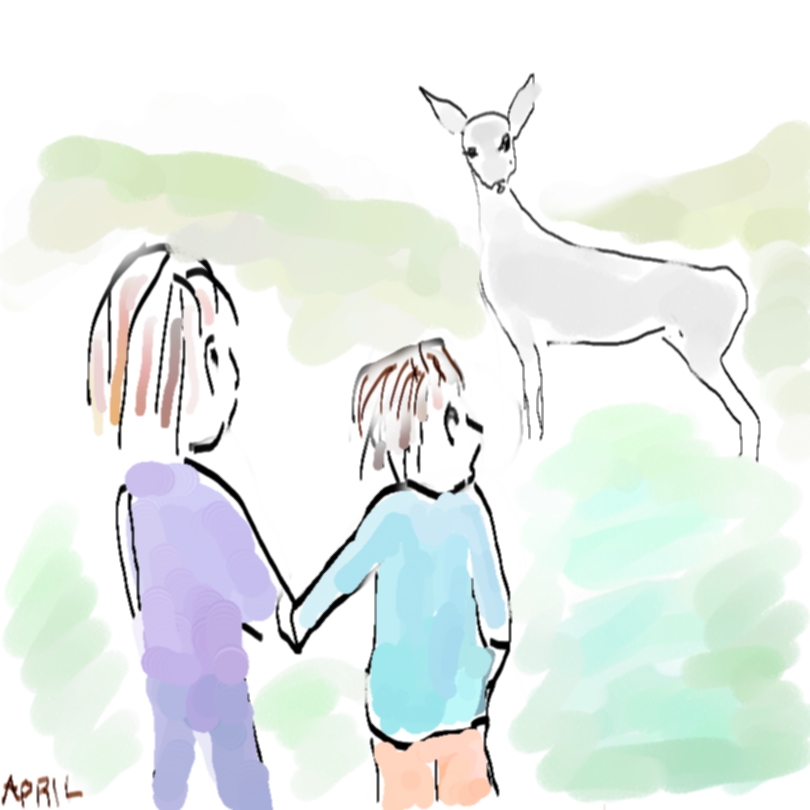
I drew this in November, 2010, after Mom and I walked around a park in Malibu...and suddenly I was the parent
I drew this in November, 2010, after Mom and I walked around a park in Malibu…suddenly I was the parent
The point is, be brave, cut deep beneath the skin, share from the gut, share your humaness. That's all we have.
                                                                             *   *   *   *
LAST CALL! If you haven't entered our current giveaway, it ends today!  To enter, go to Jill Esbaum's post to win your very own autographed copy of Jill's Angry Birds Playground: Rain Forest (National Geographic Books)!

Will you be in New York on May 18th? I'll be speaking on the Children's Books Panel of the Seminar on Jewish Story in New York City on Sunday, May 18th.  Here's my interview the seminar organizer, Barbara Krasner published on her blog.

For an example of a beautifully written post which hits a nerve, read Jama Rattigan's gorgeous and heartfelt Mother's Day post.

And, last but not least, happy Children's Book Week!  Be brave. Go forth and share the very thing that hard to share.

posted with love by April Halprin Wayland...but you knew that, right?

Monday, February 24, 2014

VOICES Heard While OUT AND ABOUT

I’ve been out and about the past few days in The Big Apple, taking in both sights AND sounds while attending the 2014 Annual SCBWI Winter Conference at the Grand Hyatt New York. 
Imagine: 1085 children’s book creators from 47 states and 20 countries gathered together in one beautiful ballroom to celebrate our community, our books, our creative efforts, each other while learning and taking heart from the words of the esteemed faculty. 

YOU can attend too, sort of and vicariously, thanks to Team Blog.  Just click here. 
I heartily recommend you do so, with a cup o'coffee or two by your side. It's an Instant Education courtesy of our Children's Book World's Best and Brightest.
You will be two-hat-sizes smarter by the time you reach Nikki Grimes' closing keynote.


Speaking of "smarter,"
why not test everything you’ve learned about voice from our past weeks’ TeachingAuthors posts by matching these unique 2014 SCBWI Winter Conference speakers (and one or two non-Conference folks I happened to meet) -

 A.   Sylvia, The Grand Central Hyatt

B.     Lin Oliver, Executive Director of SCBWI 

C.     Author Jack Gantos

D.    Author Kate Messner

E.     Author and Poet Nikki Grimes

F.     Gabriella Pizzolo, of MATILDA                             

G.    TeachingAuthor Jill Esbaum

with their identifiably-distinctive spoken words :

(1)   If you’re drawing characters, really swing your cat!”
Keynote Address: How everything I learned about fiction and nonfiction in picture books, poetry, short stories, novellas, or, angst, dialog, a hundred drafts, and good luck all end up in the crown jewel of literature: THE NOVEL

(2)  “Rule #1: You can’t have brave without scared.
Rule #2:  Never underestimate the power of failure.
Failure is a pretty good trail marker to let us know we’re going in the right direction.”
Keynote address: The Spectacular Power of Failure

(3)  “We love everyone and you’re all welcome here!  Your success is our success. The
only thing we’re missing is the Jamaican bobsledders.”
Welcome and Introduction

(4)  “May I help you, please?”

(5)  “I HATCHED was named a Sunday Book Review Editors’ Choice in today’s New York Times!!!”

(6)  It’s so important that we ask ourselves the hard questions.
Just keep writing.  You’ll figure it out eventually.
The key is to learn to trust the process.
Take 2 poems and call me in the morning.”
Keynote address: Creating the Dream through Fiction for Young Readers

(6)  Just because you find that life's not fair, it
Doesn't mean that you just have to grin and bear it.
If you always take it on the chin and wear it,
You might as well be saying you think that it's OK.
And that's not right.
And if it's not right, you have to put it right.
But nobody else is gonna put it right for me.
Nobody but me is gonna change my story.
Sometimes you have to be a little bit naughty
.”

From: MATILDA, “Naughty,” lyrics and music by Tim Minchin

Here’s hoping you earned a perfect score and took heart from the above Truths that left me hopeful, grateful, and determined to use my voice to tell my stories.
Esther Hershenhorn

P.S.
Here are the correct answers: 1-C, 2-D, 3-B, 4-A, 5-G, 6-E, 7-F
P.P.S.
Alas, I still dream of winning an SCBWI Conference Joke Contest. This year's theme? Placing a children's book character in a Winter Olympics headline.  My favorite winner was "Humpty Dumpty Disqualified for Possession of Crack."

Friday, February 21, 2014

Sylvia Vardell's Poetry Aloud Here! Using Your Voice in a Poem of Instruction ~

.
Howdy Campers!

Happy Poetry Friday ~ the hostess for today's poetry feast is Karen Edmisten--thank you, Karen!

http://karenedmisten.blogspot.com/

and congratulations to Sylvia Vardell on the publication of an updated, shiny NEW EDITION of her fabulous Poetry Aloud Here--Sharing Poetry with Children, which has been in print for over ten years (the new book is called Poetry Aloud Here 2)! I am elated that one of my poems (printed below) introduces the book.  Man-oh-man--what an honor!

Click here for Sylvia's description of her inspiring book (Booklist called the first edition "required reading for all children's librarians"), and here's the notice from ALA.

If you've been following TeachingAuthors, you know that we're in the middle of our series exploring Voice: what it is, how to find yours and/or how to teach it.  JoAnn kicked off our discussion with her definition of voice and her original poem, "I Have A Voice"; Jill continued with a real-life example of student voices and some wonderful picture book writers' voices; Carmela introduced us to a terrific book on this topic and offered an e.e.cummings poem as a stunning example of voice; Mary Ann showed us how she teaches how to create a character's voice; and Carmela came back with a Wednesday Writing Workout on distilling your own writing voice.

When talking about voice in my Writing the Children's Picture Book class, I read parts or all of the following books: Gennifer Choldenko's Moonstruck, Karla Kuskin's The Philharmonic Gets Dressed, Ruth Lercher Bornstein's Little Gorilla and Rabbit's Good News, Chris Raschka's Yo! Yes? and John Coltrane's Giant Steps, Susan Patron's Burgoo Stew, and many other books.  My heavens--what a chorus of wildly diverse voices in that flock of books!


Then I read them Edward Lear's "The Owl and the Pussy-Cat (sic)," which begins:

The Owl and the Pussy-cat went to sea
   In a beautiful pea-green boat,
They took some honey, and plenty of money,
   Wrapped up in a five-pound note.
The Owl looked up to the stars above,
   And sang to a small guitar,
"O lovely Pussy! O Pussy, my love,
    What a beautiful Pussy you are,
         You are,
         You are!
What a beautiful Pussy you are!" (read the rest here)


and give them 10-15 minutes to write the same story from the POV of one of the characters in the story.  They may decide to become the Owl the Pussycat, the boat, the ring...whatever they want.  (Someone in today's class wrote from the POV of the Bong Tree!) The results are wonderful, distinct and often hilarious (Pussycat as a woman of the night, for example...)  We immediately discover both the writer's and the character's voice.

Stéphane Jorisch illustrated this version of Lear's poem...
demonstrating his own distinctive voice

So many ways to convey one's voice!

Here's my poem that's in Sylvia's book (she says joyfully)--it's a poem of instruction

HOW TO READ A POEM ALOUD
by April Halprin Wayland

To begin,
tell the poet’s name
and the title
to your friend.

Savor every word—
let
    each
         line
              shine.

Then—
read it one more time.

Now, take a breath—
and sigh.

Then think about the poet,
at her desk,
late at night,
picking up her pen to write—

and why.


Now it's your turn: try writing your own poem of instruction!


poem and drawing (c) 2014 April Halprin Wayland, who thanks you for reading all the way to the end


Wednesday, February 19, 2014

Wednesday Writing Workout: Distilling Your Writer's Voice


In last Friday's post on "voice," I mentioned the book Finding Your Writer's Voice: A Guide to Creative Fiction by Thaisa Frank and Dorothy Wall (St. Martin's), and how it provides specific exercises for helping a writer develop his or her distinctive voice. As promised, for today's Wednesday Writing Workout I'm sharing an exercise based on one in the book. It's from Chapter Seven, "Distilling Voice." I encourage you to borrow the book from a library (or better still, buy your own copy) to read more about this exercise and others in the book.

This is basically a freewriting exercise. Since there are many variations of freewriting, let me start by describing my "rules" for freewriting (which I first introduced back in this blog post):
  • the idea is to keep your pen moving without pausing and definitely without editing
  • write with pen and paper rather than at a keyboard
  • if you find yourself stuck, write something like "I don't know what to write next but I'll think of something soon" until you do think of something
  • if your mind wanders away from your main topic, that's fine. Just keep writing.  
Now, for today's Wednesday Writing Workout: Distilling Voice.
  1. Using a timer, freewrite for ten minutes each day for a week. Write as quickly as you can, without thinking, judging, or editing. You can start something new each day, or continue where you left off the day before. 
  2. After the week is over, put aside what you've written. Take a week off without looking back at what you wrote. 
  3. After the second week, pull out your notebook and read aloud your freewrites. As you read, mark the words, phrases, or passages that "leap out at you, that grab your attention."
  4. Repeat step 1, only this time, begin each freewrite session with one of your marked words or phrases. As it says in Finding Your Writer's Voice"Using your most exciting writing as your point of departure helps you avoid introductions and leap right into what's vital."
  5. After you've done this for seven days, again put your writing aside for a week.
  6. Repeat step 3, only this time, after marking the words and phrases that most captivate you, cross out any words that you don't find interesting or unique. Read aloud what's left. What you have now should really "sing." If the writing still feels bland or weak, repeat steps 4-6.
I first did this exercise years ago and found it extremely enlightening. To quote Finding Your Writer's Voice:
"You may end up with a prose poem, a surprising non sequitur with its own sense of wholeness, a surreal story, humorous nonsense. Consider this one of your best pieces of writing. Pin it above your desk. Let it inspire you."
If you give this exercise a try, do let us know how it works for you.
Happy writing!
Carmela

Monday, February 17, 2014

Replay of "Wrestling with Voice"


Hello, Readers! Carmela here with a quick announcement. Today would normally be Mary Ann Rodman's turn to post. However, she is taking a blogging break. We hope she'll be able to return soon. Meanwhile, we've lined up a terrific new "voice" to join us. I'll post an official welcome to her in a few weeks. For today, since we've been discussing Voice as the third of the Six Traits of Writing, I'm providing you with an excerpt from Mary Ann's post, "Wrestling with Voice," which she published back in March 2010.   

So now, I turn the microphone over to Mary Ann. Enjoy!


Trying to define “voice” in writing is like trying to define “air” (the invisible stuff you breathe) or “love”( an emotion that makes you act stupid). After much hairpulling and consulting a bunch of writing manuals, I think I have a definition.

     Writing is what you say, and how you say it. Voice is the “how you say it” part. The term can be used in different ways. One is the writer’s voice. Since I am not a literature scholar, I’m not going to try analyzing writer’s voice, within the confines of a blog post!

     A more manageable topic is character voice. In this context, “voice” consists of the vocabulary, speech pattern and tone used by the individuals. Think of some memorable fictional figures. Could you ever confuse Jane Eyre with Scarlett O’Hara? Huck Finn with Holden Caulfield? Ramona Quimby with Laura Ingalls? Is there another literary child who sounds even remotely like Eloise? Each of them speak and think in a way that is completely their own.

     What influences character voice? The character's gender, age, setting, cultural background, education, family, economic status, occupation and on and on. Taking these factors into consideration, even persons who share some these aspects will still sound unique. Huck Finn and Holden Caulfield are both teenage boys. The uneducated, resourceful and adventuresome Huck, narrates in the dialect of a 19th century Mississippi River “rat.” Holden, immature and introspective, uses repetition, slang and fairly limited vocabulary, that reflects his isolated, upper-middle class, Post-World-War-II American prep school life.

     Even characters who may share many of the same characteristics, should be distinguishable from one another. One of the best examples of this is Rachel Vail’s Daring to Be Abigail. The story takes place in a camp cabin of 11-year-old girls who at first glance, seem to share exactly the same background. Within two pages, the reader knows each of the eight main characters as separate entities. I have read this book over and over, trying to figure out how she established characterization through voice so rapidly, without resorting to stereotype. I’m still reading!

     My students sometimes have trouble creating distinct character voices. For instance, a conversation between two ten-year-old boys, whose dialog could be interchangeable, because they speak exactly alike. When I ask the writer to tell me about these characters…who is their BFF? what’s in their school backpack? what is their least favorite school subject? …the answer is often “I don’t know.” The problem is that the student is trying to write about characters they don’t really “know”.

     My characters live in my head for years and years before I get around to bringing them to life. I keep notebooks, computer files and file folders on future characters, as they "share" with me such diverse information as their favorite baseball player, what their side of a shared dresser top looks like, how they feel about various family members. Sometimes I learn more about my characters through the writing process, but I would never presume to tell their stories without having at least a working knowledge of them.

written by Mary Ann Rodman

Friday, February 14, 2014

Finding Your Writer's Voice


Happy Valentine's Day to all our
TeachingAuthors Readers!
 

Since today is also Poetry Friday, I'll be sharing an excerpt from a favorite love poem at the end of this post. But first, I want to continue our current discussion of Voice, the third of the Six Traits of Writing.

As JoAnn said when she kicked off the topic last Friday: "we each have a writer’s voice that is all our own." Finding Your Writer's Voice: A Guide to Creative Fiction by Thaisa Frank and Dorothy Wall (St. Martin's) calls voice "your most powerful tool" as a writer, saying:
"Your voice is actually a very ordinary thing: It is just who you are, projected artistically. It is often linked to your speaking voice, and your breath, and the rhythms and sense of pace that you draw on when you are too absorbed in what you are saying to listen to yourself from a distance. It is also linked to your body, the language or dialect you spoke in childhood, and whatever naturally interests you. Your voice is how you write when you don't have time to be elegant."
I also agree with what JoAnn said about a writer's voice developing over time. But Finding Your Writer's Voice provides specific exercises to help speed up the process. I plan to share one in our next Wednesday Writing Workout. (If you happen to live in the Chicago area, you may be interested in a course I'll be teaching this spring in Oak Brook, Illinois, using the book as our text. See my website for details.)

I love the experiment Jill mentioned in her post on Monday, in which students easily identified the author of something written by one of their classmates. It reminded me of feedback I've heard from several of our email subscribers. When they receive a TeachingAuthors post, they don't know who wrote it until they see the byline at the end. But after subscribing to our blog for awhile, they're able to guess the author long before then.

Jill also shared some wonderful examples of distinctive voices in picture book texts, in both first-person and third-person narratives. One thing my students often struggle with is making a first-person narrator's voice different from their own writing voice. I try to help by sharing this excerpt from Monica Wood's book Description (Writer's Digest Books):
"Consider the differences in the following line delivered by different narrators:
         Sandra's son reminded me of a prince, only more imperious.
Or:
         Sandra's kid looked kind of like my cousin Gino, only loads cuter.
Or:
         Sandra's little boy reminded me of that boy in the shelter, only fatter, and a cleaner face. . . . 
All of these narrators have a set of experiences and prejudices and obsessions that is unique to them. As their author you must allow them their own visions."

There's so much more I could say on the topic of voice, but I'll leave that to my fellow TeachingAuthors.

Before I share the poetry excerpt I promised, I want to remind you that today is the last day to enter for a chance to win Crystal Chan's acclaimed debut novel, Bird. You can read all about it here.

Now, for today's poem. One of my favorite love poems is "[i carry your heart with me(i carry it in]" by e.e. cummings. Wow, talk about a distinctive voice! Here's how the poem ends:

            from [i carry your heart with me(i carry it in]
                     by e.e. cummings 
            . . .
           here is the deepest secret nobody knows
           (here is the root of the root and the bud of the bud
           and the sky of the sky of a tree called life;which grows
          higher than soul can hope or mind can hide)
          and this is the wonder that's keeping the stars apart

          i carry your heart(i carry it in my heart)

You can read the whole poem at the Poetry Foundation website. And then visit Linda's TeacherDance blog to check out the full Poetry Friday round-up.

Happy writing!
Carmela