Showing posts with label wordplay. Show all posts

Friday, March 1, 2024

Play, Play, and More Play

My word for the year is PLAY.  The opposite of toil.  And why not? 

17 years ago, at my current school, I wrote my Teaching Philosophy to articulate the direction that I was headed as a kindergarten teacher.


“I believe in the power of play (think of anyone you know who has lost their passion for life and they’ve probably forgotten how to play.)

I believe in learning through wonder, exploration, and discovery (think of anyone you know who is a lifelong learner and they’re probably driven by wonder, exploration, and discovery rather than thinking of learning as a task that must be completed.)”

My commitment to play has become even more entrenched.  I’m not sure what my life would have been like had I not found my way to a career surrounded by 5-year-olds and a life of visual art and writing for children.  Play is powerful. My own daughter went to a school until she was 12 in LA committed to play, Play Mountain Place.  I carry the lessons of our experience there as a parent into my classroom every day.

https://www.playmountain.org/

I design writing, reading, math, science, and social studies invitations to deepen the play and find relationships between scholastic skills.  
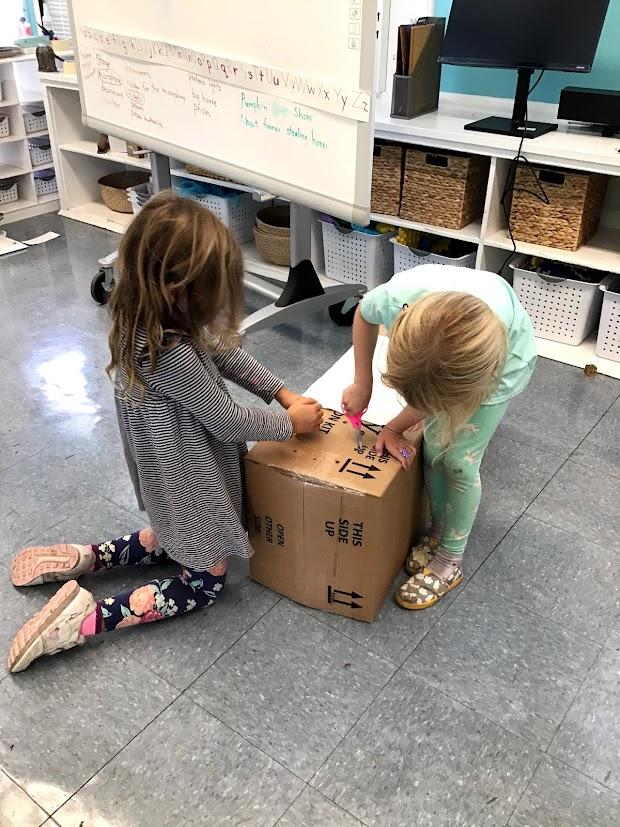


Writing is a tool to express oneself.  This is the reason to learn to write.  Our week is designed with many different projects anchored in play, all leading to the goal of writing.  Story crafting in the Wildlands (an acre of outdoor learning on campus), the classroom, or the play yard is designed to end in writing.  Making inventions at the Maker Table is designed to lead to writing about the invention. Consistent writing leads to more writing.  Writing makes stronger readers. All of this steeped in play.


In my own writing, play drives my work.  It is the joyful adventure of following an idea without fully knowing where I’ll land.  It is playfully following the twists and turns. It is the journey of delight that brings me back to the computer (or notebook) again and again.  Creativity anchored in play is like a drug. If it were toil, I doubt I would be compelled to return over and over.  It is play that drives me. Play that beckons me back. Play that keeps it fresh, alive, and youthful. 


Friday, October 29, 2021

1 Way I Play: Poem Making!

 Howdy, Campers, and Happy Poetry Friday

In this round, we TeachingAuthors are tossing around the idea of PLAY.  Carmela started us off Playing with Poetry Snowballs; Zeena took a look at Play Deprivation During the Pandemic; Bobbi introduced us to a fascinating book called Story Engineering in My Kind of Play; Mary Ann writes about what's been taken away during the pandemic in I Got Dem Ol' Kozmic (Creative) Blues Again; and now it's my turn.

We had house guests last week! It was SOOOO good to see my longtime friend, Bruce and his wife Alene who have been sailing around the world for over 15 years! It hasn't been 15 years since we've seen them...but it was the first time my husband and I have lived with other people for over two years...

At first it was weirdly scary. Gradually, very gradually, was fine. One night, we brought out the 1960's edition of GO TO THE HEAD OF THE CLASS (remember that game?)...


I choose the token of the red-headed boy named Butch.

...and laughed our heads off at the antiquated questions. 

What a relief play provides.

I build play into my 10 week beginning picture book class, especially the class on rewriting, because it's the session I dread teaching the most. Why? Because I lift the curtain to reveal the long, painful path some picture books trudge. Using my book NEW YEAR AT THE PIER as an example, I show them its depressing nine-year timeline.

Then, to dispel the nasty fog of despair in the room, my students play...with Play-Doh! 


Can you remember that Play-Doh smell?

In an older post, I included a step-by-step description of the Play-Doh exercise. To my surprise, this exercise also works well on Zoom, so I also describe how to modify it for a virtual class.

But how do I personally play these days?  Well, not so much with Play-Doh, and for the time being, not with my folk music friends and my fiddle in our cozy livingroom. :-(

Most days I'll either exercise, hike with friends and dogs, or walk by the beach. But every day I take my vitamins and every day I dive into Poem-Making (I borrowed this word from my mentor Myra Cohn Livingston's book of the same name.)

Some days I try different poetry forms, some days I write adult poems or poetry on a particular topic. Other days I'll goof around with In One Word poems...or simply play.  Here's an example of playing with a poem I sent to Bruce in 2011. He sends me a poem every day, too.. Below the poem is the backstory I included when I sent it...and his comment.

CAMERON SCAMPER

Cameron Scamper

baked glue-crayon cake.

“Yum,” said his brother.

“Yawn,” said the snake.


Cameron Scamper

taught their dog how to fly

“Wow,” said his brother.

The snake closed its eyes.


Cameron Scamper

stopped talking for weeks.

“Gosh,” said his brother.

The snake went to sleep. 


Cameron Scamper

hid the dog in a drum.

“Oooh!” said his brother

The snake said, “Ho-hum.”


Cameron Scamper

made soup out of dirt.

“Yum,” said his brother.

Snake said he much prefered chocolate yogurt.

===================================
I sent this backstory to Bruce:

Always listening for odd names, I thought I heard "Cameron Scamper please report to Gate 14" at the Los Angeles International Airport...but later I heard it as a slightly tamer name.

I played with it below...and played and played and ran out of steam! 

Bruce replied: We liked this poem a lot… except for the last line (which, as you said, did run out of steam). Fix it and keep it.

====================================

Writing and sending a poem a day for the last 11 years has made us even closer friends than we were before. Try it and see: gGrab someone you love who loves to write and dive in!

Thank you, Linda at TeacherDance, for hosting Poetry Friday this week!

posted by April Halprin Wayland (before I've written today's poem) with the help of  Meredith and Derek our 10-month-old tortoises, Sheldon, our hibernating 28-year-old tortoise, Kitty, our most excellent pandemic adoptee, and Eli our elder statesman dog. (for pix of them scattered among other posts, see FB or Instagram)

Friday, October 1, 2021

Playing with Poetry Snowballs

Happy Poetry Friday! Today, I kick off a new series on the topic of PLAY and share a related poem. It's also the last day of our current giveaway, so if you haven't entered yet, be sure to check out the link at the end of this post.

When we TeachingAuthors were discussing our next topic, April Halprin Wayland suggested "something light, such as, how we each play with words." The idea felt perfect, especially because I'd recently read the following Tweet from Nir Eyal:

 Personally, I have been doing a lot of playing lately--with poetry!

Photo by Jasmin Schreiber on Unsplash
 
Back in December of 2020
, I'd shared:

"one of the things I'm looking forward to in 2021 is becoming even more steeped in poetry, both reading and writing it."

I'm happy to say that I followed through on that intention. I've been not only reading and writing more poetry, but submitting it for publication, too. I'm thrilled to announce that several of my poems have been accepted and will be coming out in two new anthologies. I can't share the details yet, but will provide them when I'm able. 

One way that I've been playing with poetry is by writing in new-to-me forms, particularly math-based ones, such as pi-ku, Fib poems, and Etherees. I recently learned about snowball poems, developed by the OULIPO. If you aren't familiar with the organization, here's a description of OULIPO from Poets.org:

"Although poetry and mathematics often seem to be incompatible areas of study, the philosophy of OULIPO seeks to connect them. Founded in 1960 by French mathematician Francois de Lionnais and writer Raymond Queneau, Ouvroir de Litterature Potentielle (OULIPO), or Workshop of Potential Literature, investigates the possibilities of verse written under a system of structural constraints. Lionnais and Quenuau believed in the profound potential of a poem produced within a framework or formula and that, if done in a playful posture, the outcomes could be endless."

While writing my first snowball, or boule de neige, as the OULIPO call it, I definitely tried to keep a "playful posture." Here's what I came up with:

Background photo by Clay Banks on Unsplash

This snowball poem is an example of one that grows, which is called a boule de neige de longueur. Such poems should resemble a right triangle. The text I've quoted in my poem is taken from this page. There, you can read more about the various types and shapes of snowball poems.

As I worked on this poem, I realized I have written snowballs before, in the form of nonets and Etherees. So technically, this isn't really my first snowball poem, though it's the first containing twelve lines. 😀

I'm wondering how many of you are familiar with snowball poems. Have you ever written one? Do let me know in the comments. I also wonder: Is there a name for a poem that describes the form it's written in? I think there should be.

You can check out more poetry at this week's Poetry Friday roundup hosted by Catherine Flynn at Reading to the Core. Before heading over there, though, don't forget to enter our current giveaway if you haven't already done so. Details are at the end of Esther's Student Success Story interview with Gwen Neiman Levy about the release of her debut picture book, What the Cluck?

Happy writing!
Carmela

Tuesday, July 21, 2009

What’s So Hard (for Me) about Writing Picture Books

I love wordplay. I savor the delicious way words feel in my mouth. The taste of an especially yummy combination—one that tingles with rhythm, rhyme, or alliteration. The way exciting language tickles my ears. I search for tangy, succulent, flavorful words.


Sometimes the sounds of words almost feel more important than their meanings.


Eeek! Halt! Hold everything!

When I get so enamored with sounds, I know I’m sliding off track. Because something else is much more important. Those tantalizing words have to say something. Mean something. The ideas they express have to take precedence over the sounds, no matter how delectable they are.


When I work on a picture book, I write by hand in purple ink on legal pads, over and over and over until I feel each stanza, each line, each word is pulling its weight—fitting into the pattern, portraying an emotion, saying what I want to say. Something grabs me, I play with it, I sink into the words and ideas and sounds and images and write. And write and write and write.

The hardest part for me is recognizing and incorporating something that resembles an actual plot—a story with a beginning, middle, and end—that adds the necessary depth to those strained-to-attain scrumptious sounds.


When I sold my first picture book, Cats on Judy, the editor asked me to add details that implied the passing of time so that the text felt more like a story. The same thing happened with Sing-Along Song. Do you see a pattern here? I didn’t, at least not at first.


Many of my rejection letters say that the text is “slight.” What does that mean? How many rejections have I received over the years for the same reason? I’m afraid to count.

Not too long ago as I worked on a new picture book idea, something clicked—almost audibly—like the flick of a light switch.

Eureka!

Somehow right after I finished the first complete draft, I knew it was weak. It needed something more to propel it beyond a simple counting book with rhythm and rhyme. After all these years (and rejections!), I figured it out for myself. I recognized slightness when I saw it (at least in this one manuscript) and took it back to my desk to tear it apart and start over. Now it’s more than a counting book with rhythm and rhyme; it’s an actual story—with counting elements woven in in alternating stanzas—and I’m also adding nonfiction back matter. I hope it works!

Some writers seem to attain the necessary depth in a picture book manuscript without a conscious thought. Or they know enough not to begin writing unless and until all the elements are in place. Not me. I have to work at it, word by flavorful word. But at last, I understand the meaning of slight—lacking that strength, that depth, that extra layer that makes a manuscript more than just what meets the eye at first glance and makes readers want to read it again and again.