Showing posts with label Teacher Resources. Show all posts

Friday, October 21, 2022

2 Mentor Poems to Try and Then Teach


Howdy Campers! Happy National Day on Writing (this week) and Happy Poetry Friday! My poem and the link to PF are below.

Today's topic? Anything I want to share with you. Hooray!  Let's dive in.

The UCLA Extension Writers' Program offers an Annual Instructor's Retreat. It's well-run and much-needed, connecting instructors from all over the world to share wisdom, teaching challenges and conundrums and more.

I wanted to share my love of mentor texts with fellow instructors. Here's my proposal:

A Mentor Poem Exercise That Changes Everything.

1) I'll share two poems

2) You'll write your own version of one of them.

3) Your mind will explode.

4) The End.

The Program Director thought it was funny, and I was given the go-ahead.

If the term is new to you, here is how an author on an episode of a podcast at the National Writing Project defines it (slightly paraphrased):

Mentor texts are pieces of literature that you — both teacher and student — can return to and reread for many different purposes. They are texts to be studied and imitated … Mentor texts help students to take risks and be different writers tomorrow than they are today. It helps them to try out new strategies and formats. They should be [texts] that students can relate to and can even read independently or with some support...And of course, a mentor text doesn’t have to be in the form of a book — a mentor text might be a poem, a newspaper article, song lyrics, comic strips, manuals, essays, picture books—almost anything.

In my session I offered attendees a choice. They could either riff off a long poem or a short prompt.

1) The long poem (I first read it on Alison McGhee's wonderful blog):


IF THE MOON CAME OUT ONLY ONCE A MONTH
by Cathy Ross

If the moon came out only once a month
people would appreciate it more. They’d mark it
in their datebooks, take a walk by moonlight, notice
how their bedroom window framed its silver smile.
And if the moon came out just once a year,
it would be a holiday, with tinsel streamers
tied to lampposts, stores closing early
so no one has to work on lunar eve,
travelers rushing to get home by moon-night,
celebrations with champagne and cheese.
Folks would stay awake ’til dawn
to watch it turn transparent and slowly fade away.
And if the moon came out randomly,
the world would be on wide alert, never knowing
when it might appear, spotters scanning empty skies,
weathermen on TV giving odds—“a 10% chance
of moon tonight”—and when it suddenly began to rise,
everyone would cry “the moon is out,” crowds
would fill the streets, jostling and pointing,
night events would be canceled,
moon-closure signs posted on the doors.
And if the moon rose but once a century,
ascending luminous and lush on a long-awaited night,
all humans on the planet would gather
in huddled, whispering groups
to stare in awe, dazzled by its brilliance,
enchanted by its spell. Years later,
they would tell their children, “Yes, I saw it once.
Maybe you will live to see it too.”
But the moon is always with us,
an old familiar face, like the mantel clock,
so no one pays it much attention.
Tonight
why not go outside and gaze up in wonder,
as if you’d never seen it before,
as if it were a miracle,
as if you had been waiting
all your life.

(Isn't that poem glorious?)

2) The short prompt: write a poem in which all events occur simultaneously.

All at once...


Here's an example:

At the very moment the phone rang
the meringue fell
the baby fell out of the swing
the earthquake toppled Tokyo
at that moment
I decided to leave him

~ author unknown


3) What the moon poem inspired me to write:

IF MY SISTER CAME BY ONLY ONCE A MONTH
by April Halprin Wayland

If my sister came by only once a month
I would appreciate her more. I’d mark it
in my datebook, take a walk with her, notices
how her smile glowed like the moon.
And if my sister came by just once a year,
it would be a holiday, with tinsel streamers
tied to lampposts, stores closing early
so no one in our family would work on Sister Eve,
I’d rush to get home before she knocked,
we’d celebrate with non-alcoholic champagne and non-dairy cheese.
I’d stay awake ’til dawn
to watch as she left my house and disappeared down the road.
And if my sister came by randomly,
the world would be on wide alert, I would never know
when she might appear, friends would scan the skies for her plane, the internet for her arrival info
weatherpeople on TV would give odds—“a 10% chance
of your sister coming over tonight”—and when suddenly there was a knock (!)
everyone would cry “your sister’s here,” crowds
would fill the streets, jostling and pointing at us,
happy for us and envious we had a sister.
Night events would be canceled,
My Sister’s Here signs posted on my door.
And if my sister showed up but once a century,
ascending luminous from Southwest Airlines flight #274 on a long-awaited night,
all humans on the planet would gather by their screens
in huddled, whispering groups
to stare in awe, dazzled by her brilliance, my brilliance,
our love; enchanted by this spell of sisterhood. Years later,
they would tell their children, “Yes, I saw them together once.
Maybe you will live to see them, too.”
But my sister is always with me,
a beloved familiar taste, like stew, warm and full of comfort
which no one appreciates much.
Tonight
I am outside and gaze up in wonder,
as if I’d never seen her before,
as if she were a miracle,
as if I had been waiting
all my life.


4) What the poem the prompt inspired me to write:

ALL AT ONCE
by April Halprin Wayland

At the very moment my hot cocoa spills in the car,
and its marshmallow lands in my wet lap --
a white island in a tsunami of hot, dark liquid --
a squirrel shoots across the street
and our dog jumps joyfully out of the open sunroof,
onto the asphalt.

That's when I know
that no one is an island,
we all need the love of a dog,
the thrill of the chase,
and a crossing guard
or green light
to watch over us.

both poems© 2022 April Halprin Wayland. All rights reserved

Now it's your turn: pick a poem, a picture book, song lyrics--anything--and write your version of it, focusing on a topic that's close to your heart. Or follow the prompt and write what I call an All At Once poem. 

Then pass the magic onto your students, kids, friends, or that guy wearing the Dodger cap at the drug store.
https://www.teachingauthors.com/2021/06/poem-that-changes-everything.html 

Please join my next UCLA class, An Introduction to Picture Books for Absolute Beginners on November 19, 2022 from noon-3pm Pacific Time! Enrollment begins November 5th

Thank you, Bridget, for hosting this week's Poetry Friday at wee words for wee ones !


Posted by April Halprin Wayland, who has one more thing to say: 

Please vote. America needs you to. If you don’t know who to vote for, do some research. Ask one of your very smart friends, then, make an educated guess.  Don’t hand your vote to someone else by not voting. Your voice matters. So thank you for voting. Thank you for helping to save our democracy.


drawings© 2022 (If you use any of them, please credit April Halprin Wayland. Thank you!)


Friday, September 2, 2022

No Voice Too Small

     When my daughter was little, she once asked me why I spent my time as an activist trying to save public education and not trying to stop global warming (as it was called at that time before it was expanded). Her logic was that education justice would not matter if we didn’t have a planet to live on. I paused for a moment before answering, not knowing the answer myself. And then I responded with my own logic. If education was lost, then we wouldn’t have a chance at saving the planet. Only through an educated global population could we begin to mitigate global warming. And so, I continued my work to struggle to maintain an equitable public education with my union and other organizations as well as working in my classroom to develop as a child-centered educator. I was sure I could be a part of positive change in my own little corner of the world.


     Years later, I still believe that losing public education for all would be a travesty, but I am beginning to see that it is undeniably time to actively work to mitigate climate change in a more focused way. Again, I feel like I can only work effectively on climate change in my own little corner of the world. And so, my path leads me back through education and to the very young people I am tasked with guiding.

     There was a moment when Greta Thunberg dominated the news cycle and my kindergarteners pre-Covid became intrigued by her work. This group of young 5-year-olds were interested in what global warming was, what caused it, and eventually they wondered what could be done. The energy of the group took on a life of its own that lead to questions about how to change policy specifically around climate change. We had a staffer from our state senator’s office come and talk about his job focusing on climate change bills. The students’ interest culminated in the writing of policy recommendations that I delivered to our city, state, and federal policy makers. It amazed me how much these young people thought deeply and expansively about such critical matters.


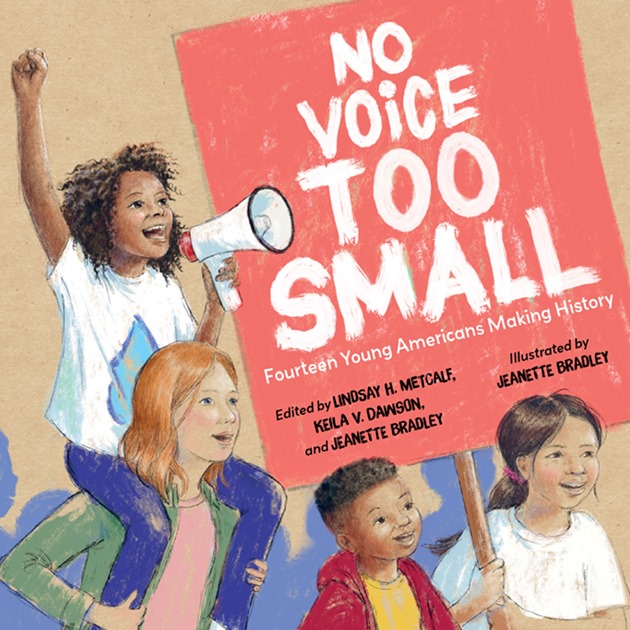
     My own experience with the powerful voices of very young people led me to the book that I learned from this year. No Voice Too Small: Fourteen Young Americans Making History edited by Lindsey H. Metcalf, Keila V. Dawson, and Jeanette Bradley and beautifully illustrated by Jeanette Bradley. The picture book combines very short biographies, illustrations, and poetry by 14 different poets to tell the stories of 14 young changemakers. The picture book is laid out in a way that educators from kindergarten to high school can utilize the stories of these young activists to engage other young activists. It’s just what the world needs now. 


See Book Trailer Here

https://www.youtube.com/watch?v=rNUDTayofso


My current students are especially drawn to the illustrations. I am especially drawn to the poetry that precedes the introduction of each new activist. My students engage with the stories especially  because they can relate to the children who are celebrated in the book. This year we have already begun recognizing power and the ability to speak out using this important piece of literature. This spring, this same team will launch their companion title, No World Too Big: Young People Fighting Global Climate Change. I am so moved by the first book, No Voice Too Small, that I am including them in a climate activism project that I am developing with my kindergarten class this year. 

     Building the conditions for climate activism to occur with young children, I am working with environmental organizations in Los Angeles to create field trips to natural habitats to build a foundation of environmental engagement. I am partnering with policy-makers to create policy engagement. I am anxiously anticipating the second book, No World Too Big and I have reached out to the authors of these books to create literary engagement. I am proud to know Keila and Jeanette through our Kidlit for Growing Minds group. I am hoping to create an event with a local, Los Angeles, independent bookstore, The Book Jewel, that brings together my current students and the creators when they launch their second book this coming spring. 


     I’m not sure what my young daughter had in mind when she questioned my methods, but I feel like have found my way to engage with the ongoing climate crisis. It is my hope that by bringing together organizations that can get children into nature, elected officials  who can demonstrate that young people can and should be able to access and influence policy making, and authors who can write about and inspire young people to tell their stories (which ultimately makes movements), I am doing my own part in my own little corner of the world. 

You can find out more about Kidlit For Growing Minds from our website, our BOOKTALK YouTube channel and our Twitter page. Find our books on our Bookshop Storefront.

Website: https://kidlitforgrowingminds.weebly.com/
YouTube: https://www.youtube.com/channel/UC0w51tG16_RpkA_CDNsgjlA
Bookshop: https://bookshop.org/shop/ForGrowingMinds
Twitter: @ForGrowingMinds

By Zeena M. Pliska

Friday, November 2, 2018

A Nation's Strength

Don’t forget, award-winning author, poet, teacher and mentor Ann Whitford Paul has revised and expanded her 2009 go-to hands-on guide on writing picture books, aptly named WRITING PICTURE BOOKS!Writer’s Digest releases this 2018 edition November 13. You can win a free copy in our Book Giveaway! Be sure to check the entry details at the end of Esther’s post!


For these weeks leading up to Thanksgiving, we at Teacher’s Authors continue our tradition of giving thanks. This week, I give thanks to our most fundamental characteristic that defines our American way: we have a voice in our destiny. As Michael Waldman, president of the Brennan Center for Justice (New York University) suggests, the American democracy “remains a living, breathing idea, a work in progress…American democracy is not perfect, but it is perfectible. For all of us… America is not just an actuality but a potentiality, too.” This week, don’t forget to use your voice, your right to have a say in what defines us as a people and a society.

Meanwhile, I found a wonderful resource in teaching civic education to help students build their basic civic knowledge and understand their role as active citizens. Civics in Literature  is a production between the National Constitution Center and the Rendell Center for Citizenship.We the Civics Kids offers a selection of lessons and activities that enable students to find their voice and work as a change agent in their community!


A Nation's Strength
What makes a nation's pillars high
And its foundations strong?
What makes it mighty to defy
The foes that round it throng?

It is not gold. Its kingdoms grand
Go down in battle shock;
Its shafts are laid on sinking sand,
Not on abiding rock.

Is it the sword? Ask the red dust
Of empires passed away;
The blood has turned their stones to rust,
Their glory to decay.

And is it pride? Ah, that bright crown
Has seemed to nations sweet;
But God has struck its luster down
In ashes at his feet.

Not gold but only men can make
A people great and strong;
Men who for truth and honor's sake
Stand fast and suffer long.

Brave men who work while others sleep,
Who dare while others fly...
They build a nation's pillars deep
And lift them to the sky.

-- by William Ralph Emerson. Born in 1833, Emerson was an architect and  the second cousin to Ralph Waldo Emerson. "A Nation's Strength" first appeared in Our Little Kings and Queens at Home and at School (Louis Benham & Co., 1891). This poem is in the public domain.

"I will tell you that we are not powerless... Every single one of us has something that, if done in numbers too big to tamper with, cannot be suppressed and cannot be denied.” -Oprah Winfrey

Bobbi Miller

Monday, June 19, 2017

Guest TeachingAuthor Interview and Book Giveaway with Darcy Pattison


Today’s guest TeachingAuthor interview is a nationally known author and writing teacher, Darcy Pattison.  She is the author of fiction and nonfiction picture books, and novels.  Pattison travels all over the country to provide her high acclaimed Novel Revisions Retreats. 

As if that wasn’t enough, here are a few of her accomplishments: 
Storyteller, writing teacher, Queen of Revisions, and founder of Mims House (mimshouse.com) publisher, Darcy Pattison has been published in nine languages. Her books, published with Harcourt, Philomel/Penguin, Harpercollins, Arbordale, and Mims House have received recognition for excellence with starred reviews in Kirkus, BCCB and PW. Three nonfiction nature books have been honored as National Science Teacher’s Association Outstanding Science Trade books. The Journey of Oliver K. Woodman (Harcourt) received an Irma Simonton Black and James H. Black Award for Excellence in Children's Literature Honor Book award, and has been published in a Houghton Mifflin textbook.  She’s the 2007 recipient of the Arkansas Governor’s Arts Award for Individual Artist for her work in children’s literature.

Darcy and I have been friends since the early days of both our careers.  We met when she was the SCBWI Regional Advisor, and since then have supported each other through the ups and downs of building careers as published authors.  We celebrate each other’s accomplishments, and commiserate each other’s disappointments.  I am fortunate to call Darcy my friend. 

Enter for a chance to win Sleepers, Darcy Pattison's new book!  Follow the instructions at the end to enter.       
She has agreed to give away a copy of her brand new novel titled Sleepers.  It is Book 1 in an exciting new trilogy called The Blue Planets World.  Enter the TeachingAuthor book giveaway for a chance to win this excellent book that will be released in July 2017.  Read this interview with Darcy and enter the giveaway at the end. 

Darcy Pattison
Now, here’s Darcy: 

1.     How did you become a TeachingAuthor?

I think I was born a teacher. When I learn new information, my first thought is, “How can I make this easier for a person to learn?”

When I read a book, I think about how I can entice someone to read and enjoy it. How can I set up the story in such a way to make it appealing? Our education system rarely recognizes the importance of reading for pleasure. I want to help kids enjoy the story, first and foremost. What you want is passionate readers, who will jump into discussions because they care about the story and characters. That comes most readily from readers who read for pleasure. That’s the first goal of teaching any book – did the reader enjoy it?
Once they’ve enjoyed a book, students are ready to discuss with passion.

2. What's a common problem/question that your students have and how do you address it?

One problem I see with readers in middle school and high school readers is that they start to self-identify with a particular genre and become unwilling to try other genres. It makes sense in many ways. The task of a middle and high school student is to become their own person. They start the process of deciding for themselves what they like and dislike. When they start to self-identify as a reader of historical fiction, for example, this aligns them with others who have a similar interest. Instead, I keep encouraging students to expand and to read other genres. While I can hardly be convinced to read a war story, I enjoy many other genres and find the variety stimulating. I try to encourage kids to branch out and find at least two or three genres to read.


3. Would you share a favorite writing exercise for our readers?

 When I’m teaching writing with kids, I love to use the Pick and Draw card game (PickandDraw.com), which was developed by my friend, artist and illustrator Rich Davis.

Students using the Pick and Draw card game created by illustrator Rich Davis. 

The card deck has different colored sets. The first option is the head cards, which present six possible head shapes. After the student draws the head shape they were dealt, though, they must decide on a name. A complete name. With a middle and last names. Specificity is the biggest problem of student writers, so I encourage it at every stage.

Next, they draw a card for a hair shape. Davis is brilliant in his choice of facial features, which create their own excitement. This time, they must write down something that the character wants. For older students, they must write three things the character wants.

We continue this way, alternating drawing a body part (eyes, nose, and ears), with a specific trait of the emerging character.  I usually ask students to tell something about what the character hates and fears, something about the family, and the place where they live.

Quickly, within 30 minutes, students have developed a character that excites them. They know enough about the character to write a story with this plot structure:

This is the story about ______, who more than anything else wants ______, but can’t have it because 1) _________(use a fear) , 2)__________ (encounters something they hate), and 3) __________(use something about the family), UNTIL ____________(How do they solve the problem?)

The one-hour class produces great stories. 

4.  How did you come to write your new science fiction series? Do you have any suggestions for teachers on how they might the books in the classroom? 

My forthcoming science fiction series, The Blue Planets World series, is about the first contact with an alien species. Earth finally hears from space: You only live on land; allow us to live in the seas.

If humans occupied the land, and aliens filled the seas, what would the world be like?

The story began when I was researching the plight of puma (cougars) in Brazil. The pumas live within sight of skyscrapers, in an urban landscape. Scientists are working to create corridors, wild places, which connect one bit of forest to the next. The plight of the puma bothered me for a long time. It seems to me that the environmental questions of the next generation have changed. We used to ask, “How can we preserve habitats for wildlife?”

But we’ve failed badly. Our student’s generation will have to answer this question: “How can we make room for wildlife in an urban environment?”

That led me to the science fiction story of the Blue Planets Worlds series. Beginning in July with Book 1, SLEEPERS, I explore the problems of sharing our world with another species. Science fiction is good at putting social or philosophical problems into a story form.

Ask students to think about a specific environmental problem and try to fictionalize it. Depending on the class, write an outline, a short story, a plot summary or character sketches for their environmental story.

Or, read other science fiction stories and discuss the questions that the writer probes in the story. For example, in Ender’s Game, the author explores the limits of war against another species. Is it right to utterly obliterate them before they kill us?

Thank you, Darcy, for sharing your work with TeachingAuthors.com!

Readers, to enter our drawing for a chance to win a copy of Sleepers (Mims House Books), written by Darcy Pattison, use the Rafflecopter widget below. You may enter via 1, 2, or all 3 options.

If you choose option 2, you MUST leave a comment on TODAY'S blog post below or on our TeachingAuthors Facebook page. If you haven't already "liked" our Facebook page, please do so today! In your comment, tell us what you'd do with the book if you win our giveaway--keep it for yourself or give it to a young reader?

(If you prefer, you may submit your comment via email to: teachingauthors [at] gmail [dot] com.)

Email subscribers: if you received this post via email, you can click on the Rafflecopter link at the end of this message to access the entry form.

Note: if you submit your comments via email or Facebook, YOU MUST STILL ENTER THE DRAWING VIA THE WIDGET BELOW. The giveaway ends June 30 and is open to U.S. residents only.

P.S. If you've never entered a Rafflecopter giveaway, here's info on how to enter a Rafflecopter giveaway and the difference between signing in with Facebook vs. with an email address.

Carla Killough McClafferty

a Rafflecopter giveaway

Monday, March 6, 2017

Online Research Sources for Writers and Teachers


I love facts.  And lists of facts.  And lists of lists of facts.  There are countless amazing online resources for writers.  Since this is the theme for TeachingAuthors.com for a couple of weeks, I thought I'd share some of my favorites.  


If you want the complete list of the resources for writers I've compiled, go to the "for teachers" page on my website: 

Click here for Carla Killough McClafferty's website.


Carla Killough McClafferty


Win a copy of Children's Writer's and Illustrator's Market 2017!


Monday, February 27, 2017

Amazing History


I write historical fiction. I’ve discussed before the many reasons why historical fiction is important, most especially these days. (Did you see my article, Doctor Who and Historical Fiction?) 


Our history is full of amazing stories. The artistic nature of historical fiction presents several challenges, especially in books for children. Events must be winnowed in order to create forward movement that leads to a resolution. Historical fiction makes the facts matter to the reader.

Historical fiction helps young readers develop a feeling for a living past, illustrating the continuity of life, according to Karen Cushman. Historical fiction, “like all good history, demonstrates how history is made up of the decisions and actions of individuals and that the future will be made up of our decisions and actions.”

David McCullough once said, “We are raising a generation of young Americans who are by-and-large historically illiterate…The textbooks are dreary, they’re done by committee, they’re often hilariously politically correct and they’re not doing any good. [But] there are wonderful books, past and present. There is literature in history.”

Through the years, I’ve discovered several resources that have proven valuable not only for research, but also about teaching history to young readers.

You’ve probably heard of these:

Teachinghistory.org is designed to “help K–12 history teachers access resources and materials to improve U.S. history education in the classroom. With funding from the U.S. Department of Education, the Center for History and New Media (CHNM) has created Teachinghistory.org with the goal of making history content, teaching strategies, resources, and research.”


“…good historical fiction exercises a child’s imagination through a vicarious experience. It leads children to use themselves and their own lives as comparisons to the characters that lived long ago and often, far away, to reflect on their own experience, to ask their families questions. It awakens awareness, perks up perception, sparks conversations. Reading historical fiction can lead a child to ask, “What’s my voice? What’s my view? Which side should I be on? Is there a right side?” – Valerie Tripp, Vitamins in Chocolate Cake: Why Use Historical Fiction in the Classroom? (2011 )

One of my favorite sites, the Zinn Education Project “promotes and supports the teaching of people’s history in middle and high school classrooms across the country. Based on the lens of history highlighted in Howard Zinn’s best-selling book A People’s History of the United States, the website offers free, downloadable lessons and articles organized by theme, time period, and reading level. The Zinn Education Project is coordinated by two non-profit organizations, Rethinking Schools and Teaching for Change.”


Important in these political times is teaching students how to be engaged citizens by learning their history. Colonial Williamsburg is one of my favorite resources where you can “connect with a community of educators and find the tools you need to inspire students to become engaged citizens.”


Presented by the National Museum of African American History and Culture in partnership with the Thomas Jefferson Foundation at Monticello, this amazing exhibition asks the challenging question, “How could the author of the Declaration of the Independence own slaves? How could twenty percent of the population of the new United States, founded on the principles of liberty and equality, live in bondage?”


Speaking of amazing resources, don't forget to enter (here) our new drawing for a chance to win a copy of the Children's Writer's and Illustrator's Market 2017!

 What do you think? Do you have any favorite resources?


Bobbi Miller