Showing posts with label Teacher Tip. Show all posts

Monday, June 19, 2017

Guest TeachingAuthor Interview and Book Giveaway with Darcy Pattison


Today’s guest TeachingAuthor interview is a nationally known author and writing teacher, Darcy Pattison.  She is the author of fiction and nonfiction picture books, and novels.  Pattison travels all over the country to provide her high acclaimed Novel Revisions Retreats. 

As if that wasn’t enough, here are a few of her accomplishments: 
Storyteller, writing teacher, Queen of Revisions, and founder of Mims House (mimshouse.com) publisher, Darcy Pattison has been published in nine languages. Her books, published with Harcourt, Philomel/Penguin, Harpercollins, Arbordale, and Mims House have received recognition for excellence with starred reviews in Kirkus, BCCB and PW. Three nonfiction nature books have been honored as National Science Teacher’s Association Outstanding Science Trade books. The Journey of Oliver K. Woodman (Harcourt) received an Irma Simonton Black and James H. Black Award for Excellence in Children's Literature Honor Book award, and has been published in a Houghton Mifflin textbook.  She’s the 2007 recipient of the Arkansas Governor’s Arts Award for Individual Artist for her work in children’s literature.

Darcy and I have been friends since the early days of both our careers.  We met when she was the SCBWI Regional Advisor, and since then have supported each other through the ups and downs of building careers as published authors.  We celebrate each other’s accomplishments, and commiserate each other’s disappointments.  I am fortunate to call Darcy my friend. 

Enter for a chance to win Sleepers, Darcy Pattison's new book!  Follow the instructions at the end to enter.       
She has agreed to give away a copy of her brand new novel titled Sleepers.  It is Book 1 in an exciting new trilogy called The Blue Planets World.  Enter the TeachingAuthor book giveaway for a chance to win this excellent book that will be released in July 2017.  Read this interview with Darcy and enter the giveaway at the end. 

Darcy Pattison
Now, here’s Darcy: 

1.     How did you become a TeachingAuthor?

I think I was born a teacher. When I learn new information, my first thought is, “How can I make this easier for a person to learn?”

When I read a book, I think about how I can entice someone to read and enjoy it. How can I set up the story in such a way to make it appealing? Our education system rarely recognizes the importance of reading for pleasure. I want to help kids enjoy the story, first and foremost. What you want is passionate readers, who will jump into discussions because they care about the story and characters. That comes most readily from readers who read for pleasure. That’s the first goal of teaching any book – did the reader enjoy it?
Once they’ve enjoyed a book, students are ready to discuss with passion.

2. What's a common problem/question that your students have and how do you address it?

One problem I see with readers in middle school and high school readers is that they start to self-identify with a particular genre and become unwilling to try other genres. It makes sense in many ways. The task of a middle and high school student is to become their own person. They start the process of deciding for themselves what they like and dislike. When they start to self-identify as a reader of historical fiction, for example, this aligns them with others who have a similar interest. Instead, I keep encouraging students to expand and to read other genres. While I can hardly be convinced to read a war story, I enjoy many other genres and find the variety stimulating. I try to encourage kids to branch out and find at least two or three genres to read.


3. Would you share a favorite writing exercise for our readers?

 When I’m teaching writing with kids, I love to use the Pick and Draw card game (PickandDraw.com), which was developed by my friend, artist and illustrator Rich Davis.

Students using the Pick and Draw card game created by illustrator Rich Davis. 

The card deck has different colored sets. The first option is the head cards, which present six possible head shapes. After the student draws the head shape they were dealt, though, they must decide on a name. A complete name. With a middle and last names. Specificity is the biggest problem of student writers, so I encourage it at every stage.

Next, they draw a card for a hair shape. Davis is brilliant in his choice of facial features, which create their own excitement. This time, they must write down something that the character wants. For older students, they must write three things the character wants.

We continue this way, alternating drawing a body part (eyes, nose, and ears), with a specific trait of the emerging character.  I usually ask students to tell something about what the character hates and fears, something about the family, and the place where they live.

Quickly, within 30 minutes, students have developed a character that excites them. They know enough about the character to write a story with this plot structure:

This is the story about ______, who more than anything else wants ______, but can’t have it because 1) _________(use a fear) , 2)__________ (encounters something they hate), and 3) __________(use something about the family), UNTIL ____________(How do they solve the problem?)

The one-hour class produces great stories. 

4.  How did you come to write your new science fiction series? Do you have any suggestions for teachers on how they might the books in the classroom? 

My forthcoming science fiction series, The Blue Planets World series, is about the first contact with an alien species. Earth finally hears from space: You only live on land; allow us to live in the seas.

If humans occupied the land, and aliens filled the seas, what would the world be like?

The story began when I was researching the plight of puma (cougars) in Brazil. The pumas live within sight of skyscrapers, in an urban landscape. Scientists are working to create corridors, wild places, which connect one bit of forest to the next. The plight of the puma bothered me for a long time. It seems to me that the environmental questions of the next generation have changed. We used to ask, “How can we preserve habitats for wildlife?”

But we’ve failed badly. Our student’s generation will have to answer this question: “How can we make room for wildlife in an urban environment?”

That led me to the science fiction story of the Blue Planets Worlds series. Beginning in July with Book 1, SLEEPERS, I explore the problems of sharing our world with another species. Science fiction is good at putting social or philosophical problems into a story form.

Ask students to think about a specific environmental problem and try to fictionalize it. Depending on the class, write an outline, a short story, a plot summary or character sketches for their environmental story.

Or, read other science fiction stories and discuss the questions that the writer probes in the story. For example, in Ender’s Game, the author explores the limits of war against another species. Is it right to utterly obliterate them before they kill us?

Thank you, Darcy, for sharing your work with TeachingAuthors.com!

Readers, to enter our drawing for a chance to win a copy of Sleepers (Mims House Books), written by Darcy Pattison, use the Rafflecopter widget below. You may enter via 1, 2, or all 3 options.

If you choose option 2, you MUST leave a comment on TODAY'S blog post below or on our TeachingAuthors Facebook page. If you haven't already "liked" our Facebook page, please do so today! In your comment, tell us what you'd do with the book if you win our giveaway--keep it for yourself or give it to a young reader?

(If you prefer, you may submit your comment via email to: teachingauthors [at] gmail [dot] com.)

Email subscribers: if you received this post via email, you can click on the Rafflecopter link at the end of this message to access the entry form.

Note: if you submit your comments via email or Facebook, YOU MUST STILL ENTER THE DRAWING VIA THE WIDGET BELOW. The giveaway ends June 30 and is open to U.S. residents only.

P.S. If you've never entered a Rafflecopter giveaway, here's info on how to enter a Rafflecopter giveaway and the difference between signing in with Facebook vs. with an email address.

Carla Killough McClafferty

a Rafflecopter giveaway

Friday, August 23, 2013

Unreliable Narrator: Verse Novelist Sonya Sones is Lying! Autographed Book Giveaway AND Poetry Friday!

.
Howdy, Campers! Betsy H. is hosting Poetry Friday today at I Think in Poems. Thank you, Betsy!

At the end of this post are:
1) the details of today's Book Giveaway of an autographed book by verse novelist Sonya Sones;
2) one of Sonya's deliciously enigmatic poems.

However, if you came here to meet Sonya and learn all about her newest YA novel, I'm sorry to say you'll be disappointed.  Sonya just called--she had a dental appointment and couldn't be here today.

 Exclusive photo of Sonya Sones and her dentist.

I lied.  Sonya doesn't need to see the dentist--her teeth are gleaming!  Say hello to my long-time friend, critique buddy, fab author and poet, Sonya Sones:
 
 photo by Ava Tramer
Her novels-in-verse include: Stop Pretending, One of Those Hideous Books Where the Mother Dies, (great title!), What My Mother Doesn’t Know (one of the top 100 most challenged books of the decade) and its companion, What My Girlfriend Doesn’t Know.

Sonya has graciously agreed to reveal the very first poem in her book that isn't even out yet and YOU, Campers, will be among the very first readers of this poem!  Her newest book, To Be Perfectly Honest (A Novel Based on an Untrue Story) (Simon and Schuster Books for Young Readers), comes out on August 27 and is full of lies. 

Sonya is an original in the best sense of the word. She and I met in poet Myra Cohn Livingston's Master Class.  When Myra died, her students hosted classes at our homes, teaching each other the fine points of poetry.

When it was Sonya's turn to host, she surprised us by hiring a drummer who gave each of us a drum and taught us different rhythms for an hour!  An unforgettable way to instruct and inspire.

She continues to inspire me, always thinking of new ways of telling a story.  I'll never forget the day Sonya said she'd decided to write a novel in verse with an unreliable narrator.  I was lucky to witness the unfolding of what became To Be Perfectly Honest (A Novel Based on an Untrue Story).

Here's a bit of what School Library Journal says about this book:
"Sones captures the ache of first love. Readers may find themselves laughing, crying, and wanting to believe the unreliable, well-developed narrator. Excerpts may make for a stepping stone to William Shakespeare’s Romeo and Juliet. Like Shakespeare’s play, this title lends itself to discussion about healthy relationships, setting limits, defining oneself, and evaluating what is real. Fast paced and great for reluctant readers.”

Sonya!  Welcome to TeachingAuthors' humble abode!  How did you officially become a TeachingAuthor?

I officially became a teaching author the day I volunteered to teach a poetry writing workshop to my son’s fourth grade class. I gave each student a donut and told them they couldn’t eat it until they gave me a simile to describe it. The rest is history.


Besides bringing donuts, what's one piece of advice you have for teachers?

Make poetry fun! Don’t only expose your students to classic poetry. I teach workshops to middle-schoolers and high-schoolers, and I find that they respond with more enthusiasm to current poetry. There’s a very funny poem by Billy Collins called “Introduction to Poetry,” about tying a poem to a chair and trying to beat a confession out of it, that might be a good place to start. There’s another one called “Pearl” by Dorianne Laux, which is a fabulous portrait of Janice Joplin. Try reading that poem to them and challenging them to write a poem about their own favorite musician. And there’s a great very short love poem by Eve Merriam called “New Love.”

Don’t force students to memorize and analyze. If you choose the right poems, your students will feel the words washing over them like a cool ocean breeze on a broiling hot day. Your goal should be to teach them how to love poetry, not how to “understand” it.

Whoops. Was that more than one piece of advice?

Sonya crossing her eyes with the Book Café Club
at La Salle Academy in Providence, RI

Who's counting?  Please tell us the Cinderella story of how you sold your first book.

I didn’t sell my first book. Or my second book. Or my third. That was when I decided to enroll in a poetry class at UCLA extension taught by the brilliant Myra Cohn Livingston. She set me on the path to writing Stop Pretending. I finished it just before the annual SCBWI conference in Century City and brought my manuscript with me. There, I attended a presentation by a very young  agent  (he was only 24 years old!) named Steven Malk who gave a speech about why you should have an agent if you wrote or illustrated for kids. Then halfway through the speech, he switched over to talking about why that agent should be him. He was so persuasive that after his talk 75 authors ran up to him to ask for his business card. But I hung back, not wanting to crowd him.

Later that day, however, I found myself in the lobby, and there he was, standing all by himself.  Even so, a friend had to convince me to go up and talk to him. But I finally did and I said, “I wrote a book about what happened when my big sister was sent to a mental hospital, it’s written in verse, it’s sort of edgy, and I was wondering if I could send it to you.” He said, “Okay.” And that was it. A twenty second conversation. I mailed it to him on Wednesday. He called me on Friday to tell me how much he liked it. And by the following Wednesday he had a bidding war going. That week remains one of the most astonishing and exhilarating times of my entire life.

I love that story.  And now I've learned that To Be Perfectly Honest (A Novel Based on an Untrue Story) is also available as an audiobook in CDs and MP3, narrated by Kate Rudd, who also narrated John Greene's The Fault in Our Stars.   

I want your life!

What's on the horizon for you?

A lot of traveling! Simon and Schuster is sending me on a book tour: Chicago, D.C., Miami, San Francisco, Menlo Park, Pasadena, Ontario, Raleigh and Phoenix. Then, in October, I’ll be going to Hong Kong where I’ve been invited by Hong Kong Baptist University to participate in an International Writer’s Workshop for a month. I’ve never been to that part of the world, and I’m very much looking forward to this grand adventure. And wherever I go, I will be scanning the horizon for stories…
 
Oh my gosh!  I'm exhausted just reading your itinerary!  I know you'll meet interesting folks on the way!
Sonya, meeting a fan.
photo by Ava Tramer

And finally, since it's Poetry Friday in the Kidlitosphere, please share a poem!

This is the first poem from To Be Perfectly Honest (A Novel Based on an Untrue Story):

They Tell Me There Was an Accident
by Sonya Sones

Though I can’t
remember it happening.
Here’s what I do remember:

I remember climbing into a limo
with my little brother Will to visit our mom
on the set of her latest film.

It smelled
like someone had been
smoking pot in there.

Or maybe drinking champagne.
Or throwing up.
Or all three.

Sort of like
our living room
after one of Mom’s all-night parties.

I remember
rolling down the window
for some breathable air

while Will bounced around,
like he always does
when we’re in a limo,

telling me
one goofy knock-knock joke
after another.

I remember turning onto Sunset Boulevard,
and seeing a massive billboard
of a guy wearing nothing but jeans—

his fly unzipped
just low enough
to make me look twice.

Will saw it too.
He grinned at me and lisped through the gap
where his baby teeth used to be, “Thex thells!”

Sex sells?
How does a seven-year-old even know that?
I was just about to ask him—

but I never got the chance. 
poem © 2013 Sonya Sones. All rights reserved

Newsflash: Sonya's own three-book box set of trade paperbacks, The Sonya Sones Collection, will be released the same day To Be Perfectly Honest (A Novel Based on an Untrue Story) comes out. Sonya's comment: "Wow...a new boxed set...now Calvin Klein and I both have collections."


Visit her at SonyaSones.com, follow her on Twitter, and for goodness sake friend her on FaceBook!                                                           

Thank you for offering our readers a chance to win a copy of your new book (details below) and thanks for stopping by, Sonya!


And now, for the Book Giveaway details:


We use Rafflecopter. If you've never entered a Rafflecopter giveaway, you may want to read their info on how to enter a Rafflecopter giveaway and/or the difference between signing in with Facebook vs. with an email address.

To enter for a chance to win an autographed copy of
To Be Perfectly Honest (A Novel Based on an Untrue Story) log into Rafflecopter below (via either Facebook or an email address). You'll see that we've provided three different options for entering the giveaway--you can pick one or up to all three. The more options you choose, the greater your chances of winning. While we haven't made it a requirement for entering, we hope that everyone will WANT to subscribe to the TeachingAuthors blog. We give you several ways of doing so in the sidebar, for example, via email, Facebook Networked Blogs, Jacketflap, Bloglovin', etc.

If you're already a TeachingAuthors subscriber, you need only click on the first option below and tell us how you follow our blog, which will give you THREE entries in the giveaway! (If you received this post via email, you can click on the Rafflecopter giveaway link below to enter.)

As it says in the "Terms and Conditions," this giveaway is open to U.S. residents only. You must be 18 or older to enter. And please note: email addresses will only be used to contact winners. The giveaway will run from now through August 29, 2013.

If you have any questions about the giveaway, feel free to email us at teachingauthors [at] gmail [dot] com. 

 
a Rafflecopter giveaway

merrily posted by April Halprin Wayland and her dog, Eli...who wish you a Happy New Year and shyly remind you about April's award-winning book, New Year at the Pier--a Rosh Hashanah Story

Wednesday, August 14, 2013

V is for Viper: The Word Game

     Remember school vocabulary tests?  Lists of words that you probably would never use again once you took your college boards?  (I don't remember the last time I used the word pusillanimous, do you?)

     Those old words lists did have their uses. Occasionally a decent word popped up, one that you could use in every day life without sounding pompous or pretentious (like those two words, for instance.)

     My writing camps this summer had some outstanding writers. I did not realize at first, that roughly half of my campers were ESOL students (English Speakers of Another Language.)  The only giveaway was a somewhat limited vocabulary.  They tended to use the same words five and six times within a couple of paragraphs.

     My Young Author camps are about fostering a love of writing...not to teach grammar, spelling or punctuation.  That's the job of the school.  However, without a good working vocabulary, your writing will never improve.  In other years, I have had kids keep vocabulary lists...words they have come across in reading, or have heard, to look up on their own. This year's group was much much younger than usual, and were not reading particularly challenging books.  So how to build vocabulary and still have fun?

    The Word Game.

     This is actually a rip off of one of my favorite games, Scategories. Scategories is played with 4-8 people.  Categories are called out (colors, dog breeds, sports) and then a letter. The player has to come up with a color or dog or sport that begins with that letter. Anyone whose answer is duplicated does not get a point. Anyone who find a unique word for that category and letter, scores a point.

     I had the campers write the alphabet down the side of a sheet of notebook paper, as if they were numbering for a spelling test.  I then would announce a category ('actions kids do",  "another word for sad" "an animal") and gave the group five minutes to come up with one word for each letter with double points for "hard" letters (X, Q, V,Y).  When the time was up, the kids shared their lists.

    This worked on several levels.  1) These kids were competitive.  2) They couldn't cheat because duplicate answers didn't count. 3) They learned from each other when they shared their answers with the group. 4) Because it was a  game, no one ever realized we were building vocabulary.

    Best of all, we had fun. So much fun, some days the kids wanted to cut their breaks short and play "The Word Game."  You can't ask for a better result than that!

P.S.  I sometimes use a version of this when I am trying to think of character names rapidly...although as of yet, none of my characters have been named Xavier or Yarnell.

     Don't forget their is still time to enter our latest book giveaway for TA Esther's baby board book TXTING MAMA.  Click here.

Posted by Mary Ann Rodman

Friday, May 21, 2010

Writing an End of the School Year Poem

xxxx
Howdy--and happy Poetry Friday!

Ellen Hopkins, author of Young Adult novels in poems Fallout, Tricks, Identical, Glass, Impulse, Burned, and Crank, uses interesting alignment in her poems. They are often layered, allowing the poem to say more than one thing, as if she were writing two poems at once.

An example of this is the poem, I had to Explain, in her book Crank.  On the left side of this poem are stanzas; on the right side are a words pulled from each stanza to make a parallel poem.  The words down the right side are:

kiss
first kiss
best kiss
that kiss
kiss so tender
kiss me again
fused by kisses

Writing Workout ~
Writing an End of School Year Poem


I've wanted to play with this form for some time.  So let's write a poem about the end of the school year!

I don't know how Ellen Hopkins approaches her poems, but here’s what I did:
xx
1)    I flipped through my school year calendar, thinking about what happened each month.  Then I jotted down five events that brought up strong emotions.
xx
2)    I chose one of the memories.
xx
3)    I constructed a simple sentence (for the right side) that conveys some of what I wanted to say.
xx
4)    I wove the words of this short sentence into the stanzas on the left side.
xx
Here's a list of some of my memories from this past school year:
xx
1)    The pre-launch very first-in-the-entire-world reading of New Year at the Pier on the beach at sunset—I was scared, it was cold and there weren’t very many people at the event (Can you blame them?  It was freezing!)  See photo above.
xx
2)  Casting the three young actors for the launch of my book New Year at the Pier  (See a photo of them on the left side of my calendar page.)
xx
3)    Driving to the grocery store in Kauai when my agent called my cell to tell me she loved my novel (!)
xx
4)    Playing the tune Ashokan Farewell on my fiddle at the memorial service for my friend,  folk singer Fred Starner   
xx
5)    Writing a poem a day for National Poetry Month…then continuing to write one a day for (hopefully) forever.  (I send these new poems each day to my best friend, author Bruce Balan, who is sailing around the world.)
xx
So here’s my rough draft stab at this stucture—not a polished poem:
xx
MY BOOK LAUNCH AT THE BEACH
by April Halprin Wayland
xx
They told me, “You’ll really have to project.xxxxxxxxIt
will be a big crowd—the last onexxxxxxxxxxxxxxxxxwas
huge—at least a hundred people.
xx
There were maybe twelve people.  I wasxxxxxxxxxxxstill
a nervous wreck, wondering
if they could hear me over the waves.
xxxxxxxxxxxxxxxxxxxxxxxxxxxxxxxxxxxxxxxxA beautiful
child with dark curls sat right in front. 
I focused on her.  I read the story as thexxxxxxxxxxxxxxxxxxxxxxxxxxxxxxxxxxxxxxxxsun set.
xx
The next step would be to work on the words and the rhythm; to make it more lyrical.  (Lee Bennett Hopkins suggests taking out as many ands & thes as possible)
xx
When you have a poem you like--ta-dah!  Waving your poem in the air, run, don't walk to someone who loves you and ask him or her to read it. 
xx
And then?  Dive into summer!
 
poem and drawing (c) by April Halprin Wayland

Wednesday, May 19, 2010

An End and a Beginning, for Teachers and Writers

Here in the United States, the school year is drawing to a close. Around this time last year, we received an Ask the TeachingAuthors question about end-of-the-school-year writing activities. Unfortunately, we weren't able to address the question in time. To make up for that, we'll be providing a series of end-of-the-year Writing Workouts this week and next. If you're a teacher, you'll find the first below.

If you're a writer, this may be the time to look ahead and think about how summer will affect your writing schedule. Summer is a very productive time for some writers. Many of my adult students are teachers and librarians who look forward to summer vacation as a time to catch up on their writing.

Not for me. Maintaining my writing routine during the summer months is often a challenge. When my son was young, the challenge was not to let my writing interfere with his summer activities, and vice versa. Now that he's grown up, that's no longer an issue. But teaching has become one of my summer activities. I teach several week-long writing camps for young writers, along with adult classes. I love teaching, and I'm always revising and fine-tuning my camps to keep them fresh and fun for my young students. That takes creative energy, as well as time. I'm not complaining. It's just something I need to allow for when I set my summer writing goals. 

I'd love to know how other writers deal with this seasonal transition. Will the end of the school year affect your writing schedule? Does taking a vacation refresh you as a writer or do you feel you've lost your momentum and have to start over? Do you have any tips on staying creative during the lazy, hazy days of summer?  Please share your ideas via our comments.

And don't forget: today is the last day to enter our giveaway drawing for an autographed copy of April Pulley Sayre's picture book Turtle, Turtle, Watch Out! See JoAnn's last post for details.

Blogosphere buzz:
Writing Workout
End-of-the-school-year activities

I found a helpful list of ten end-of-the-year story starters on the abcteach website. These all involve looking back on the past school year. But we can also invite students to write creatively about the future. Here are two writing ideas you can use for your students (or yourself):
  1. Create a 5 x 7" postcard from your fantasy vacation destination. On one side, draw a picture of the fun activities you're enjoying on your vacation. On the other side, write a description of your amazing vacation. 
  2. Write a letter to yourself that begins: Next fall, one thing that will be different is . . .  If this is for your students, you can have them bring in self-addressed stamped envelopes for their letters. Then be sure to place the letters in the mail on the first day of fall, which is September 22 this year. If the letter is for yourself, attach it to the September page of your calendar, and don't read it until then.
April and Jeanne Marie will share additional end-of-year Writing Workouts in their upcoming posts. If you have an activity that works well with your student, please share it by posting a comment below.

Happy Writing!
Carmela

Wednesday, February 24, 2010

The "R" Word: Revision (with a Tie-In to our Current Giveaway)

One of the greatest challenges writing teachers face is helping students understand that a first draft is only the beginning of the writing process. As TeachingAuthors, we often talk about the  "R" word: Revision.  Two weeks ago, Mary Ann shared her memories of being a young writer who hated revision. (You can read her post here.) I meet many young writers (and some not-so-young ones) with a similar attitude. They feel that after struggling long and hard to complete that first draft, they're done. That's it! Convincing these writers to revisit and revise can be next to impossible. Today I'll share three points I emphasize with such students to help them appreciate the value of revision. I hope these ideas will help you and/or your students embrace revision:

1. Revising a story doesn't mean it isn't a good story, only that it can be better.
In Seeing the Blue Between: Advice and Inspiration for Young Poets, compiled by Paul B. Janeczko, award-winning poet Naomi Shihab Nye writes:
"If a teacher told me to revise, I thought that meant my writing was a broken-down car that needed to go to the repair shop. I felt insulted. I didn't realize the teacher was saying, 'Make it shine. It's worth it.'
Now I see revision as a beautiful word of hope. It's a new vision of something. It means you don't have to be perfect the first time. What a relief!"
To emphasize this point, I tell young writers about the process I went through to write and eventually publish my novel, Rosa, Sola. I wrote the novel as my creative thesis while pursuing an MFA in Writing at Vermont College. The first draft took me three semesters to complete. By the end of my third-semester, my adviser was pleased with the manuscript. She was even willing to sign-off on it as my thesis, but she suggested I hold off and have my fourth-semester adviser critique it first. Or, as I tell young students, she was ready to give me a "B+," but she knew my next teacher could help me make it an "A."

My fourth-semester adviser did provide wonderful feedback, especially regarding some weaknesses in the plot. However, one of her suggestions was rather daunting: she wanted me to rewrite the entire 125-page novel from third-person point of view to first-person. I resisted the idea, in part because I liked it in third-person, and in part because of all the work such a change would require. In the end, though, I gave in and did the rewrite. At the same time, I revised the plot issues. When I was done, my adviser loved the first-person voice of the new draft. She signed-off on that version as my official thesis.
This is a picture of my thesis draft, which I show students when I talk about revision.
There was only one problem--I still preferred the voice in the earlier, third-person draft. The first-person narration didn't ring quite true to me; it felt too mature and thoughtful to come from an average ten-year-old struggling with complex emotions. After graduation, I decided to go back to third-person viewpoint before trying to sell the manuscript. Of course, since I'd changed the story's plot in between, I couldn't just go back to the earlier draft (which I had saved on my computer). I had to do another FULL rewrite. Knowing how much work that would take, I procrastinated for a long time. However, I eventually bit the bullet and did the rewrite. To my surprise, the revised third-person draft was MUCH better than my earlier third-person version, and it wasn't just because of the plot changes. The process of rewriting the story in first person had given me a better understanding of my main character, and that new understanding now made the third-person version  much richer .

This is the third-person draft that was accepted by Candlewick Press.
My revision story doesn't end here, though, which leads to my second point:

2. Published authors typically revise again (and again and again), even after they've sold their work.
In
January 2003, I received a call from an editor at Candlewick Press who wanted to buy Rosa, Sola. I was ecstatic!  She mentioned on the phone that she had some revision suggestions she'd be sending me. Fortunately, I knew enough about publishing to know this was common. However, most of my students (even the adult ones) are surprised when I tell them this. I point out to them that the editor obviously thought I'd written a good novel or she wouldn't have wanted to buy it in the first place. Or, as Naomi Shihab Nye would say, the editor didn't think my novel was a broken-down car wreck; she simply wanted to help me make it shine.

First, the editor sent me a single-spaced, three-page letter filled with questions and suggestions for improving Rosa, Sola. It took me several months to work through those changes and send her a new manuscript. She then read through the story again and marked the pages she still had questions or comments on with yellow sticky notes. When I show that version of the manuscript to students, they usually gasp:   
Unfortunately, this photo only shows the sticky notes on the LEFT side of the pages. There are as many, if not more, on the right side.

I fixed those issues, sent the new draft back, and my editor replied with more yellow notes, though not quite as many this time:
Again, students are usually shocked to see all the pages that still need revision. However, by this time, the students usually begin to see my point--a first draft is only the beginning of the writing process, especially if you want to create something that really shines.

If you or your students aren't convinced such last minute changes are common, then I encourage you to read our Guest Teaching Author Sarah Campbell's blog post about revising her latest book, Growing Patterns: Fibonacci Numbers in Nature. And don't forget to enter for a chance to win an autographed copy of the book here.

Finally, the third point I remind students of to help them appreciate the value of revision:

3. We are constantly growing as writers.
The more we read and write, the more we grow as writers. While this may seem obvious, at least to adults, we often forget it. And for young writers who are learning and maturing at a tremendous rate, the passage of a month or more can make a tremendous difference in their writing skills. The following Writing Workout is a way to help you take advantage of that growth, whether you're a writer or a teacher.
Writing Workout:
Revision=Re-seeing
After submitting a draft of Rosa, Sola to my editor, I sometimes had to wait months for her feedback. While that long wait was often frustrating, it did have some benefits: by the time I looked at the manuscript again, I could read it more objectively. It was almost as though someone else had written it. The "cooling off" period, combined with my ongoing growth as a writer (mentioned in #3 above) made it easier to see how I could improve the story.

You can create a similar effect. After you or your students have completed what you believe is a polished draft of a piece of writing, try the following:
  1. If the work is on a computer, print it out in a font you don't typically use. For example, if you usually print in Times New Roman, try an Arial or Verdana font, and maybe change the font size to slightly smaller or larger, too. If you're working with students who have written something by hand, have them type up and print out their work. (Addendum 3/15/10: I recently came across a blog post by Sharon Creech where she discusses using different colored paper for different drafts. I may try that some time. See her post here.)
  2. Put the work aside for awhile, preferably, at least a month.  No matter how tempted you are, do NOT look at the manuscript at all during this time.
  3. While the work is "cooling," keep reading and writing. Read the kinds of things you like to write and/or books about the craft of writing. At the same time, start a new writing project, brainstorm future writing topics, or write daily in a journal, even if for only a minute. (See April's post about this.) This step is VERY important--you want to continue your growth as writer while your story cools.
  4. At the end of the month, pull out your "cooled" draft. When you read it, pretend it was written by someone else. What do you like about the piece? What don't you like about it? What would make it better?
Happy writing (and revising)!
Carmela

Friday, September 25, 2009

Books on Craft: How One Chapter Changed My Life

Hooray--it’s Poetry Friday! Today’s poem and lesson plan are at the end of this post.


I’ve always felt that that if nothing else, I’m good at being a portal. A conduit between what someone wants and how they can get it. That's what has given me the to courage to teach Writing Picture Books for Children through UCLA Extension’s Writer’s Program for over a decade. This class is for newbie children’s book writers--not for those who have read a lot, taken classes, submitted stories, or joined organizations.

To these toe-in-the-water beginners I assign two books. The first is

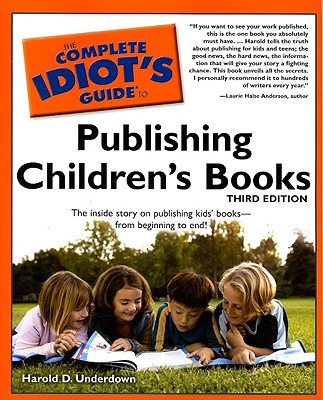
The Complete Idiot’s Guide to Publishing Children’s Books—3rd Edition by Harold Underdown.

This is a comprehensive, down-to-earth guide—worth reading cover-to-cover and easy to dip into as a reference. It presents a broad overview of the field but also gives specifics. As with all Idiot Guides, it's easy to browse and packed with extras like "Vocabulary Lists," which explain terms in the children's publishing industry; "Class Rules," which detail warnings and cautions; "Can You Keep a Secret?" which include tips and resources to help a children's writer or illustrator present him or herself as a pro; and my favorite, "Playground Stories," which are anecdotes from and profiles of children's authors and publishers, giving an insiders view of the children's publishing world.


The other required book is Bird by Bird: Some Instructions on Writing and Life by Anne Lamott.


Teaching Authors Jeanne Marie and Mary Ann have both talked about Bird by Bird...and I’m going to talk about again. Because yes, it’s that good.

My favorite chapter is the one on jealousy, which changed my life. I read it at least once a year to quell my burning heart.


Though I happily celebrate most friends' successes, some colleagues' successes cause me great agony and confusion.
Several years ago, someone gently suggested that perhaps I shouldn't read the book review section right before I went to sleep. She was right. When I'd see certain names, I'd toss and turn all night, feeling like I'd lost a race I didn't even know I was in.

I am a mean and tiny person with tight fists and a black heart.

This is really embarrassing to admit.

I've been more loving to myself about this in the last few years, and Anne Lamott's BIrd by Bird is a big reason why. She writes:
“But if you continue to write, you are probably going to have to deal with [jealousy], because some wonderful dazzling successes are going to happen for some of the most awful, angry undeserving writers you know—people who are, in other words, not you."

and later,

"It can wreak just the tiniest bit of havoc with your self-esteem to find that you are hoping for small bad things to happen to this friend--for, say, her head to blow up."


Who, me?

She writes about seeing a documentary on AIDS:

"You could see the amazing fortitude of people going through horror with grace...seeing that this is what you've got, this disease, or maybe even this jealousy. So you do as well as you can with it. And this ravaged body or wounded psyche...should...be cared for as softly and tenderly as possble."

Lamott has shown me that yes, I have this tendency to be jealous, yes, I have this green spot on my heart…and though I try each year to make it smaller, I may have to live with that little green spot, be amused by that part of me and love myself anyway.


I’m human. What a surprise.

Writing Workout / Lesson Plan—
Metaphor—Getting a Handle on a Really Uncomfortable Feeling

For ages 7 through adult (or younger, with individual help.)

Objective:
This lesson reminds us how writing can help us when we feel awful. (And if the feeling doesn’t go away, at least we’ve got a poem out of it!)

Instructions:

1. Think of someone or something that fills you with envy (or another awful feeling).

2. Close your eyes. Take a deep breath.

3. Feel this feeling in your stomach, in your bloodstream, filling every bone in your body.

4. Or instead, think about what helps drive this emotion from your body. Feel the relief as it leaves through the top of your head, through your finger tips, through the bottoms of your feet.

5. Brainstorm at least five metaphors for jealousy or for what makes jealousy go away. Are you a leaf and is your jealousy a worm chewing on you? Is your jealousy a ring in the bathtub being scrubbed clean with Ajax cleanser?

6. Write a poem using one of your metaphors.

7. Write honestly—even if it embarrasses you.

ANYTHING I CAN DO YOU CAN DO BETTER

or

CAN OF WORMS

by April Halprin Wayland

Varda once told us

that we were all cans on a shelf.

Cans of chili, kidney beans, split pea soup.

I decided that I was a can of apricot halves.

She said that the shelf was only one can deep

but that it stretched out forever

so there’s always room

for one more.

“You don’t have to be afraid that adding another can
means there isn’t enough room for you,”she said.

“You can even help a new can

onto the shelf next to you.”

And she never talked

about jealousy again.

© April Halprin Wayland

Out and About

I’m giving a short program and book signing at the fabulous

Children’s Book World in Los Angeles on Saturday, September 26th at 10:30 am.

If you can’t come, call 310-559-2665 (310-559-book) and they’ll send you your very own autographed copy of New Year at the Pier!


All drawings by April Halprin Wayland