Showing posts with label Inspirational Quotes. Show all posts

Friday, February 16, 2024

My Word for the Year—Hope by Mary Ann Rodman


 My word for this year is right next to my front door. Hope. 

I am a pessimist by nature. I think I inherited this “attribute” from my mom who had two favorite sayings. 1.  Don’t get your hopes up. 2. Don’t expect the best and you’ll never be disappointed. (So that’s how The Greatest Generation got through the Depression, WWII and raising us Boomers. Chronic skepticism.)

So when my college roommate sent me this during the Pandemic, I had to chuckle. The world was going to hell in a hand basket, and she literally sent me Hope, courtesy of UPS. I hung it where I would see it multiple times a day. Who knew? Maybe it would inspire hope. Right, I thought. As if!

This has been a particularly grim winter for me. Battleship grey skies…not even clouds, just solid grey overhead. Every time I turned on my computer I learned another cousin, friend, former student or had died. I was writing myself into literary cul-de-sacs. And let’s not talk about the general state of the world. In fact, the only hopeful thing in life was that little word, hanging by the front door.

But you know what? The sun started making cameo appearances throughout the day. People didn’t stop dying but now there was good news as well. Friends who had searched decades for an agent, acquired one. First time authors of a certain age (which is now how I refer to myself) were being published. My long dormant brain became aware of story ideas.

In other words, I felt hopeful. I also had faith, that elusive concept that makes hope possible. As the Bible says  “Now faith is the assurance of things hoped for, the conviction of things not seen.” --Hebrew 11:1

I will write my way out of those cul-de-sacs. Those ideas will blossom into stories.

I can feel that fluttering of hope that Emily Dickinson wrote of.  If there comes a time when hope seems to be taking another sabbatical, I can always recall my favorite Woody Allen quote: 

 “How wrong Emily Dickinson was! Hope is not the thing with feathers. The thing with feathers has turned out to be my nephew. I must take him to a specialist in Zurich.”

Hope also has a sense of humor.

When all else fails, there are the wise words of Cormac McCarthy—“Keep a little fire burning; however small, however hidden.” 

Posted by Mary Ann Rodman

Friday, February 2, 2024

My Word for 2024


Great minds think alike. Or rather similar Spirits recognize 

a similar need.

My word for 2024 – LIGHT, both the Noun and the Verb, and 

Carmela’s LIGHTER, both the Adjective and the Adverb, share 

the same root:         

            The word “light” comes from Old English leht 

            (Anglian), Leoht (West Saxon), meaning 

            “brightness, radiant energy, that which makes 

             things visible.”

I admit (painfully):

My expertise at finding silver linings?

My ability to focus on the positive?

To date, neither has totally reduced the sometimes-crushing 

weight of our oft-dark World that surprisingly leaves me – 

a Cubs Fan! – wobbly, unable to navigate.


Fortunately, the two inspirational quotes I keep in view on my 

real-life desk top broadcast a qualifying NEVERTHELESS.

Dr. Martin Luther King’s words help me steady my footing, 

look up and find my way.

He’d been asked if given the choice, what era would he live in?  

He acknowledged his land’s troubles and confusion, messes 

and sicknesses.

     “But I know, somehow,” he said, “that only when it’s dark 

       enough can you see the stars.”

        
(Curly Girl Designs)     

The Dark, I’ve learned, can indeed be a Good Thing.

So, thirty-three days into this New Year, I continue to focus all of 

me on the Anyones and Anythings who and that gift me with joy, 

wonder, cause for celebration and/or prompt me to count my 

blessings on a quarter-hour basis.

All those lights, all those nouns, especially the Proper ones, keep 

me keepin’ on.

Ah, the Possibilities!


But even more important, I learned all those lights empower me so 

can do the same for others.

They recharge my batteries so I can burn bright, so I can light the 

way enabling others to keep keepin’ on.

                                                       (Mary Lou Falstreau)


L.R. Knost’s words remind me. “The broken world waits in 

darkness for the light that is you.” 

Ah, the opportunities!


 Thanks to Mary Lee at A(nother) Year of Reading for hosting 

today’s Poetry Friday. 


 In signing off, I can’t help but recall the motto of my family’s 

electrician Moish Dove who happened to be my father’s lodge 

brother.  “Let there be light!”


Esther Hershenhorn

p.s.

My go-to sources for inspirational cards that help to keep me, 

and thus everyone I know and love, keepin’ on?

Curly Girl Designs and Marylou Falstreau’s Cards and Prints!

Thursday, July 20, 2023

HOW TO END A...

Howdy, Campers and Happy Poetry Friday! (The link to PF is below)

Our topic this round is HOW DO YOU APPROACH ENDINGS?

How do we know the last chapter, last paragraph, last word is the right last piece of a puzzle?  

In ending my first picture book, TO RABBITTOWN, I took the advice of poet Maxine Kumin without realizing it.
Image of a large red speech bubble with the following quote in white lettering: "One way to end the poem is to turn it back on itself, like a serpent with its tail in its mouth." ~ Maxine Kumin

Here are the first two pages of TO RABBITTOWN by me, with beautiful watercolor illustrations by Robin Spowart (Scholastic):
 

I opened her rabbit-y cage
and while she nibbled celery
I asked her:
Where do the rolling hills go?
She said:
Beyond the wheat
to a pine forest
to the edge of it all
to Rabbittown

I snuggled her close
She told me:
Hop there
Ride the green waves
Find the cliffs
past the smell of the sea
There you’ll find
those brown rabbit eyes
And so I went

The child leaves home and joins a world of rabbits, slowly turning into one.  The last three pages read:

I said:
I miss them
I want to run back through the hills
to the tops of the cliffs
toward the smell of mown lawns
where I’ll find
those curious human eyes

And off I hopped
through the pine forest
over the rolling wheat hills
past the smell of the sea
back to mown lawns
and my family

To grow legs again
to grow arms again
to hold my pet bunny again
who holds memories
of Rabbittown.

That book was published in 1989. At the time, I knew nothing about serpentine endings or writing. Nothing. I just liked tinkering with words. And that's how I still feel. Every. Single. Day. (Except some days...keep reading.)

How DOES one write (and end) a poem about endings?  I began by brainstorming:

ENDINGS

the last cookie
the last episode
the last stop for four hours so you’d better pee now
the last words before the lights go down and the curtain comes up

the end of summer
the end of the year
the end of the meeting

the end of wearing diapers
the end of wearing braces

the end of the song
the end of Uncle Rob

the end of...
the end

============
A week or so after writing that, I threw everything into the pot (including the fact that my son's an ER doc) and messed around with end rhymes, without any organization or story:

HOW TO END...


A fire, a falsehood, a romance? (Swipe right.)

A concert, a friendship, a novel, a flight?

A sentence (that’s spoken), a sentence (for life)?


A shell game, a head trip, a story, a hike?

A hoax at a rally, a ruling, a right?

A swing shift, a bleeding, a day and a night?


A habit, an anthem, a bias, a fight?

A birthday, a luncheon, an obit, a rite?

A card: “may this new year be filled with bright lights”?


Wild rhyme, unhinged rhyme in this labyrinth?

Good night!
========

Clearly it needed some kind of organizing principle. Maybe the words in each line could be related? Or the lines could all march to a satisfying ending? I sent it to my best friend Bruce Balan, asking:

Dear Poem Repair Person, Please take my out-of-tune poem and make it sing in four-part harmony. 
===================== 
The suggestions he sent were supposed to go here: _________________________________. But I'm not going to tell you his suggestions because he's right and I'm tired and it'll take too much work and I don't wanna.

Well, okay, I will share one question he sent:  "My real question is, what are you trying to say?" I had no idea.  

Sometimes internal logic, metaphors and a perfect visual shape will emerge from the muck of the marsh. And since none of that happened, I was hoping he would just tell me what I was trying to say. Or just rewrite the whole thing for me. Isn't that what friends are for?
Image of the last piece fitting into a completely white puzzle with these words on the puzzle: "I was hoping that as I moved the puzzle pieces around, they would come together in a satisfying, cohesive click." ~ AHW

Though the poem above didn't have heart or logic or answer the title's question, it was a SO MUCH FUN to write!  

Breaking News:
 sometimes it's not fun.

Sometimes I have to let things "cook" for awhile and the answers appear. But I didn't have time for that--this post was due! 

I decided to admit to you, dear campers, that "I'm tired of trying to figure things out" (phrase from a song by Tom Hunter). I can't seem to write a poem about endings. So, I took Dory's advice. I just kept swimming. I thought about my favorite hike and how last week it was mysteriously much harder than usual. (I didn't know I was coming down with a cold.)

JUST KEEP SWIMMING

This gentle path along the bluff

becomes a trail up a hill

and now a trek up to the ridge...

that peak is far.

That peak is steep.

This hike is hard.

I hear it growl...

and then it steepens loud

at me.

============ 
all poems--or rough drafts of future Pulitzer Prize-winning poems (c)2023 April Halprin Wayland. All rights reserved.

Thank you for sticking with me to the bloody end! I'll leave you with one last thought and, of course, the link to Poetry Friday:

“Poems are short stories
with punctuation disorders”

Tom Cassidy 

Thank you, Margaret at Reflections on the Teche
for hosting Poetry Friday this week!

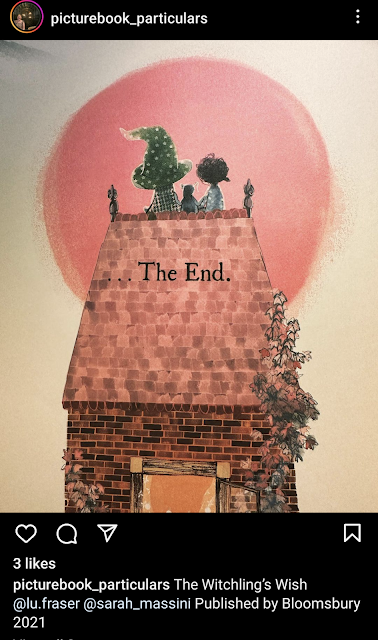
Image of the end papers from The Witchling's Wish
by Lu Fraser, illustrated by Sarah Massini
posted by Picturebook_particulars on Instagram 

posted with love by April Halprin Wayland with help from Bruce Balan and the infinite knowledge of poets everywhere.
_____________

PS from Carmela: Congratulations to the winner of our 2 for 1 Giveaway: A Set of Metaphor Dice and a copy of the Poetry by Chance Anthology 
Marcie F.

Friday, December 11, 2020

A Quote, a Tree, and Good-bye, 2020!

First of all--thank you, Carmela Martino for switching posting dates with me. In a year where everything that could go wrong, went wrong, my laptop expired the week I was originally supposed to post. Thank you for coming to the rescue...and for that wonderful video of Rebecca Howard singing "You'll Never Walk Alone." (Howard's sabbatical from the Alabama Shakes is one of the good things about this year.)

After all the posts in this topic of "Inspirational Quotes" by my fellow TA's, it's hard to find anything to say, that they haven't said already, and better than I could. So that leaves my "inspiring quote." Being the Eternal Librarian, I double-checked my sources before I wrote this. It appears my "quote" has a dubious history. Sigh. Leave it to me to find inspiration in a historical mystery.

You can tell when I'm stressed or troubled by looking at my Kindle reading queue. Tales of the Resistance movements during WWII. Heroic quests of people leaving a violent homeland, finding a new one. Stories of Ordinary People in Extraordinary Times. 

My reading included more than one book about the Holocaust. In one of them, (I can't remember which one...there were so many) I thought I read this, by Anne Frank's father, Otto: "Even if I knew I would die tomorrow, I would still plant a tree today."

That really had an impact on me. Everyone has had the Year from Hell. My personal "mental hell" was being officially declared "elderly" by the CDC. I never think about age at all. I'm a life-long late bloomer--late to marry, give birth, publish--which means that my peers in those events were generally much younger than me. So I've spend most of my adult life with people ten to twenty years younger than me, while my actual "peer group" had moved on to being retired grandparents. But in one fell swoop, medicine declared people my age "elderly" and "at risk." Although I'm in better shape than ever, and my parents and grandparents lived impossibly long and healthy lives, I felt as if The End Was Near. That everything good and useful was being done by the young. I was elderly and "fragile" and should stay out of everyone's way.

I know this feeling doesn't make sense. Feelings rarely do. So Otto Frank's "quote" inspired me to re-engage with the world, crazy as it is right now.

Alas, Otto Frank did not say this. He didn't even say something sort of like this.

The actual quote is "Even if I knew the world would go to pieces tomorrow, I would still plant my apple tree." 

The quote is attributed to Martin Luther. Ironic, because I was raised in the Lutheran Church, and outside of Luther's Small Catechism which I had to memorize, I don't recall anything memorable that Luther ever said. (Not memorable to me, at least.)

But wait...what is this asterisk next to the quote?  What? No! What does that mean,"allegedly attributed?" A little more digging and, I find this: No one knows who really said this. It seems to have first surface in Nazi-era Germany. It is believed to have been something the German Lutheran Church manufactured and attributed to Luther to "give people hope in a dark time."

Well-done, German Lutherans! Even if the quote was not authentic to Luther and his time, it certainly spoke to me in our current "dark time." So in honor of Martin Luther, fake quotes and the year 2020, I light my candle. But most of all, to my fellow Teaching Authors. You shine your light in all years and circumstances. I'm honored to be one of you. Here's to planting our apple trees in 2021.


Posted by Mary Ann Rodman


Friday, December 4, 2020

WHAT IN THE HECK CAN ONE PERSON DO?

 Howdy, Campers, and Happy Poetry Friday! (my poem and a link to PF is at the end)

Our topic this round? A Favorite Book, Poem, or Quote.  Gwendolyn started us by recommending the book, I SEE YOU-I SEE MYSELF; Carmela followed with 3 Favorite Books + an Inspiring Song; Bobbi came next with a wonderful quote from Emma Dryden and more; Esther cheers us on with Three 2020 Favorite Books to Keep Us Keepin' On; now it's my turn.

I love quotations. Like so many of us, I collect them. And when I teach onsite, every week I paste quotes on walls and windows of my classroom which reflect that week's topic. I have lots of favorite political quotes, too. But one in particular has kept me afloat all year. It's been in my files and by my side in the past, but this year I wrote it on our bathroom wall (which is a whiteboard). 

Today I wrote to a dear friend: You sent 160 Vote Forwards?!?!! Wowee, Rooti, way to go!

I just taught class #9 of 10. It's been like a long walk through the Valley of Death, this business of  learning how to teach on Zoom, but now I feel I'm on the other side of the valley...

There was a day in early summer that I broke down from the craziness of technology, screwed-up passwords, fears of Covid, isolation, mising my son, our "toddler-in-chief" etc. I wailed like a banshee. Gary said in the 40 years we've been together he's never seen me that dark. 

But now my class is almost over and it's been rewarding in so many surprising ways. And there's hope on the political horizon thanks in part to you, Rooti.

And one quote has helped me walk through it all:


The following is what I call a Golden Quote poem. Modeled after Golden Shovel poems, the last word of each line forms a quote.

ONE BIRD
by April Halprin Wayland

Once there was one

bird. Such a lonely little bird. No person,

no fellow sparrow, no tin can

to roll around rocks. Only

a wee plant, its round leaves shining, as leaves do.

That bitter winter, those round leaves wilted. So

Little Bird wrapped her wings around the plant. Did it help? It helped so much.

poem and drawings © 2020 April Halprin Wayland. All rights reserved

One person can only do so much.

One person (or bird) can only do so much.

What's your favorite quote?

Thank you, Mary Lee for hosting PF at A Year of Reading!


posted with a deep breath of gratitude for you,dear readers, and for my students this quarter who are very forgiving by April Halprin Wayland, with help from her trusty hiking partner, Eli-the-old-but-hanging-in-there-dog.

Today's hike tired Eli out.

Friday, March 8, 2019

Show Don't Tell Me, Mentor Text

.
Howdy, Campers ~ happy Poetry Friday!  (my poem and the link to P.F. and are below.)

And the winner of our latest give away--Laurie Wallmark's book, Hedy Lamarr's Double Life: Hollywood Legend and Brilliant Inventor--is....Katie G!  Katie, a loyal subscriber, also won a TeachingAuthors giveway in 2013. Moral: it pays to hang out in the TeachingAuthors' tree house!

And speaking of the TeachingAuthors' tree house, these days we're up here drinking hot cocoa and sharing how we use Mentor Texts.

Carmela starts us off by defining what mentor text is and more; Bobbi's post talks about what 54 TV years of Doctor Who can teach us; and Mary Ann shows us the ways in which she systematically studied picture books (and found love...sort of).

In all my classes I use mentor texts. Show, Don't Tell is the first thing I teach. Even if a student is a published novelist, a renown screenwriter, or a seasoned journalist, it never hurts to be reminded of what Anton Chekov means when he writes: "Don't tell me the moon is shining; show me the glint of light on broken glass."  


image from Pixabay.com by Dana Tentis

In one exercise (created by my son when he was in elementary school), volunteers act out something in silence and their classmates guess what they are trying to convey. We discuss: how did they know the dog was happy, the child was having a tantrum, or the woman was old?  They showed us, they didn't tell us, of course.

The first book I read to introduce Show, Don't Tell is Barbara Shook Hazen's masterful and moving picture book illustrated by the brilliant Trina Schart Hyman, TIGHT TIMES (Viking Press, 1979).

I wish I could put this book in your hands, but I can't, so I'll give you an example of how Hazen shows, rather than tells:

When the child narrator asks why he can't have a dog, his father explains,
"Because of tight times" and continues:
"He said tight times are when everything keep going up.
I had a balloon that did that once.
Daddy said tight times are why we all eat Mr. Bulk instead of cereals in little boxes.
I like little boxes better.
Daddy said tight times are why we went to the sprinkler last summer instead of the lake.

I like the lake better."

I just typed the text of this book. It's astonishing what Hazen does in just 694 words. This book was published at a time it was perfectly acceptable to turn in a picture book manuscript of 1200 words or more!

And having typed this text, I can feel in my fingers that one of the picture books I am working on needs more showing, less telling!

* * *

A month before my mother, a classical pianist, died, I couldn't tell you what I was already missing...I had to show it:

WHERE IS MY MOTHER?
by April Halprin Wayland


Quietly she cries,
“Mama, Mama…”

Eyes half-closed,
she lies blanketed in grief.

Where is my mother:
whirling dervish,

spark of light,
moving, always moving,

striking a match,

setting piano keys on fire?

poem (c)2019 April Halprin Wayland. All rights reserved.

Okay, Campers...do you have favorite picture book that demonstrates Show, Don't Tell?  I'd love to know what it is!

Spread the word: on April 13, 2019 from 9:30 am-4:30 pm, author/illustrator Barney Saltzberg, fiction and nonfiction picture book author Alexis O'Neill and I are reprising our one day class at UCLA, Writing a Picture Book and Getting it Published. Join us!

Thank you, Catherine, for hosting Poetry Friday today at Reading to the Core ~

posted with love by April Halprin Wayland, with help from Mateo, our latest monarch butterfly caterpillar, who is currently looking for a place on our kitchen wall to build his chrysalis. 

Mateo, named after a character in this book

Did you know that monarch butterflies are endangered...and that you can help by raising them?  Just ask beloved TeachingAuthor emeritus, JoAnn Early Macken; click here  for the monarch resources on her website.

Monday, October 23, 2017

What Exactly is a Short Story?


These last few days, theTeaching Authors have shared their admiration and wisdom about the indomitable short story. With special congratulations to our own TeachingAuthor Carla Killough McClafferty on having a story featured in the brand new collection, 30 People Who Changed the World: Fascinating Bite-Sized Essays from Award-Winning Writers--Intriguing People Through the Ages: From Imhotep to Malala edited by Jean Reynolds. Short stories are Mary Ann’s guilty pleasures.  Esther raises four cheers for the short story.

I have to admit, I am not a big reader of short stories, although I’m not exactly sure why. In fact, I'm not so sure I know what a short story is. O yes, I’ve read Edgar Allen Poe and Shirley Jackson. I’ve even published a few, working with the mighty Marion Zimmer Bradley when I first started out, many years ago.

But what exactly is a short story? I mean, I certainly understand the more cursory elements of the short story versus the novel. Short stories are, well, short. The character comes for a visit, stays for an evening, and complains about a particular problem. But then just as she is getting interesting, she leaves.

As Eudora Welty once said, “A short story is confined to one mood, to which everything in the story pertains. Characters, setting, time, events, are all subject to the mood. And you can try more ephemeral, more fleeting things in a story – you can work more by suggestion – than in a novel. Less is resolved, more is suggested, perhaps.”

 It turns out, the short story is becoming popular again. In her 2016 article, The Rise of the Short Story, Laurie Hertzel examines the reasons why the short story is not only gaining popularity, but enjoying a new heyday not seen in decades.


But, what exactly is a short story? 


“Writers who do short shorts need to be especially bold. They stake everything on a stroke of inventiveness. Sometimes they have to be prepared to speak out directly, not so much in order to state a theme as to provide a jarring or complicating commentary. The voice of the writer brushes, so to say, against his flash of invention. And then, almost before it begins, the fiction is brought to a stark conclusion - abrupt, bleeding, exhausting. This conclusion need not complete the action; it has only to break it off decisively.” -- Irving Howe


“It’s possible, in a poem or short story, to write about commonplace things and objects using commonplace but precise language, and to endow those things – a chair, a window curtain, a fork, a stone, a woman’s earring – with immense, even startling power.” – Raymond Carver 

“A short story I have written long ago would barge into my house in the middle of the night, shake me awake and shout, ‘Hey, this is no time for sleeping! You can’t forget me, there’s still more to write!’ Impelled by that voice, I would find myself writing a novel. In this sense, too, my short stories and novels connect inside me in a very natural, organic way.”Haruki Murakami

“A short story is the ultimate close-up magic trick – a couple of thousand words to take you around the universe or break your heart.” – Neil Gaiman

"I seem to turn out stories that violate the discipline of the short story form and don't obey the rules of progression for novels. I don't think about a particular form: I think more about fiction, let's say a chunk of fiction." -- Alice Munro


“I’ll give you the whole secret to short story writing. Here it is. Rule 1: Write stories that please yourself. There is no Rule 2.”O. Henry


Anita Desai (July 2017) reflects on how tales briefly told are in the habit of returning, that "... a short story is not a failed novel any more than a novella is an extended short story. Each has an altogether different set of rules and effects. Length is one of them, but lengths vary wildly. As Hortense Calisher said, “How long should a short story be? As long as a piece of string. I mean – to tie up the parcel with.”

 "Instead of those long stretches in which a novelist becomes stranded, the short-story writer must launch forth on what is a high-wire act, refusing to look back or down into the abyss, running the length of it at a sprint so as not to lose balance: quick, quick before you fall!" -- Anita Desai

So, it seems a short story is an organic, boldly told magical trick resembling a high wire act that stretches to the end of the universe and back. And if it makes you feel something, especially if it breaks your heart, it's good.

Does that sound about right?

Bobbi Miller

Friday, May 12, 2017

Will Rogers: Actor, Trick Roper WRITER!

.
Howdy, Campers and Happy Poetry Friday! (My poem and the link to PF is below)

This time around, we TeachingAuthors are rhapsodizing about our favorite American writer's museum or home. Bobbi began with a post on Emily Dickinson's Museum, Mary Ann wrote about William Faulkner's Rowan Oak, And Carla, in her post titled "Listen My Children," wrote about Henry Wadsworth Longfellow's home.

Today I'm going to introduce you to a beloved place in my Southern California childhood, Will Rogers State Park and ranch house, just a 15-minute drive from UCLA.

But first, a bit about Will, gleaned from the Will Rogers Memorial Museum and Birthplace Ranch in Claremore,  Oklahoma:


My ancestors didn’t come over on the Mayflower, but they met the boat.” (Will was "born to a Cherokee Nation family.")

He wanted more than anything in the world to become a trick roper, and did, touring the US and Europe in Wild West and vaudeville shows. If his rope tricks failed on stage, he made jokes, and those "jokes became better than ropes." He signed with Ziegfeld's Follies and become a Broadway star.

But Will was also a writer. He was, to put it mildly, prolific. "He put approximately two million words in print—six books, more than 3,600 [daily!] newspaper columns..." and wrote frequently for The Saturday Evening Post. His "syndicated weekly and daily columns were prized by 600 newspapers ...including at least one in every major city...and reached a potential audience of 40 million readers." In addition, he wrote"scores of magazine articles—in a span of only sixteen years, stretching from the publication of his first newspaper article in 1916 until his last one in August 1935."

"I don't make jokes. I just watch the government
and report the facts."

Are you out of breath yet? There's more:

He appeared regularly on radio through the 1920's and 30's, and went on to produce, direct, write and star in the 20-minute silent picture, "Ropin' Fool," in which he pioneered slow-motion cinema to better demonstrate his roping tricks. (Watch him do 3 minutes of rope tricks from that film.)

He went on to star in 50 silent films, and when "talkies" replaced them, appeared in 21 pictures in five years and becoming Hollwood's highest paid actor. (In fact, here's his IMDB)

He was a force of nature. My mom and dad loved that he spoke truth to power--so naturally, I did, too. What I knew of Will reminded me of Molly Ivins, who I wrote about right after the November election. But as I've read more, I was surprised to find that I disagree with some of his political views. Still, it seems he kept politicians on their toes--an important job of a columnist/political satirist.

For example (from Wikipedia):

Rogers thought all campaigning was bunk. To prove the point he mounted a mock campaign in 1928 for the presidency. His only campaign promise was "If elected, I will resign." Every week Rogers caricatured the farcical humors of grave campaign politics.  During this campaign he answered questions: What does the farmer need? Obvious: "He needs a punch in the jaw if he believes that either of the parties cares a damn about him after the election."  On election day he declared victory and resigned.

"Ten men in our country could buy the whole world and ten million can't buy enough to eat."

But my memories are of Will Rogers State Park, and more specifically, Will's 31-room Western Ranch House not far from the Pacific Ocean, with its long porch, and an expansive lawn (i.e. park) which stretched from the family's stable to their polo field.


Oh, that lawn. Oh, that polo field. And oh, the trails leading from the ranch to forever, which my hiking group returns to often.

And what's the first thing I always wanted to see as a five-year-old, as a ten-year-old, and today, when touring his home?  The roping calf. In his living room. His living room! 
Cool.

Here's a poem I wrote in 1995 about one of my all-time favorite birthday parties under the trees which surround the lawn of the Will's ranch house:

PARTY AT THE PARK
by April Halprin Wayland

Surrounded by shedding eucalyptus trees,
been here forever, they’ll be here forever, too.

All of my cousins, aunts and uncles
spreading table cloths, taking out potato salad,

handing me hugs and presents and long kisses,
talking to everyone as they talk to me,

big arms and bodies and laughing, laughing
Cousin Bruce, Cousin Robbie, my sister, and Cousin Franklin

running after pigeons, running after frisbees, running into me
more presents and pass the plates and did you have enough?

taste Aunt Sylvia’s kugel, yes, says Uncle Raphael, taste
Fran’s chopped liver, is it time for birthday cake? asks Uncle Moish

and we all gather ‘round for two cakes for Dad and me--mine is pink
Dad says I can have a corner flower and

Mom and Aunt Cissie are putting candles in the plastic flower
holders and sticking them in the cake and then Mom lights them with a little

match, lights the last one holding the very teeny part of the match, burning close to her fingers, but she’s fast and they burst into song and I feel full and

like bursting
full of cousins and aunts and uncles and potato salad

surrounded by shedding eucalyptus trees,
been here forever, they’ll be here forever, too.

poem © 2017 April Halprin Wayland. All rights reserved. 


Here's a 2-minute video about Will Rogers:

"The man with the best job in the country is the Vice President. All he has to do is get up every morning and say, 'How's the President?'"

Thank you for reading this post. As some of you may remember, I am terribly afraid of making factual errors when writing non-fiction. It scares the dickens out of me. Do you ever feel this way?

And congratulations to Gail P, who won an autographed copy of Lisa Cron's STORY GENIUS (which Esther reviewed here) in our latest book giveaway celebrating TeachingAuthors' 8th blogiversary!

Thank you, Tara, for hosting Poetry Friday at A Teaching Life!

posted by April Halprin Wayland with the help of Will, who said: "Live in such a way that you would not be ashamed to sell your parrot to the town gossip."