Since 1919, this national literacy initiative, the
longest-running in our history and co-anchored by the Children’s Book Council
and Every Child A Reader, has celebrated books for young people and the joy of
reading.
Visit the website to learn the
bounty of events and activities that commemorate this once-a-year week and to
read more about this year’s poster
creator, Grace Lee.
Book Week’s goal? To make sure every child is a reader!
But today is Wednesday, yes? – which means it’s time for a TeachingAuthors
Wednesday Writing Workout, one that will give every child, both current and former, the opportunity to write.
Enjoy!
Esther Hershenhorn
P.S.
Don’t forget to enter our Book Giveaway to win a copy of Stefanie Lyons’
YA novel in verse DATING DOWN (Flux). The deadline to enter is midnight May 15.
. . . . . . . .
Let’s tweak the Children’s Book Week goal a tad to read…. make
sure every child – current and former (!) – is a reader who writes!
Click HERE to download these children’s book week story
starters and create your own ending!
What I Didbegun by National Ambassador Katherine Paterson(New!)
BLAM!begun by Mo Willems (2009 Children's Choice Book Award
winner)(New!)
The Night Visitorbegun by Dinah Williams (2009 Children's Choice Book
Award winner)(New!)
And Then...begun by National Ambassador Emeritus Jon Scieszka
The Unexpected Blastbegun by Elaine Landau (2008 Children’s Choice Book
Award winner)
Surprise On the Matbegun by Lola Schaefer (2008 Children’s Choice Book
Award winner)
I had a wonderful poetry teacher, Tony Lee, who taught us about voice. Describing
something, as a journalist does, Tony said, is the reporting voice.That voice comes from the lips, the mouth,
the throat.
from morguefile.com
Writing about feelings comes from the gut, a lower, truer, sometimes scarier place, he said.
from morguefile.com
This is the deep voice. The deep voice attracts readers. It connects them to your story. Be brave, he told us. Find the feelings. Go there.
So why do some blog and FaceBook posts get nine kazillion comments (not mine!) and some get zip?
it seems to me that getting your work read (or, more to the point, getting your work read and passed on) is about superficial vs. deep.
Just like a book in which the author rips off her shirt and shows us her scars (as Anne Lamott does), FaceBook and blog posts that come from the gut are the ones that resonate.
I was at a meeting the other day; each of us had three minutes to talk about anything we wanted. The first two minutes and 30 seconds I talked about some success I had had. In the last 30 seconds, my mouth opened and an embarrassing truth popped out. I said that Robyn Hood Black had very kindly gifted me homemade granola. It was especially touching because Robyn knows I can't eat sugar, so she made it with sugar-free maple syrup. I could actually have it. Delighted, I sat down for lunch, thinking I'd taste just a spoonful, just to see what it was like.
Good granola is dense, so you don't need much. And you and I know that you're supposed to eat two cups of granola over a period of several days--with fresh blueberries and your pinky finger raised, right?
Not me... immediately my mouth opened, a vacuum turned on, my brain turned off, and nearly two cups of absolutely delicious granola were gone. Gone!
This isn't Robyn's granola.
Hers had yummy bits of coconut in it.
But...um...I didn't have time to take a picture of hers.
So this is from morguefile.com
As we went around the room sharing, do you think others in the group commented on the nicely packaged pithy wisdom in my first two minutes and thirty seconds? Nope. Nearly ALL of them talked about my granola adventure. It hit a familiar nerve. We've all been there.
It was no longer mine...it was all of ours.
During Poetry Month this year, I had what I called a metaphoraffair--I practiced finding metaphors, posting one each day, both on my website (where, it turned out, the comment mechanism was broken) and on FaceBook and Twitter.
The metaphor which drew the most interest was my final post for Poetry Month 2014, written with and about my mother, who is 91 and not doing great. It was hard for me to post; it was true. It was from my gut.
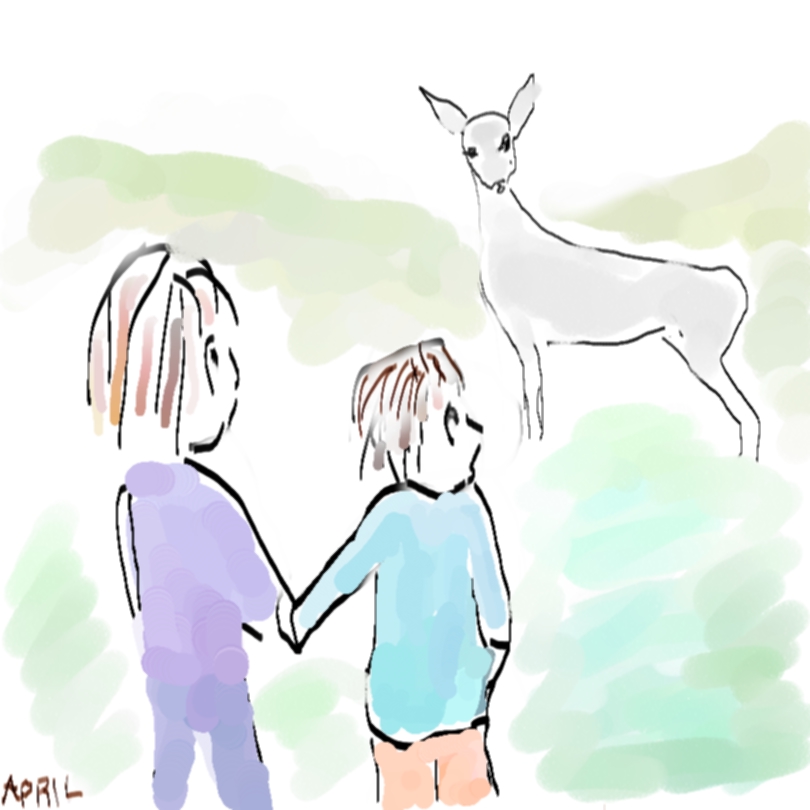
I drew this in November, 2010, after Mom and I walked around a park in Malibu…suddenly I was the parent
The point is, be brave, cut deep beneath the skin, share from the gut, share your humaness. That's all we have. * * * * LAST CALL! If you haven't entered our current giveaway, it ends today! To enter, go to Jill Esbaum's post to win your very own autographed copy of Jill's Angry Birds Playground: Rain Forest (National Geographic Books)!
Will you be in New York on May 18th? I'll be speaking on the Children's Books Panel of the Seminar on Jewish Story in New York City on Sunday, May 18th. Here's my interview the seminar organizer, Barbara Krasner published on her blog.
My favorite from the site above? Take a pic of yourself with your favorite children's book, then share it on Twitter using the hashtags #plaea #cbw14. Fun!
Also, if you happen to be in a bookstore this week, my newest picture book debuts Thursday (we'll have a book giveaway sometime this fall). Keep your eyes peeled for I Am Cow, Hear Me Moo!
Last week, Jeanne Marie kicked off Children's Book Week by introducing our series of posts about beloved children's books we've lost and miss. Before I share my own lost-book story, I want to congratulate the winners of the Sixth Annual Children's Choice Book Awards. According to this press release, over 1,000,000 votes were cast! How cool is that? You can see the list of finalists and winners here.
Now my lost-book story is nowhere near as intriguing as April's. (If you haven't read her post yet, go do so now. I'll wait.) My story starts some years back, when I created a new one-day workshop for College of DuPage called "Writing for Children and Young Adults: From Goodnight Moon to Harry Potter," designed to introduce students to the field of writing for children and teens. As part of the class, I planned to give an overview of the "ages and stages" of children's literature, sharing examples of a variety of genres and formats, classics and contemporary works.
Margaret Wise Brown's Goodnight Moon was one of my son's favorite picture books as a child, especially at bedtime. We read the marvelously lyrical, calming text so many times that I memorized it. But when I went to prepare for the class, I couldn't find our copy anywhere. It wasn't in my son's bookcase (he was away at college); it wasn't in his closet; it wasn't in my office. I finally gave up and borrowed a copy from the public library to use in my class.
I taught the class multiple times, and each time I looked for our copy of Goodnight Moon. No luck. Finally, my husband reminded me that I had packed away some of my son's books and baby things in a box that sits in the attic of our garage. Not wanting to ask my husband to drag out the box, I bought a used, paperback copy of Goodnight Moon for class. If my son eventually has children of his own, we'll get that box down from the attic. When we do, I'm hoping to find that it contains not only Goodnight Moon, but also another Margaret Wise Brown/Clement Hurd classic I've been missing for many years--The Runaway Bunny, the story of "a bunny's imaginary game of hide-and-seek and the lovingly steadfast mother who finds him every time." As a first-time mom, reading that book to my son was my way of saying that I would always be there for him. But even now I'm not sure who found the book more comforting, my son or me.
By the way, in case any of you who live in the Chicago area are interested, I'll be teaching my workshop "Writing for Children and Young Adults: From Goodnight Moon to Harry Potter" at College of DuPage again this summer. See my website for details. And I'm thinking it may be time to update the class name, perhaps to "Writing for Children and Young Adults: From Goodnight Moon to Hunger Games." Or if you have any other suggestions, let me know. :-)
In the Ford household, we've celebrated three birthdays, one First Communion, and Mother's Day (happy, happy!) all within the last month. Heaven forbid we should rest on our laurels, so let's keep the party going with Children's Book Week!
In our next series of posts, the Teaching Authors are planning to share titles of beloved childhood books that have sadly been lost to the ages (loaned, tossed, or otherwise lost). This is a timely topic for me, as my newly minted eight-year-old asked me last week for new reading suggestions. We trekked together to the attic, where my childhood books are stored. As an Army brat with at least 25 moves under my belt, I possess very few relics of my childhood -- toys, treasures, clothes, memorabilia. But books, I was smart enough to schlep and save.
I've got Charlie Brown's Super Book of Questions and Answers and the complete Bobbsey Twins (which, alas, I do not feel I can share with my daughter today, what with Dinah and Sam and Flossie, her father's "little fat fairy" (goodness!)). However,I pulled together a pile of about 12 books, old and new, that I think she will love. I also did a quick and painful assessment of what I thought I had that I do not:
The Moffatts series by Eleanor Estes Figgs and Phantoms and The Tattooed Potato and Other Clues by Ellen Raskin
Most of the All-of-A-Kind family series
Anything by E.B. White (!)
And, for when my daughter is older: Waiting for Johnny Miracle by Alice Bach A House Like a Lotus by Madeleine L'Engle
I am thankful that old and/or out-of-print books are now typically available on the Internet, though I suspect some of these will be hard to find. I plan to get these books into my daughter's hands or die trying.
Happy Children's Book Week (and month and year) to all! And if you haven't already done so, it's not too late to enter our Blogiversary Contest to win one of four gift certificates to Anderson's Bookstore. Happy Book Buying to All! --Jeanne Marie
It's Children’s Book Week -- yay! Of course, we at Teaching Authors celebrate all year long, but this week is truly a coast-to-coast party. If you're a teacher or librarian, you may already be planning to stage a read-in, have a poster contest, or dress like a Hoo. Find more resources and tips here.
In equally exciting news, students can vote for the Children’s Book Award. This is
the only national book awards program where the winning titles are selected by
young readers of all ages. Voting is open from 3/19—5/3/2013. Check out the finalists, listed by
reader age group, and then tally your class vote!
My daughter turned 8 yesterday, and the only thing she wanted for her birthday? Books! Thus, here's how the Fords heralded the start of Children's Book Week (along with the belated appearance of spring):
Charlotte's Web, Phineas and Ferb, and a side of fruit salad. Bliss! - Jeanne Marie
Before I share what's on my to-read stack and a bit about my latest read, I want to remind you that time is running out to enter our current giveaway contests:
to win an autographed copy of Guest TeachingAuthor Karen Schreck’s newest YA novel, While He Was Away (Sourcebooks Fire), you must enter by 11 p.m. Monday, May 14, 2012 (Central Standard Time). Read my interview with Karen for all the details; and
for our TeachingAuthorsThird Blogiversary Giveaway Contest prize of one of THREE $30
gift certificates to Biblio.com (where you can purchase new and used
books from independent booksellers around the world, often with free
shipping!) you must enter by 11 pm (CST) Monday, May 21, 2012. See April's post for more information.
And now, for our current TeachingAuthors' topic: Children's Book Week and what we're currently reading: I'm lucky to live in the same town as the wonderful independent bookstore, Anderson's Bookshop, which hosts the monthly Not for Kids Only Book Club "for adults who like to read books for children and teens." At our next meeting, on Sunday, May 20, we'll be discussing Dead End in Norvelt (Farrar, Straus and Giroux) by Jack Gantos, this year's Newbery Award Winner. I just picked up the book, so I can't comment on it yet. However, I can comment on, and heartily recommend, last month's book,Between Shades of Gray(Philomel) by Ruta Sepetys. The book was a finalist for the American Library Association's 2012 William C. Morris Award, which "honors a book written for young adults by a previously unpublished author."
In 1941, fifteen-year-old Lina is preparing for art school, first dates, and all that summer has to offer. But one night, the Soviet secret police barge violently into her home, deporting her along with her mother and younger brother. They are being sent to Siberia. Lina's father has been separated from the family and sentenced to death in a prison camp. All is lost.
Lina fights for her life, fearless, vowing that if she survives she will honor her family, and the thousands like hers, by documenting their experience in her art and writing. She risks everything to use her art as messages, hoping they will make their way to her father's prison camp to let him know they are still alive.
It is a long and harrowing journey, and it is only their incredible strength, love, and hope that pull Lina and her family through each day. But will love be enough to keep them alive?
I found Between Shades of Gray to be a powerful and moving story. Before reading this book, I knew nothing of Stalin's atrocities during World War II, which it so vividly depicts. I recommend the novel not only as a terrific read for ages 12 and up, but also as a wonderful contribution to World War II-related literature.
I met Ruta Sepetys a few weeks ago when she visited the Anderson's Bookshop in Naperville to celebrate the paperback release of Between Shades of Gray. She spoke then about the connections between her own family history and her novel. Her words reminded me of stories my mother told of her childhood in Italy, when German troops occupied her small mountain village. And that leads me to today's Writing Workout.
Writing Workout:
Researching Our Family Stories
Are there stories your relatives have told that could make interesting seeds for a story? Did any of them live through unusual or difficult circumstances, such as war, economic hardship, or natural disaster? Don't know? Then ask! Schedule time to sit down with a family member and really listen to his or her stories. Take notes. Then write a short story that captures part of his or her experience. If you need some inspiration for how powerful this process can be, go to the official Between Shades of Gray website and watch the video about how Ruta Sepetys researched her novel. And for another Writing Workout about writing family stories, see this post by April.
Wait!And
whoa there! Before
you read another line, be sure to enter, if you haven’t already, (1) our
TeachingAuthors Blogiversary 3 Contest to win one of three $30.00 gift
certificates to Biblio.comand (2) our separate autographed book giveaway of
Guest TeachingAuthor Karen Schreck’s newest YA novel, While He Was Away.
Sponsored
by the Children’s Book Council and administered by Every Child is a Reader,
Children’s Book Week celebrates the transformative power of reading. It is the longest-running literacy initiative
in the country, formally established in 1919.
Be sure to visit the website to
learn more about official and local events, including author and illustrator
appearances, accompanying activities for teachers, parents, booksellers and
librarians and the listing of the 2012 Children’s Choice Book Award Winners.
I’m biting at the chomp, beyond
eager to share the latest children’s book I read, re-read and took into my
heart, R. J. Palacio’s multiply-starred middle grade novel Wonder.
Here’s the flap copy:
“August (Auggie) Pullman was born with a
facila deformity that prevented him from going to a mainstream school – until now. He’s about to enter fifth grade at Beecher
Prep, and if you’ve ever been the new kid, then you know how hard that can
be. The thing is, Auggie’s just an
ordinary kid, with an extraordinary face.
But can he convince his new classmates that he’s just like them, despite
appearances?"
Auggie
introduces himself to the reader:
“I know
I’m not an ordinary ten-year-old kid. I
mean, sure, I do ordinary things. I eat
ice cream. I ride my bike. I play
ball. I have an Xbox. Stuff like that makes me ordinary, I
guess. And I feel ordinary. Inside.
But I know ordinary kids don’t make other ordinary kids run away
screaming in playgrounds. I know
ordinary kids don’t get stared at wherever they go….. My name is August, by the way. I won’t
describe what I look like. Whatever you’re thinking, it’s probably worse.”
The flap copy is right: R.J. Palacio has crafted an uplifting
novel full of wonderfully realistic family interactions, lively school scenes,
and writing that shines with spare emotional power.”
The Former Fifth Grade Teacher inside me wondered
non-stop: how could Palacio present this grade and age so perfectly, portray the truths
of the school experience so honestly?
Oh, to have a class with which to share this book today! (I’ve emailed three teachers already recommending
this title.)
The Mother in me ached, kissing the top of
Auggie’s head each and every time his Mom or Dad did the same. So often we writers are told: kill those parents
in Chapter One! The child needs to navigate the world on his own! But the depth and glory of Auggie’s parents’
love for him, and his sister’s love too, portrayed honestly, warts and all,
prove pure Show, Don’t Tell so Auggie can be brave.
The writer in me simply sighed at Palacio’s
craft, how she brilliantly chose multiple viewpoints to tell Auggie’s story so we
the readers could see how others saw Auggie - for who he is, what
he is and not how he looks, how she nailed each and every voice, and best of all, how
she still moved Auggie’s story forward, in compelling scenes, September through
June.
It’s the little ol' me I am, though, who, along with Auggie and his
changed-forever classmates, was different for the journey. Auggie became everyone’s Hero, standing out
and above the crowd because of who he was - an ordinary kid doing extraordinary
things.
The Library of Congress classified the
novel [1. Abnormalities, Human – Fiction. 2. Self-importance – Fiction. 3.
Middle schools – Fiction. 4.
Schools – Fiction.] I wish they would
have asked me. I would have listed Kindness
as the one-and-only classification.
Auggie’s English teacher Mr. Browne shares
a precept for each month of the school year; students copy the precept into
their English notebooks. Precepts, they decide, are “rules
about really important things.”
September’s precept had me on my way, turning the pages late into the night, and it turns out, so was Auggie, after heartbreaking hurts and the inevitable taunts. “WHEN GIVEN THE
CHOICE BETWEEN BEING RIGHT OR BEING KIND, CHOOSE KIND.”
IMHO, WONDER
is an important book. Auggie Pullman
is an unforgettable character.
Thank you, R.J. Palacio, for showcasing
the transformative power of literacy.
Oh, and Happy Children’s Book Week!
Esther Hershenhorn
Writing
Workout
Up for Auggie’s
October Homework Assignment?
Mr. Browne’s October precept read, OUR DEEDS ARE OUR MONUMENTS.
It was written on the tombstone of an
Egyptian who died thousands of years ago and Auggie’s class was beginning its
study of ancient Egypt. The homework assignment: write a paragraph
about what the precept means or how you feel about the precept. Here’s what Auggie wrote:
“This precept means that we should be
remembered for the things we do. The
things we do are the most important things of all. They are more important than what we say or
what we look like. The things we do
outlast our mortality. The things we do
are like monuments that people build to honor heroes after they’ve died. They’re like the pyramids that the Egyptians
built to honor the pharaohs. Only instead
of being made out of stone, they’re made out of the memories people have of us. That’s why your deeds are like your
monuments. Built with memories instead
of with stone.”
What better way for this children’s book writer to celebrate Children’s Book Week than to capture the event’s heart in a Zeno poem, the original poetic format shared last Friday, May 7 in my fellow TeachingAuthor April Halprin Wayland’s post.
Wave your bookmark! Clap! Shout! Holler, “Let’s go, readers!” This week beams on Children’s Books - golden reams of pages bound. How each gleams!
Sponsored by The Children’s Book Council since 1919 (!) and administrated by Every Child a Reader, this year’s May 10-16 celebration includes a bounty of brand-new events and initiatives to accompany the third annual Children’s Choice Book Awards.
The CBC is partnering with a bookstore in at least 10 cities to stage CBW events, including Atlanta, Chicago, Houston, Minneapolis, San Jose and Philadelphia. Former Children’s Book Ambassador Jon Scieszka and current Ambassador Katherine Paterson appear May 10 at the Barnes & Noble at 86th and Lexington. To learn what’s going on in your neck of the woods, check CBC Online.
CBW receives a boost from a first-time TV partnership. Lifetime's The Balancing Act hosts a different author every morning from May 10-14, including Scieszka, Johnette Downing, Barbara Bottner, Jo Nobisso, and Carol Nevius.
The online website offers all sorts of fun, meaningful ways for teachers, librarians, booksellers, parents, writers and of course, last but not least, young readers to celebrate children’s books and the wondrous book selections available to kids this week, May 10 through 16, but any week, any month, any year, every year.
Share how-to instructions for making Children’s Book Week bookmarks.
Check out the downloadable Children’s Book Week Crossword and Word Search puzzles.
Be sure to also check listings for your local libraries, local booksellers and local community events.
And, don't forget Jeanne Marie's Monday, May 10 Writing Workout link to the Children's Book Week Story Starters created by National Ambassador Katherine Paterson, Eoin Colfer, Barbara Park, Lemony Snickets and others. Mo Willem's contribution starts a short comic story titled "BLAM!" His opening line?
"DUDE! DID YOU HEAR ABOUT THE NEW TEACHER?"
Happy Children's Book Week!
Esther Hershenhorn
Writing Workout:
My B is for Book page in S is for Story: A Writer’s Alphabet (Sleeping Bear Press, ’09) offers up Andrew Clements’ words:
“I don’t know a single writer who wasn’t a reader first.”
We remember our First Kiss, our First Love, our First Job, our First Sale.
What about our First Children’s Book?
Think back on the children’s books that made you a reader and thus made you a writer.
Track down your very favorite – on your own bookshelf or on the bookshelf of another, in a basement or attic box, at your local library or bookstore.
Turn the pages, remembering who you were the first time you heard the story.
If possible, read the words out loud.
YOU, of course, have changed.
But has the story and its telling? Has its place in your heart?
Now, try your hand at writing a Zeno poem – one that celebrates the character, pays tribute to the story or simply acknowledges the deliciousness of the reading experience.
If I can do this, so can you!
Here are April Halprin Wayland’s instructions.
A) Pick a topic.
B) Spill memories about this topic on paper.
C) Choose one of the memories.
D) Decide on the one-syllable word on which you’d like your poem to end.
E) List at least three one-syllable words which rhyme with the word you chose above and which could somehow be related to your subject. Find the rhymes by using your noodle, opening up a handy rhyming dictionary or using one online.
F) Review the structure of a Zeno. It helps to write out the pattern this way (the numbers indicate how many syllables, “A” indicates the same rhyme):
8
4
2
1 A
4
2
1 A
4
2
1A
7) Get down in your mud puddle of form, ideas and words—and play
Happy Children's Book Week! Most of us are likely still recovering from Mother's Day and Teacher Appreciation Week (or, at my kids' school, teacher/parent/child appreciation -- poor teachers never get a break). Here's a shout-out to Mr. Micklos, Mrs. Weingarten, Mr. Bennett, and Mr. Ford -- the chief reasons that I am a writer today. (And Mr. Ford, thanks for taking such good care of our family!)
I was just putting my daughter to bed and asked her, after she'd begged for yet one more story, why exactly she likes to read. Apart from the obvious answer (stalling bedtime), she had to ponder for a bit. Finally, "I'll have to think about it and answer that question tomorrow." Hmm. So much for asking the experts! What kind of stories does she like? "Nice stories. Where people are nice."
Meantime, my three-year-old tonight demanded for the first time, "Put down your computer, Mommy." And, when I was too slow to comply, he bopped me in the head with a ping pong ball. Didn't he know I was writing a story just for him? So much for Mother's Day!
Writing (and selling) children's books is a uniquely challenging endeavour, let's face it, because our audience and our consumers are not at all the same. Editors are not children. Parents are not children. Our books must appeal to both these groups of gatekeepers before they can get into the hands of the children who will devour them (or not).
What were your favorite books of childhood? Do you still love them? What are your children's favorites? How much do these categories overlap? I like to think that I have tasteful children, but for every Jane Yolen or Carolyn Crimi that I relish reading aloud, there's some dreadful novelty book complete with finger puppets that is in equal demand.
Do you ever secretly suspect that Henry Huggins or The Moffats could never be published today? I love episodic books, quiet books, character studies, humor. Apart from humor, there's not a lot of cachet in any of those categories today, is there?
What I especially love about Children's Book Week, of course, is that kids get to vote in their own version of the Newbery Awards. Of course, their participation is still entirely dependent upon the adults who love them, and the adults who love books -- us!
Writing Workout
For those teachers among us, check out these awesome story starters!
In her recent post, "Read Your Brains Out" (part of our Children's Book Week series), Mary Ann Rodman shared some references for recommended reading. As a follow-up, we've added links from this blog to online recommended reading lists--see the sidebar section labeled "Children's/YA Reading Lists." Now you have no excuse for not "reading your brains out." (And if you have suggestions for other online recommended reading lists, please let us know.)
By the way, Mary Ann was too modest to mention that her middle-grade novel, Yankee Girl, made one of those recommended reading lists: the Spring '09 Indie Booksellers Recommendations for Kids. Congratulations, Mary Ann!
Two other new features on our blog: 1) We often receive questions from our students about graduate programs specific to writing children's literature. (Perhaps this is because four of the TeachingAuthors hold MFAs in writing for children and young adults from Vermont College.) To help answer those questions, I've added a section in the sidebar with links to "Graduate Programs in Writing for Children and Young Adults." If you know of any I missed, please let us know.
2) We've added a link to show our support for independent bookstores. We encourage all readers to shop at independent booksellers, either online or in person.
Finally, today is Memorial Day here in the United States, a day to remember those who have died while serving our country. In the May, 2009 issue of the Illinois Reading Council (IRC) Communicator, IRC president Roxanne Owens discusses using the poem "In Flanders Field," by Lieutenant Colonel John McCrae, as part of a middle school Veteran's Day project. After discovering that the poem has been set to music, Owens incorporated the following YouTube videoclip into her lesson. The clip features high school dancers interpreting the poem's lyrics
I have something embarrassing to tell you.Something that makes me feel as small as a flea, especially in the kidlit blogosphere.
I am a v-e-r-y s-l-o-w reader.
Or maybe I’m simply a distr—did you see that!?!—acted reader.
Either way, though I do read, I don't eat novels for breakfast like every single solitary author, teacher and librarian I know.
On the other hand, I love listening to books while I drive.Those I eat for breakfast, lunch and dessert.
Reading is a sometimes frustrating search for that satisfying click in my brain.Why don’t I read as fast as my very smart husband?He’s a CPA but he reads as if he were a librarian.
Maybe it has to do with the way I was taught to read (an experimental method of the 1960s) or maybe my brain is just wired differently than yours.Probably.
In any case for me, getting into a book is like diving into black water with a braided rope I’m supposed to slip onto a hook on the bottom of a boat.
I can’t see, I don’t want to be there, I don’t like the yucky taste in my mouth.I just want to do it and get back to dry land, ASAP.My fingers feel the boat bottom. They slide over the slimy wood, searching for the blasted hook.Where the heck is it?
And then…wait.Here it is! I loop my rope over the hook and make a good strong knot.
I float. Look around.And hey—the water’ s clear here! And…was that a cobalt blue fish? Schools of silvery things swim past my cheek.Elegant plants sway with the current.
Now I’m in no rush. In fact, I don’t want to leave this place.Ever.Now I’m the one that’s hooked.
That’s what cracking a new book feels like to me.A grumbly sort of “should” on my to-do list…resentment at having to take the time…and then, finally, click: that glorious never-wanting-to-put-this-book-down rush.
Here’s a poem about reading, a WIP—work-in-progress—for my novel-in-poems about a girl struggling with issues of food, fat, faith and friends.The book is called THIRTEEN, FOURTEEN, FATTEEN.
So, tell me--does anyone else feel like this?Please tell me I’m not the only one!**********************************************************************************
It's Poetry Friday--write a poem today! Try the following Writing Workout. It's one of my favorite ways to crank up my poetry engine.
WRITING WORKOUT
FIVE RANDOM WORDS--A POETRY GAME
One summer, Myra Cohn Livingston gave her Master Class several variations on this exercise.She liked our poems so much, she collected them into a collection called, I AM WRITING A POEM ABOUT...
It was like a game. Like magnetic words on the refrigerator door.A word bowl filled with slips of paper, one word per slip. A word written on the bottom of each shoe, tossed into the center of the classroom.
Play this game alone, in class, with a group of friends, with another poet via email.
Here's all you do: choose five nouns.
Four could be related in some way and the fifth? Completely unrelated. For example: match, flame, fireplace, logs, walrus.
Or pick five unrelated words like: piano, blueberry, pigeon, cliff, map
.
To find them, look around the house, use a dictionary, leaf through a book or newspaper, take a walk outside, or ask family members for a word. (I just called to my teen son in his room, "Give me a noun!" He called back, "Map!")
Don’t think too hard, too long.Pull them out of your hat and write them down. Now.
Feel the words in your body.Close your eyes and find associations.Play with the words!Write a poem.Rhyme only if it serves the poem.
Cut words. Cut more.
Poetry is meant to be read aloud.So read it aloud.To your cat.
Change what needs to be changed.Shift for the gold.
Read it aloud again.Is it finished? Do you like it? Then stand, stretch, smile.
The TeachingAuthors are six children's book authors with a wide range (and many years) of experience teaching writing to children, teens, and adults. Here, we share our unique perspective as writing teachers who are also working writers. Our features include writing exercises (our "Writing Workouts"), teaching tips, author interviews, book reviews, and more. Click here for detailed information about our "Writing Workouts." For our individual bios, please see the "About Us" page. To contact us regarding reviewing a book on the craft of writing, see the section below labeled SUBMITTING BOOKS FOR REVIEW.
Barbary Chronicles: The Lost Prince (Charlesbridge Moves) by Bobbi Miller
Anthology Featuring TeachingAuthor Story
Chicken Soup for the Soul: The Spirit of Christmas: 101 Joyful Holiday Stories, edited by Amy Newmark, includes a story by Carmela A. Martino
Recent TeachingAuthor Title
Playing by Heart by Carmela A. Martino (revised edition)
Anthology featuring Poetry by two TeachingAuthors
Clara's Kooky Compendium of Thimblethoughts and Wonderfuzz, edited by Sylvia Vardell and Janet Wong, illustrated by Frank Ramspott (Pomelo Books), includes poems by April Halprin Wayland and Carmela A. Martino
Anthology Featuring TeachingAuthor Poetry
The Mistakes That Made Us: Confessions from Twenty Poets edited by Irene Latham and Charles Waters, illustrated by Mercè López (Carolrhoda Books), includes a poem by April Halprin Wayland
Submitting Books for Review
If you have a writing book you would like to submit for review consideration, then Contact us!for submission guidelines. Please be sure to include the words "Teaching Authors Book Review" in the subject.
If you have general questions about this website, please contact Carmela Martino via her contact page here.
We Support Independents!
Click the above image to shop Bookshop.org and support Independent Bookstores.
The individual opinions expressed on this blog do not necessarily reflect the opinions of the other contributors to the blog, nor do they necessarily reflect the opinions of any of our publishers. We encourage our visitors to try out the tips and advice shared here. However, please do not copy any information without the written consent of the person who posted it. Thank you.




 Posts


