Showing posts with label nonfiction for kids. Show all posts

Friday, September 2, 2022

No Voice Too Small

     When my daughter was little, she once asked me why I spent my time as an activist trying to save public education and not trying to stop global warming (as it was called at that time before it was expanded). Her logic was that education justice would not matter if we didn’t have a planet to live on. I paused for a moment before answering, not knowing the answer myself. And then I responded with my own logic. If education was lost, then we wouldn’t have a chance at saving the planet. Only through an educated global population could we begin to mitigate global warming. And so, I continued my work to struggle to maintain an equitable public education with my union and other organizations as well as working in my classroom to develop as a child-centered educator. I was sure I could be a part of positive change in my own little corner of the world.


     Years later, I still believe that losing public education for all would be a travesty, but I am beginning to see that it is undeniably time to actively work to mitigate climate change in a more focused way. Again, I feel like I can only work effectively on climate change in my own little corner of the world. And so, my path leads me back through education and to the very young people I am tasked with guiding.

     There was a moment when Greta Thunberg dominated the news cycle and my kindergarteners pre-Covid became intrigued by her work. This group of young 5-year-olds were interested in what global warming was, what caused it, and eventually they wondered what could be done. The energy of the group took on a life of its own that lead to questions about how to change policy specifically around climate change. We had a staffer from our state senator’s office come and talk about his job focusing on climate change bills. The students’ interest culminated in the writing of policy recommendations that I delivered to our city, state, and federal policy makers. It amazed me how much these young people thought deeply and expansively about such critical matters.


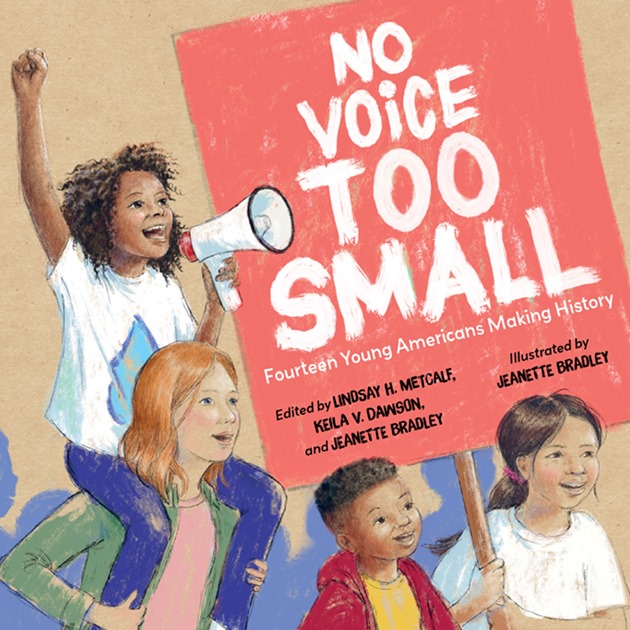
     My own experience with the powerful voices of very young people led me to the book that I learned from this year. No Voice Too Small: Fourteen Young Americans Making History edited by Lindsey H. Metcalf, Keila V. Dawson, and Jeanette Bradley and beautifully illustrated by Jeanette Bradley. The picture book combines very short biographies, illustrations, and poetry by 14 different poets to tell the stories of 14 young changemakers. The picture book is laid out in a way that educators from kindergarten to high school can utilize the stories of these young activists to engage other young activists. It’s just what the world needs now. 

See Book Trailer Here

https://www.youtube.com/watch?v=rNUDTayofso


My current students are especially drawn to the illustrations. I am especially drawn to the poetry that precedes the introduction of each new activist. My students engage with the stories especially  because they can relate to the children who are celebrated in the book. This year we have already begun recognizing power and the ability to speak out using this important piece of literature. This spring, this same team will launch their companion title, No World Too Big: Young People Fighting Global Climate Change. I am so moved by the first book, No Voice Too Small, that I am including them in a climate activism project that I am developing with my kindergarten class this year. 

     Building the conditions for climate activism to occur with young children, I am working with environmental organizations in Los Angeles to create field trips to natural habitats to build a foundation of environmental engagement. I am partnering with policy-makers to create policy engagement. I am anxiously anticipating the second book, No World Too Big and I have reached out to the authors of these books to create literary engagement. I am proud to know Keila and Jeanette through our Kidlit for Growing Minds group. I am hoping to create an event with a local, Los Angeles, independent bookstore, The Book Jewel, that brings together my current students and the creators when they launch their second book this coming spring. 


     I’m not sure what my young daughter had in mind when she questioned my methods, but I feel like have found my way to engage with the ongoing climate crisis. It is my hope that by bringing together organizations that can get children into nature, elected officials  who can demonstrate that young people can and should be able to access and influence policy making, and authors who can write about and inspire young people to tell their stories (which ultimately makes movements), I am doing my own part in my own little corner of the world. 

You can find out more about Kidlit For Growing Minds from our website, our BOOKTALK YouTube channel and our Twitter page. Find our books on our Bookshop Storefront.

Website: https://kidlitforgrowingminds.weebly.com/
YouTube: https://www.youtube.com/channel/UC0w51tG16_RpkA_CDNsgjlA
Bookshop: https://bookshop.org/shop/ForGrowingMinds
Twitter: @ForGrowingMinds

By Zeena M. Pliska

Friday, November 12, 2021

Two New Books to Celebrate: Spies in the American Revolution for Kids and the 10.10 Poetry Anthology

[Note: I wrote the following before learning of the death of my friend, April Pulley Sayre. If you didn't see my post about her Wednesday, I hope you'll take a look.] 

This week I'm happy to celebrate two new book releases. The first, Spies in the American Revolution for Kids by former TeachingAuthor Carla Killough McClafferty, released on 11/2/21. The second, 10.10 Poetry Anthology: Celebrating 10 in 10 Different Ways, edited by Bridget Magee, includes three poems I wrote! You can read one of those poems at the end of this post. 

I invited Carla to share a bit about her new book. Here's what she had to say:   

My newest book Spies in the American Revolution for Kids (Rockridge Press), covers another facet of history that is little known by most people. I enjoyed the research of seeking out primary source documents like letters and codes to pull this true story together. To research spies is tricky. Most spies didn’t write down on a document that they are spies for fear of being arrested, tried, and hung as a spy. But still there is a paper trail. And as a researcher, I am a determined bloodhound for accurate source material. I followed the trail. And it was fascinating.

I’ve written about George Washington in several different books, and he is part of this story also. Washington is famous for many things. I think his role as spymaster should be one of them. He understood how nearly impossible it would be for American patriots to win a war against England, the most powerful military nation in the world. He knew America would need to find ways to gain advantages whenever possible. And that meant espionage.

Soldiers as well as civilian men and women volunteered to be spies. They secretly gathered information while hoping they didn’t get caught and killed by the British. They devised all sorts of methods to deliver vital information about troop movements, numbers, weapons, ships, and food supplies. They used clever ways to communicate including all sorts of codes. They used amazing gadgets like invisible ink, dead drops, intercepting mail, and secret messages of all sorts. Without exception, every single spy risked their lives over and over again.


In this book, I cover the Culper Spy Ring, made famous in the television series, Turn: Washington's Spies. Benjamin Tallmadge recruited a trusted circle of people he knew from his home town of Setauket, on Long Island. The ring created a complex system of gathering and sharing information right under the noses of the British army who occupied their town. Their vital information was forwarded immediately to General Washington. Tallmadge created a secret code system that kept their identities safe. Even after the war was over, and for the rest of his life, Tallmadge never revealed the identities of his friends who worked as spies.  Below are pages from the code book created by Benjamin Tallmadge for use by the Culver spy ring.


The stories I write about in Spies in the American Revolution for Kids give us glimpses of incredible bravery. Men like Enoch Crosby who worked as a double agent. Over and over, he infiltrated enemy groups, learned their secrets, and got word out which resulted in their arrests. Lydia Darrah eavesdropped on plans discussed by British officers’ and smuggled that information to the patriots under the buttons of her son’s coat. Allan McLean, a dashing leader, seemed to have no fear when he disguised himself and went into the enemy camp. McLean somehow escaped capture again and again. Some spies went deep under cover, like James Armistead Lafayette, an enslaved man who worked for General Cornwallis before the battle of Yorktown, and fed information to the patriots. And John Champe who joined the British army so he would capture Benedict Arnold-and the unexpected twist of fate which caused his mission to fail.   

My hope for those who read this book is that they are entertained and gain a deeper understanding of what it took to create this great nation. Many different types of men and women worked as American spies. Without their contributions to the war effort, perhaps the Revolutionary War would have taken even longer than eight years. Or maybe America would not have won the war at all.  

Congratulations, Carla! Your new book sounds intriguing, especially for readers who enjoy nonfiction.

And today, I'm also happy to celebrate Bridget Magee's recent release, 10.10 Poetry Anthology: Celebrating 10 in 10 Different Ways, which includes three of my poems. Some of you may recall that I mentioned in my last post that I've had poems accepted in TWO new anthologies. I don't know yet when the second will be released--I'll share more when I do.

The poems in the 10.10 Poetry Anthology are divided into ten categories, all tied to the word TEN:

  1. TENtative
  2. TENderness
  3. TENacity
  4. TEN More Minutes
  5. TENsion
  6. I Wouldn't Touch That With a TEN-Foot Pole
  7. TEN Little Fingers / TEN Little Toes
  8. Take TEN
  9. TENth _____
  10. I TENd To

  My first poem in the collection is in the TENacity section. 

The form for this poem is a variation on the “Definito” form invented by Heidi Mordhorst. My other two poems in the 10.10 Poetry Anthology include an Etheree in the TEN More Minutes section and a free verse poem in the TENsion section. I'm honored to have my work included with that of so many fine poets from around the world.

If you're looking for more poetry, check out this week's Poetry Friday roundup hosted by Matt Forrest Esenwine at Radio, Rhythm & Rhyme

Happy writing!
Carmela

Friday, June 12, 2020

Turn Your Reading Passion Into Better Writing


Years ago, when I first decided I’d like to write books for children, I attended a program about Oklahoma history. One speaker mentioned Bass Reaves. Bass escaped from slavery in Texas, crossed the Red River arriving in Oklahoma Territory ready to begin a new life. He learned the lay of the land and survival techniques from Native Americans. Eventually, he became a United States Deputy Marshal under Hanging Judge Parker and always found the outlaws who dared to hide from him.

I fell in love with Bass. I quickly decided I was the perfect person to tell his amazing life. I even found an editor who was somewhat interested in my attempts to capture his story.

Then one day, the editor sent the email that broke my heart. She explained she would not be publishing my manuscript. I was devastated! My heart was broken. I don’t remember her exact words, but I read – there is a new Bass book and it’s so much better than your feeble attempts. I still feel the pain! I remember attending an American Library Association conference and there in the distance was BAD NEWS FOR OUTLAWAS – THE REMARKABLE LIFE OF BASS REEVES, DEPUTY U. S. MARSHAL, Written by  Vaunda Micheaux Nelson and Illustrated by R. Gregory Christie. Bass in all its glory. I quickly changed directions and walked down another aisle. It was such a painful moment in my writing life. I’m tearing up now as I think about it.


My husband thought my reaction was over the top. “Write something else,” was his remedy. The editor emailed, “Send me something else.” SOMETHING ELSE! I had nothing else. My writing life was over and it had just begun.
Well, it took time (years) but I recovered and I continued to write. Then one day I bought a copy of BAD NEWS FOR OUTLAWS. It’s fabulous! A page-turner! No wonder it received so many awards. It is a thousand times better than my feeble attempts.

Recently, I met Vaunda at a conference and told her my pitiful story. She hugged me and my world righted itself.
I also typed it and I could see, feel, and understand why I loved it and what made it successful. I began typing other books that moved my spirit.

I challenge you to type a favorite book or even a page or two of a longer work. What makes you cry, smile, or laugh out loud? Why was it hard or easy to put down? What made you decide it would have a place of honor on your bookshelf?

Think about your responses. You might discover a technique that will lead to stronger writing.

Posted by Gwendolyn Hooks

Saturday, March 7, 2020

Leaping Into A New Me

Years ago, I published a few magazine articles including one about Oklahoma prairie dogs infected with the plague. The PLAGUE! Those cute little animals had The PLAGUE?

Farmers and ranchers didn’t prairie dogs because of the holes they dug caused horses and cattle to break a leg if they inadvertently stepped in one. Fascinating information.

I was so happy to receive a manila envelope with my author copies. I flipped through the pages and found it with my name as the author—By Gwendolyn Hooks. My little girl was at home and we danced together. I was so happy! But wait. Something was missing. I turned the envelope upside down and gave it a few shakes. Nothing. I flipped through the magazine. Nothing, but a letter of congratulations from the editor.

Perhaps my payment would arrive separately. To double-check, I called the editor and asked about my payment. She was cordial and asked if I was a professional. “We only pay professionals.”
I didn’t feel very professional. I said, “No, I’m not a professional.” I ended the conversation determined to learn how to be a professional writer, keep writing, and always be prepared. I took a leap of faith that I could learn how to succeed in my new career.

There was an upside to my prairie dog adventure. It wasn’t enough to write from my heart, but I needed to learn the business end as well. I attended meetings and met other writers. Some were new like me and others were real professionals who shared their experiences, answered questions and offered encouragement.

I also thought seriously about why my article was placed in the children’s section. Maybe I needed to explore writing for young readers. My leap of faith landed me where I belong and I never regretted it.

Posted by Gwendolyn Hooks

Saturday, May 18, 2019

Update from across the years


I'm delighted to be back to help celebrate the 10th Blogiversary of Teaching Authors.

My writing life has changed a good deal since I last blogged. After several years of teaching research writing and English Composition, I realized that I felt drawn to writing nonfiction. I sent out queries (thank you, Laura Purdie Salas for your invaluable information and tools) and began doing a variety of work-for-hire projects. I've greatly enjoyed the work and have published more than 20 titles in the last few years. I've come to realize how my teaching has informed my writing and vice versa, especially as exemplified by these two titles:

http://www.12storylibrary.com/non-fiction/great-tips-on-writing/12-great-tips-on-writing-to-inform/

https://cavendishsq.com/title/Screenwriting

Some things have not changed.  I am busy juggling many jobs and kids' activities and, just like old times, forgot to upload my post yesterday.  Sorry for the lapse.

Wishing everyone a wonderful summer, a break from teaching, and lots of time for writing and living!  -- Jeanne Marie