Friday, May 19, 2017

Visiting the Homes and Haunts of Twain's Fictional Characters


Today, I wrap up our series on museums honoring American writers. Esther inspired the topic when she told us of this month's opening of the American Writers Museum here in Chicago. If you didn't read her Monday post describing it, I encourage you to do so, and to watch the video clip it contains. The short video sure inspired me!

I can hardly wait to visit the new American Writers Museum. Meanwhile, I'm enjoying exploring their website, especially the list of affiliate author homes/museums. I was surprised to learn that there are three such museums here in Illinois. The only author home I've visited is in Hannibal, Missouri--the Mark Twain Boyhood Home & Museum. We explored it during a family vacation many years ago.

Unfortunately, the photos of that trip were taken back in the era before digital cameras, and they are stashed away in a shoebox. I keep saying "someday" I'll organize all those old photos and either scan them or put them into photo albums. But even without pictures to help jog my memory, three things still stand out in my mind about our visit to Twain's home.


1) Discussing Twain's novels with my husband before, during, and after the visit.

My husband is not a fan of fiction. A software engineer by profession, he has a very analytical mind and prefers to read nonfiction. So I was surprised to learn while on our trip that one of his favorite books growing up was Twain's The Adventures of Tom Sawyer. It was one of the few books my husband was assigned to read in school that he actually enjoyed. I, on the other hand, had read both The Adventures of Tom Sawyer and The Adventures of Huckleberry Finn on my own for fun. The only Twain novel I'd been required to read was A Connecticut Yankee in King Arthur's Court, which I read in high school.

2) Walking in the footsteps of fictional characters.

I still recall seeing the sign that read "Becky Thatcher's Home" and laughing out loud. Becky Thatcher is a character in a novel. How could her home exist in the real world? The home was actually that of Mark Twain's childhood friend and sweetheart, Laura Hawkins, who is said to have inspired the character of Becky. You can also find Huck Finn's house in Hannibal, and explore the nearby cave where "Tom and Becky got lost." I loved how the tour guides spoke of all these fictional characters as though they were real people. To me, it exemplified the power of fiction to inspire the imagination.  

3) Buying a souvenir t-shirt for my husband.    

I found it marvelous to be able to discuss novels my husband and I had both read and loved--a rare experience for us--and to visit Twain's home together. My husband must have enjoyed it, too, because he wanted a souvenir t-shirt, which he still wears:

He agreed to pose, as long as I didn't include his face in the picture.
The only other writer's museum I think my husband would enjoy visiting with me is the Truman Capote and Harper Lee Old Courthouse Museum, since we're both great fans of Lee's To Kill a Mockingbird. But since I don't expect to be traveling to Alabama anytime soon, I think I'll plan a visit to the American Writers Museum first.

I can't write about Mark Twain without sharing one of my favorite Twain quotes:
The difference between the almost right word & the right word is really a large matter--it's the difference between the lightning bug and the lightning.
For more writing quotes from Twain, see this site. And to read about Mark Twain's life and publications, see this detailed article on the Poetry Foundation Website.

And don't forget that today is Poetry Friday. This week's roundup is hosted by Kiesha Shepard at Whispers from the Ridge.

Remember to Write with JOY!
Carmela

Wednesday, May 17, 2017

Wednesday Writing Workout(S): THINKING WITH INK!


Welcome to the third Wednesday Writing Workout created by Sheboygan, Wisconsin author, educational consultant and veteran elementary and middle school classroom teacher Michael Leannah. It’s one of four from his recently-released book WE THINK WITH INK (Brightside Publications, 2016) that makes our TeachingAuthors month of May even merrier.

As I shared in my introduction to the first WWW that offered Get Acquainted exercises and the second WWW that shared Daily Practices, Michael writes fiction and nonfiction for children and adults. Tilbury House releases his picture book MOST PEOPLE in August.  Two other picture books are soon to follow: GOODNIGHT WHISPERS (Familius) and FARMER HUCKINSHUCK’S WILD RIDE (Splashing Cow Book)  His stories have appeared in U.S. and Australian magazines. He authored the award-winning SOMETHING FOR EVERYONE: MEMORIES OF LAUERMAN BROTHERS DEPARTMENT STORE and is the editor and contributing author of WELL! REFLECTIONS ON THE LIFE AND CAREER OF JACK BENNY.

WE THINK WITH INK is a trove of lessons, projects and activities designed to increase reading and writing skills in the classroom…and beyond.  It’s an ideas book for elementary and middle school teachers seeking to merge writing instruction into science, social studies and math classes.  It’s a guide for teachers looking to help students increase self-confidence and self-esteem.  It’s also a book for students working independently on creative writing skills as well as a manual for learners young and old – i.e. me and you, our TeachingAuthors readers - who aspire to be good – even published – writers.

“The WE THINK WITH INK approach relies heavily on the sharing and
critiquing of stories,” Michael shared.  “Our goal is publication, which means that people other than those in the classroom or group will read what we write.  Booklets are put together and made available on the shelves of the school library.  Story collections are sent home for families to read.  Our writing is distributed to local coffee shops and doctors’ waiting rooms.  Our booklets/anthologies are given as gifts to friends and family.  And yes, we write with the goal of someday sending our very best work to magazine and book publishers.”

Check out today’s WWW and try your hand, then be sure to return next Wednesday to do the same.

Thank you, Michael, for sharing your smarts, your passion for writing and WE THINK WITH INK writing workouts with our TeachingAuthors readers!  Oh, and for making yourself available at contactmichael@gmail.com, should our readers wish to share their appreciation.

Enjoy thinking with ink!

Esther Hershenhorn

. . . . . . . . . . . . . . . . . . . . . . . .


LETTERS, WORDS AND SENTENCES

In We Think With Ink, the teacher’s most important task is to engender in her students a love for words and writing. From Day One, the teacher demonstrates and encourages playfulness with words and sentences. That means occasionally using outrageous puns and repeating such refrains as “How much wood would a woodchuck chuck if a woodchuck could chuck wood?” The teacher’s enthusiasm for word play is essential.

To motivate our students, to make them eager to be creative with their writing, we point out the interesting aspects of our language at every opportunity. We demonstrate how the building blocks — the letters, words, and sentences — go together to create all the stories and poems we love so much to read…and to write.

Take every opportunity to generate interest by pointing out the quirks of our language:

  • Why does the letter “c” even exist? If we want its hard sound (“car,” “corn,” “cut”) we could use a “k.” 
  • If we want its soft sound (“celery,” “city,” “century”) we could use an “s.” Why do we need “c”?
  • Why don’t “singer,” “finger,” and “ginger” rhyme?
  • Why must some words — “mint,” for instance — be shared? A mint is a building where coins are made. A mint is also a candy flavored with wintergreen. One of them must have come first, so when the second one came along, somebody should have said, “Wait a minute. The word ‘mint’ is already being used.”
  • Some words — like “bamboozle,” “sassafras,” and “ramshackle” — are just plain fun to say. 

The way some sentences are put together makes them confusing. “The batter hit the ball off the pitcher’s leg and it rolled to the shortstop.” “The fish are biting off the coast of Maine.” “Lisa’s grandmother died when she was only six years old.”
Single words are easy to understand, but you’d better watch out when you put them into sentences. Said quickly, “some ice” and “some mice” sound exactly alike, so if you say to someone, “Please bring me some ice,” you might not like what happens next.

Some of the letter, word, and sentence games in We Think With Ink can be played five minutes here, ten minutes there, during the “cracks” in the day while the class is waiting for stragglers to come in in the morning, or while waiting for the lunch bell to ring. With the time that we have, we can model the fun of using letters, words, sentences.

Fill in the Blanks

The teacher (or leader) makes a deck of cards with a key word on each. Only she will see the words on the cards. She begins by saying, “I have a four-letter word that starts with ‘s’ and ends with ‘p.’ What is the word?”
Each student writes a guess. The teacher reveals her word. “The answer I have is ‘soap.’ What is yours?” Any student who has written “soap” gets three points. Players who have written a different word (snap, stop, soup, etc.) get one point. If a student cannot think of a word with the given letters, he gets no points and will wait for the next example.
Four-, five-, or six-letter words work best for this game. (Try “melt,” “past,” “again,” “first,” “soccer,” and “packed.”)


Change a Letter and Mix ’em Up

Start with a five-letter word (example: SPEAR). Player #1 changes one letter and now uses the letters to make a new word (SUPER). Player #2 now changes one of the letters in “SUPER” to make a new word (PAUSE). The players “win” if they can each make five different words in this manner. (To make this a competitive game, play continues until one player cannot produce a new word.)
This game could be played with longer or shorter words. It could be played with groups of three, alternating in a triangle pattern. Many individual games of “Change a Letter” can be played in the classroom at once.

Hide and Seek

On a piece of paper, each player writes a passage from a book, “hiding” parts by leaving blanks where key words belong. Partners are challenged to “seek” words to fill in the blanks so that the story or poem makes sense. In the end, the real stories and poems are revealed and the players compare the guesses to the words of the real authors.

Monday, May 15, 2017

The Must-Visit American Writers Museum That Opens Tomorrow in Chicago!


America’s – and Chicago’s - newest museum, the American Writers Museum - opens tomorrow, Tuesday, May 16 at 180 N. Michigan Avenue, down the street from Millenium Park and The Art Institute of Chicago!

Lucky me to have attended the Saturday, May 6 Special Exhibits Reception to see how successfully the AWM’s Founder Malcolm E. O’Hagan and the Founding Board Members realized their mission crafted 7 years ago: “to engage the public in celebrating American writers and exploring their influence on our history, our identity, our culture, and our daily lives.”

Honestly, though?  IMHO this one-of-a-kind museum does so much more than engage and celebrate.  It inspires and educates while honoring what all writers do. Writers across all genres, formats and publishing designs, from Cotton Mather to Dr. Seuss.  Famous writers, of course, like those we’ve read and studied.  Writers, best of all, like you and me.

Here’s an overview of the museum’s 7-exhibition design plus a click-away video-tour:


And here are some important AWM numbers, besides 1-of-a-kind, as noted in a recent article by Chicago writer Gabrielle Zepeda:

62 – the number of affiliate institutions with whom the AWM works, such as The Will Rogers State Park noted in April’s post, the Henry Wadsworth Longfellow House noted in Carla’s and William Faulkner’s Rowan Oak noted in Mary Ann’s;

100 – the number of curated works;

11,000 – the Museum’s square footage;

120,000 – the number of expected visitors;

$10,000,000 – the amount of money the museum hopes to raise by tomorrow’s opening; to date $9.2 million has been privately raised.

I was quite taken with the museum’s innovative interactive state-of-the-art exhibits, including:


the 80-foot long American Voices Gallery which presents our country’s literary history chronologically;
the ever-changing Word Waterfall;


and the Dialogue Box in the Anatomy of a Masterpiece Exhibit.

Temporary exhibits include The Writers Room's The Kerouac Scroll for ON THE ROAD and the immersive installation PALM which celebrates poet W.S. Merwin and his conservancy of palms in Hawaii.

I’m saving my favorite gallery for last, though - the Children’s
Literature Gallery!  Designed with help from children’s literature historian, critic and author Leonard S. Marcus, the space features six exhibits highlighting famous American children’s book authors and offers a place for readers and story-time listeners to interact. Mr. Marcus also made sure children’s literature is represented throughout the museum.

My favorite event of the night? Meeting Caldecott medalist Paul Zelinsky
who’d just finished painting his commissioned mural for the Children’s Literature Gallery.

The tree’s book-reading inhabitants pay homage to Paul’s Wilmette, Illinois hometown and its bounty of squirrels.  Together the book titles, purposefully chosen by Leonard Marcus, represent American Children’s Literature – the formats, the genres and best of all, the diversity of the creators.  I was happy to see Wanda Gag's MILLIONS OF CATS, Robert McCloskey’s MAKE WAY FOR DUCKLINGS, Margaret Weiss Brown’s GOOD NIGHT MOON and Crockett Johnson’s HAROLD AND THE PURPLE CRAYON as well as a Raoul Dahl title, a representative Golden Book and Madeleine L’Engle’s A WRINKLE IN TIME, just to name a few. If only I’d had a ladder to climb to the very top of the 153’ x 151’ tribute. Paul has cleverly and humorously connected each squirrel’s behavior to the book he’s reading. I did learn of one title previously unknown to me – T. Yashima’s CROW BOY, published in 1955. Closer examination of the mural is certain to reveal more titles.
[Note: please forgive my not-so-terrific picture-taking!]

Click HERE to read about the American Writers Museum's exhibits, the hours, volunteer opportunities and membership.

Living a walkable 8 blocks away, I’ll be out-and-about at the AWM often and early.  Here’s hoping you, too, can find your way to America’s and Chicago’s newest museum, starting tomorrow.

Happy writer-celebrating!

Esther Hershenhorn

P.S.
I’m honored to blog for the AWM.
Here are links to my first and second posts that celebrate two Chicago children’s book creators whose famous titles appear in the hands of Paul Zelinsky’s squirrels!


Friday, May 12, 2017

Will Rogers: Actor, Trick Roper WRITER!

.
Howdy, Campers and Happy Poetry Friday! (My poem and the link to PF is below)

This time around, we TeachingAuthors are rhapsodizing about our favorite American writer's museum or home. Bobbi began with a post on Emily Dickinson's Museum, Mary Ann wrote about William Faulkner's Rowan Oak, And Carla, in her post titled "Listen My Children," wrote about Henry Wadsworth Longfellow's home.

Today I'm going to introduce you to a beloved place in my Southern California childhood, Will Rogers State Park and ranch house, just a 15-minute drive from UCLA.

But first, a bit about Will, gleaned from the Will Rogers Memorial Museum and Birthplace Ranch in Claremore,  Oklahoma:


My ancestors didn’t come over on the Mayflower, but they met the boat.” (Will was "born to a Cherokee Nation family.")

He wanted more than anything in the world to become a trick roper, and did, touring the US and Europe in Wild West and vaudeville shows. If his rope tricks failed on stage, he made jokes, and those "jokes became better than ropes." He signed with Ziegfeld's Follies and become a Broadway star.

But Will was also a writer. He was, to put it mildly, prolific. "He put approximately two million words in print—six books, more than 3,600 [daily!] newspaper columns..." and wrote frequently for The Saturday Evening Post. His "syndicated weekly and daily columns were prized by 600 newspapers ...including at least one in every major city...and reached a potential audience of 40 million readers." In addition, he wrote"scores of magazine articles—in a span of only sixteen years, stretching from the publication of his first newspaper article in 1916 until his last one in August 1935."

"I don't make jokes. I just watch the government
and report the facts."

Are you out of breath yet? There's more:

He appeared regularly on radio through the 1920's and 30's, and went on to produce, direct, write and star in the 20-minute silent picture, "Ropin' Fool," in which he pioneered slow-motion cinema to better demonstrate his roping tricks. (Watch him do 3 minutes of rope tricks from that film.)

He went on to star in 50 silent films, and when "talkies" replaced them, appeared in 21 pictures in five years and becoming Hollwood's highest paid actor. (In fact, here's his IMDB)

He was a force of nature. My mom and dad loved that he spoke truth to power--so naturally, I did, too. What I knew of Will reminded me of Molly Ivins, who I wrote about right after the November election. But as I've read more, I was surprised to find that I disagree with some of his political views. Still, it seems he kept politicians on their toes--an important job of a columnist/political satirist.

For example (from Wikipedia):

Rogers thought all campaigning was bunk. To prove the point he mounted a mock campaign in 1928 for the presidency. His only campaign promise was "If elected, I will resign." Every week Rogers caricatured the farcical humors of grave campaign politics.  During this campaign he answered questions: What does the farmer need? Obvious: "He needs a punch in the jaw if he believes that either of the parties cares a damn about him after the election."  On election day he declared victory and resigned.

"Ten men in our country could buy the whole world and ten million can't buy enough to eat."

But my memories are of Will Rogers State Park, and more specifically, Will's 31-room Western Ranch House not far from the Pacific Ocean, with its long porch, and an expansive lawn (i.e. park) which stretched from the family's stable to their polo field.


Oh, that lawn. Oh, that polo field. And oh, the trails leading from the ranch to forever, which my hiking group returns to often.

And what's the first thing I always wanted to see as a five-year-old, as a ten-year-old, and today, when touring his home?  The roping calf. In his living room. His living room! 
Cool.

Here's a poem I wrote in 1995 about one of my all-time favorite birthday parties under the trees which surround the lawn of the Will's ranch house:

PARTY AT THE PARK
by April Halprin Wayland

Surrounded by shedding eucalyptus trees,
been here forever, they’ll be here forever, too.

All of my cousins, aunts and uncles
spreading table cloths, taking out potato salad,

handing me hugs and presents and long kisses,
talking to everyone as they talk to me,

big arms and bodies and laughing, laughing
Cousin Bruce, Cousin Robbie, my sister, and Cousin Franklin

running after pigeons, running after frisbees, running into me
more presents and pass the plates and did you have enough?

taste Aunt Sylvia’s kugel, yes, says Uncle Raphael, taste
Fran’s chopped liver, is it time for birthday cake? asks Uncle Moish

and we all gather ‘round for two cakes for Dad and me--mine is pink
Dad says I can have a corner flower and

Mom and Aunt Cissie are putting candles in the plastic flower
holders and sticking them in the cake and then Mom lights them with a little

match, lights the last one holding the very teeny part of the match, burning close to her fingers, but she’s fast and they burst into song and I feel full and

like bursting
full of cousins and aunts and uncles and potato salad

surrounded by shedding eucalyptus trees,
been here forever, they’ll be here forever, too.

poem © 2017 April Halprin Wayland. All rights reserved. 


Here's a 2-minute video about Will Rogers:

"The man with the best job in the country is the Vice President. All he has to do is get up every morning and say, 'How's the President?'"

Thank you for reading this post. As some of you may remember, I am terribly afraid of making factual errors when writing non-fiction. It scares the dickens out of me. Do you ever feel this way?

And congratulations to Gail P, who won an autographed copy of Lisa Cron's STORY GENIUS (which Esther reviewed here) in our latest book giveaway celebrating TeachingAuthors' 8th blogiversary!

Thank you, Tara, for hosting Poetry Friday at A Teaching Life!

posted by April Halprin Wayland with the help of Will, who said: "Live in such a way that you would not be ashamed to sell your parrot to the town gossip."

Wednesday, May 10, 2017

Wednesday Writing Workout(S): THINKING WITH INK!


Welcome to the second Wednesday Writing Workout created by
Sheboygan, Wisconsin author, educational consultant and veteran elementary and middle school classroom teacher Michael Leannah. It’s one of four from his recently-released book WE THINK WITH INK (Brightside Publications, 2016) that make our TeachingAuthors month of May even merrier.

As I shared in my introduction to the first WWW posted May 3, Michael writes fiction and nonfiction for children and adults. Tilbury House releases his picture book MOST PEOPLE in August.  Two other picture books are soon to follow: GOODNIGHT WHISPERS (Familius) and FARMER HUCKINSHUCK’S WILD RIDE (Splashing Cow Books.)  His stories have appeared in U.S. and Australian magazines.
He authored the award-winning SOMETHING FOR EVERYONE: MEMORIES OF LAUERMAN BROTHERS DEPARTMENT STORE and is the editor and contributing author of WELL! REFLECTIONS ON THE LIFE AND CAREER OF JACK BENNY.

WE THINK WITH INK is a trove of lessons, projects and activities designed to increase reading and writing skills in the classroom…and beyond.  It’s an ideas book for elementary and middle school teachers seeking to merge writing instruction into science, social studies and math classes.  It’s a guide for teachers looking to help students increase self-confidence and self-esteem.  It’s also a book for students working independently on creative writing skills as well as a manual for learners young and old – i.e. me and you, our TeachingAuthors readers - who aspire to be good – even published – writers.

“The WE THINK WITH INK approach relies heavily on the sharing and
critiquing of stories,” Michael shared.  “Our goal is publication, which means that people other than those in the classroom or group will read what we write.  Booklets are put together and made available on the shelves of the school library.  Story collections are sent home for families to read.  Our writing is distributed to local coffee shops and doctors’ waiting rooms.  Our booklets/anthologies are given as gifts to friends and family.  And yes, we write with the goal of someday sending our very best work to magazine and book publishers.”

Check out today’s WWW and try your hand, then be sure to return the next two Wednesdays in May to do the same.

Thank you, Michael, for sharing your smarts, your passion for writing and WE THINK WITH INK writing workouts with our TeachingAuthors readers!  Oh, and for making yourself available at contactmichael@gmail.com, should our readers wish to share their appreciation.

Enjoy thinking with ink!

Esther Hershenhorn

. . . . . . . . . . . . . . . . . . . . . . . .


DAILY PRACTICES

It is good to have at least a bit of structure in the classroom, as well as in the workings of a writers’ critique group. The Daily Practices outlined below will help to “get the juices flowing” when beginning a new assignment and to keep the focus where it belongs throughout the writing session.

For much of the work described below, I encourage the use of a chalkboard or white board. It is good for all involved to hear and see the words and sentences being presented.


The Daily Question
As students enter the room, they look to see the Daily Question on the board. They take their seats and write their answers, with sharing and discussion to follow. This whole activity takes as little as five or ten minutes, but it gets the class thinking, reasoning, writing, articulating, and listening. A lot of bang for the buck.

Here are some samples of Daily Questions:

What are you looking forward to doing later today?
What is making you nervous about next week?
What happened the last time you felt proud of someone in your family?
What would your grandmother say if she could see your bedroom right now?
What makes your best friend so good?
What farm animal is like a member of your family?
Name three good things about Mondays.
Tell about something unpleasant that happened last week.
Would you rather be a wolf, a bear, or a skunk? Why?
Write the dialog between someone you know who is very old and someone you know who is very young.
Name one thing you would change about a relative or friend so that life would be better for him/her.

The answers to most of these questions will vary from day to day, so don’t be afraid to reuse the questions from time to time. Add questions of your own to the list, but do avoid questions that can be answered with a simple “Yes” or “No.” Set the expectation for students to include explanations with their answers.

It’s good to remember that some of the best writing assignments begin with discussion, so consider using the Daily Question as a launching pad for a major writing assignment. I often used the Daily Question to address difficult situations going on in the lives of my students, such as bullying or family troubles. Start with a pertinent question, allow for a discussion, then get the class writing.


Words of Wisdom (W.O.W.)

Compile a list of meaningful quotations from the famous (or not-so-famous) to be used in place of the Daily Question occasionally. (I used W.O.W. every Friday.)

Students write the quotation and a reaction to it. Do they understand what the writer is trying to say? Do they agree with the message behind the quotation? Can they think of a time in their experience when the message applied to them?

Using W.O.W. as a writing activity has many benefits. Wisdom is imparted, of course. Attitudes might start to change, and students become acquainted with some of the great thinkers in history.

Sooner or later, they begin to recognize “words of wisdom” in the books they are reading and in the movies they see. The contributions eventually start to trickle in. Someone appears with words on a scrap of paper. “My favorite singer said this after her concert the other day. Do you want to use it as a W.O.W.?”

It’s just a matter of time until students start producing original pieces of wisdom written well enough to be presented to the class when it’s time for W.O.W. That is a time of great celebration.

Here are a few W.O.W.s to get you started:

The man is richest whose pleasures are the cheapest.
— Henry David Thoreau

It is only when you see people looking ridiculous that
you realize just how much you love them.
– Agatha Christie

Don’t cry because it’s over, smile because it happened.
– Dr. Seuss

My mother had a great deal of trouble with me,
but I think she enjoyed it.
— Mark Twain

Children need love, especially when they don’t deserve it.
— Harold Hulbert

You have everything you need by the time you're 12 years
old to do interesting writing for most of the rest of your life.
– Bruce Springsteen

Often, a W.O.W. can be used as a lead-in to a writing assignment. (“Write about a time when your mother or father may have been angry
with you, but later seemed to see things differently and appreciated what you did.”)

Monday, May 8, 2017

Listen My Children...


I’ve visited the home of only one author, poet Henry Wadsworth Longfellow, but it wasn’t on purpose.

I didn’t go there on a pilgrimage for Longfellow.  I went there to do research on George and Martha Washington.  The National Park Service operates the Longfellow House Washington’s Headquarters, a magnificent house in Cambridge, MA that has been home to both families.

Just down the block from Harvard University, General George Washington used the house as his headquarters during the siege of Boston in the early days of the American Revolution.  He arrived there not long after the “midnight ride of Paul Revere” and skirmishes in Lexington and Concord. 

Many years later, Longfellow, moved into the historic house that had once been Washington’s war headquarters and home.  About 85 years after the first shots echoed in Massachusetts that began the Revolution, Longfellow wrote the poem “Paul Revere’s Ride” with the familiar opening line, “Listen my children and you shall hear of the midnight ride of Paul Revere” and the equally famous line later “one if by land, two if by sea.”

The beautiful historic Longfellow House Washington's Headquarters in Cambridge, MA. 

These tiles surround the fireplace in the master bedroom of the house.  George and Martha Washington would have warmed themselves here.   
I can imagine General Washington climbing up these stairs after a long day of war plans.

Longfellow singlehandedly made Paul Revere famous to every school child in America.  But there are many historical inaccuracies in Longfellow’s poem.  Probably the biggest one is that the poem gives Revere alone all the credit for the warning ride.  But in fact, he was one of three riders that night.  Longfellow ignores the equally historic rides of William Dawes and Samuel Prescott.  Revere did not make it all the way to Concord because the British stopped him for interrogation.  Prescott made it all the way to Concord-but didn’t make the cut in Longfellow’s poem.

This poem is a good example of the power of the written word.  Longfellow was less concerned with historic accuracy than he was with creating an American hero on the eve of the Civil War.  The problem is that the general public believes Longfellow’s version is an accurate retelling of history.  It isn’t. 


Carla Killough McClafferty

Friday, May 5, 2017

William Faulkner's Rowan Oak--

    I lived over half my life in Mississippi. When I tell people where I'm from "originally," (I was born in Washington, D.C.), I get one of two reactions. One--"You don't sound like you're from Mississippi."(An Two--"You lived in Mississippi? WHY?"

It's complicated.

One of the most wonderful features of my adopted home state, is it's fertile ground for the artist. Even better, Mississippi honors and reveres it's artists and writers. Pulitzer winner Eudora Welty lived in a couple of blocks from my elementary school in Jackson. It wasn't unusual to see her in the supermarket or ensconced in a oversized leather chair at my favorite bookstore, a tower of "to-be-browsed" books at her feet. All the customers knew her, and let "our Miss Eudora" read in peace. Richard Wright, National Award winner Ellen Gilchrist and Newbery winner Mildred D Taylor are all Mississippi natives. Oh and don't forget Barry Hannah, Willie Morris and of course, John Grisham (who wasn't born there and doesn't live there now, but still claims the place as a home.)


OK, having dropped enough names, let's get to the subject of the post...a visit to an author's home. You might have noticed, William Faulkner was not on my list. IMHO, is The Man of American literature. Faulkner must surely occupy an honored corner of Heaven, where he is sipping whiskey with the likes of Flannery O'Connor. Pat Conroy and Carson McCullers, most of whom were also "sippers."

I first met Mr. Faulkner in a high school American novel course, when we were assigned The Sound and the Fury. Talk about a whack on the side of the head. I had never read a multiple POV non-linear novel, the narrators' voice each so distinct, you didn't need to check the chapter headings to know who was speaking. I had never had an author all but say, "Hey, I wrote this. You figure out who these people are and what's going on." I loved his utter disregard for sentence construction (the master of the run-on sentence) and punctuation. Although when I tried it, my teacher said, "When you win the Nobel Prize for Literature, you can leave out all the commas you want."

That particular lit teacher had attended Ole Miss (the University of Mississippi) while Faulkner still lived in Oxford. She told us stories of him pacing the town, mumbling to himself, or talking to invisible people. ("Probably drunk," she sniffed. Obviously he was talking to his characters. Duh!) He was not a popular figure in Oxford since he based his characters on people everyone knew and recognized. (He's still not too popular with some in Mississippi for that reason.)

I knew that his home, Rowan Oak still existed somewhere in Oxford, but back in the day (1977) interstates were all but non-existent in Mississippi and none of them ran near Oxford. 162 miles of rotten two-lane roads running through jungles of kudzu was not an expedition to be taken lightly. However, when college friends showed up to visit, I gathered my courage (along with the two males who knew how to change a tire) and headed north.

Once in Oxford, we couldn't find Rowan Oak. I knew that any house in Mississippi with a name would be too big to miss. There were no signs, "Faulkner's home this way", nothing named "Faulkner Lane." We asked students, we asked gas station attendants, we asked storekeepers.  It is no credit to the University that not only did the students not know where or what Rowan Oak was, some of them didn't know who Faulkner was either. Everyone else gave us blank stares (remember, not a popular guy, Faulkner.)

After bumbling around the town square multiple times and meandering through likely-looking neighborhoods, we found it. Although it was a scorching August day, the house seemed to rise out of a mist, at the end of a lane of cedars. A long lane. Mysterious. Only later did I learn that it is alleged to be haunted.

At a distance, it looked like any other antebellum home but as we came closer I could see that it was not as elaborate as the mansions of Natchez. Low brick porch in place of a sweeping veranda. Plain old square columns.  The once-white paint peeled in some spots and was mossy in others.

Once inside, the caretaker took our money, handed us a brochure and said "Take your time folks" and disappeared. I'd never been in a historical site where there wasn't a guide talking a mile a minute about this or that doodad, pausing only to say "Don't touch anything" and "Remember to visit out gift shop." (There wasn't one.)

The brochure informed us that 1) the house was built in 1844 2) on 49 acres of mostly timberland 3) "rowan oak" is a tree from Celtic mythology  4)Faulkner bought it during the Great Depression, living there until after he won the Nobel, where upon he moved to Charlottesville, Virginia.  The end.

My first impression was of being somewhere timeless, like a forest floor. I don't know if the walls were pale green or not, but in my mind they were. Timeless, like Faulkner's stories.

As I went from room to room, I was surprised by the sparseness of the furnishings. Every other house of this vintage I'd seen was wall to wall with fainting couches, grand pianos and dining rooms with Old Paris porcelain service for twenty. These rooms weren't empty, but they felt that way. Totally uncluttered (again, like Faulkner's prose.) I had heard that Mrs. Faulkner was something of a shopaholic. If she was, somebody with a Spartan sense of decor had come after her and re-furnished it.

I've never been anywhere so large, so uncluttered, yet so full of life. Dilsey, Benjy, Caddy, Luster and Quentin of The Sound and the Fury seemed to be just around the next corner, watching us, maybe wondering what we found so fascinating.

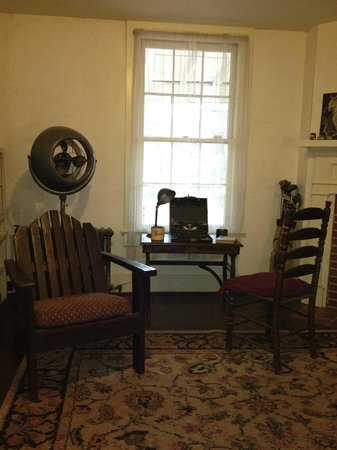
Because Faulkner bought in the 1930's, it looked a lot like my grandmother's house. Straight back, no-nonsense chairs. The world tiniest desk, just large enough for his portable Underwood.  A bag of golf clubs propped in a corner.A tall pedestal floor fan. Moth eaten rugs here and there. Some seriously uncomfortable looking Adirondack chairs (which I would've put on the porch). Yet even though I recognized the chairs and tables and couches as being of my grandparents' era, I didn't feel as if I were in a Great Depression time capsule.

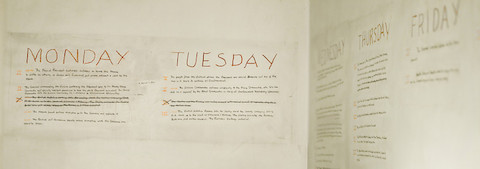
I was in the world of Faulkner's mind--utilitarian, but taking unexpected turns (the Adirondack chairs, the golf clubs) But what drew me most out of this tranquil room, and into the true mind of Faulkner, was the penciled outline for his Pulitzer/National Book Award WWI novel (and Faulkner's personal favorite) A Fable. Penciled outline on his wall. He could glance up and see where he was in his time line. Oh, for a house where you could outline your stories on the wall!

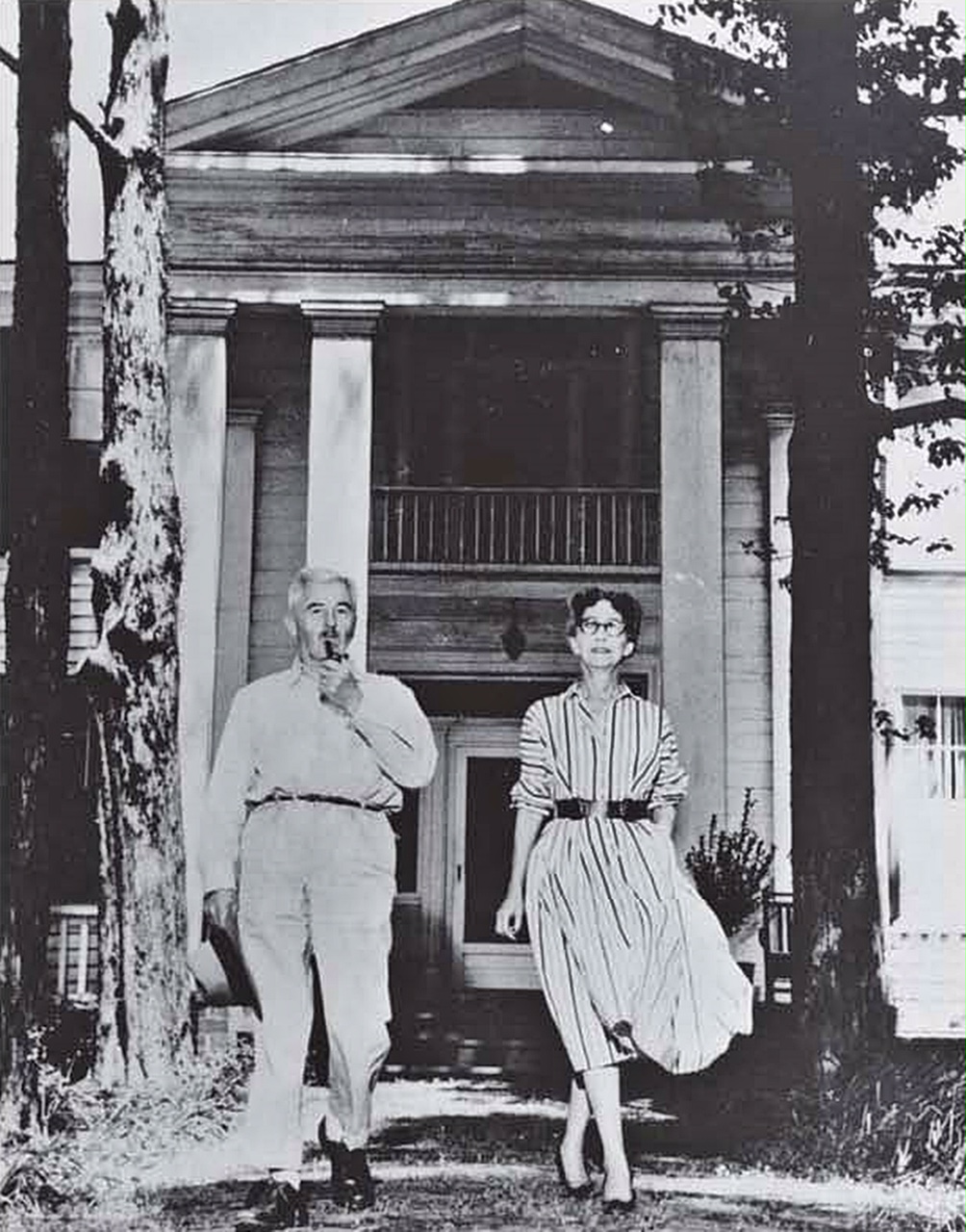
This picture of William and Estelle Faulkner was for A Fable's publication. Notice the somewhat scruffy exterior of  the house.  That's pretty much how it looked when I was there in 1977. In the ensuing years, all of those grand pianos and fancy furnishings (that would befit a Nobel Laureate) have been added in the restoration.  Faulkner himself never lived at Rowan Oak full time from the late 1950's until his death in 1962, splitting his time between Oxford, and the University of Virginia where he was the Writer-in-Residence and Lecturer in American Literature.


Having seen the pictures of the finely restored Rowan Oak, I will never go back. I prefer my memory of a mystically green place on a hot August morning, curiously empty, yet bursting with the world of Faulkner's Yoknapatawpha County.

Don't forget, today is your last chance to enter our Blogiversary Book Giveaway, Lisa Cron's, STORY GENIUS.  For details, link back to Esther's post for details.

Posted by Mary Ann Rodman
P.S. Dear devoted TA readers;  I am taking a summer sabbatical so this will be my last post until fall. Transitioning my 94-year-old dad (who lives 500 miles away) and Young Authors' Camps will pretty well usurp my writing time.  But I'll be back.  See y'all in the fall, as we say in the South.

Wednesday, May 3, 2017

Wednesday Writing Workout(S): THINKING WITH INK!


Yes, indeedy.  That’s Wednesday Writing WorkoutS, plural.

And that’s because Sheboygan, Wisconsin author, educational consultant and veteran elementary and middle school classroom teacher Michael Leannah has made our month of May even merrier by generously contributing 4 Wednesday Writing Workouts from his recently-released book WE THINK WITH INK (Brightside Publications, 2016).

Michael writes fiction and nonfiction for children and adults.  Tilbury House releases his picture book MOST PEOPLE in August.  Two other picture books are soon to follow: GOODNIGHT WHISPERS (Familius) and FARMER HUCKINSHUCK’S WILD RIDE (Splashing Cow Books.)  His stories have appeared in U.S. and Australian magazines.

He authored the award-winning SOMETHING FOR EVERYONE: MEMORIES OF LAUERMAN BROTHERS DEPARTMENT STORE and is the editor and contributing author of WELL! REFLECTIONS ON THE LIFE AND CAREER OF JACK BENNY.


WE THINK WITH INK is a trove of lessons, projects and activities designed to increase reading and writing skills in the classroom…and beyond.  It’s an ideas book for elementary and middle school teachers seeking to merge writing instruction into science, social studies and math classes.  It’s a guide for teachers looking to help students increase self-confidence and self-esteem.  It’s also a book for students working independently on creative writing skills as well as a manual for learners young and old – i.e. me and you, our TeachingAuthors readers - who aspire to be good – even published – writers. 

“The WE THINK WITH INK approach relies heavily on the sharing and critiquing of stories,” Michael shared.  “Our goal is publication, which means that people other than those in the classroom or group will read what we write.  Booklets are put together and made available on the shelves of the school library.  Story collections are sent home for families to read.  Our writing is distributed to local coffee shops and doctors’ waiting rooms.  Our booklets/anthologies are given as gifts to friends and family.  And yes, we write with the goal of someday sending our very best work to magazine and book publishers.”

Check out today’s WWW and try your hand, then be sure to return the next three Wednesdays in May to do the same.

Thank you, Michael, for sharing your smarts, your passion for writing and WE THINK WITH INK writing workouts with our TeachingAuthors readers!  Oh, and for making yourself available at contactmichael@gmail.com, should our readers wish to share their appreciation.

Enjoy thinking with ink!

Esther Hershenhorn

P.S.
Please accept my SINCERE apologies for my laptop's
misbehavior - as evidenced by the unevenly-back-grounded
text below!  My Lenova Yoga and Blogger are not playing well
together.  We're workin' on it!
. . . . . . . . . . . . . . . . . . . .

     In the process of writing our stories and poems, we learn from each other. We share our stories, compare notes, ask for honest opinions, help each other to improve our skills.

Any writers who work together, be it in the classroom, in a critique group, or just two friends who regularly get together to compare stories and give feedback, must develop a sense of trust. They must come to know each other quite well. To jumpstart the entire process, it is good to begin with a “Get to Know You” activity or two. In the school room, the following activities may be used during the first week or two in September. Because we are complex individuals and our feelings change over time, it is good to work in a “Get to Know You” activity once every couple of months throughout the year.

                                                            All About You

     Teachers may give this as a piece of homework on Day One and ask for it to be returned in one week. This gives participants plenty of time to analyze and describe their interests, likes, and dislikes.

Encourage students to explain their answers fully, using well-written sentences. Because the papers will later be shared (read aloud or passed around to be read silently), participants should provide information that is interesting and — to an extent that is comfortable — revealing.

Students are required to answer at least seven of the ten questions. When it is time to share, students will read their answers aloud, or have a friend or the teacher do it.

1.       In what cities have you lived?

2.      What do you like about your favorite food?

3.      What character in a book or movie do you admire?

4.      What character in a book or movie scares you?

5.      What character in a book or movie would you like to be for one hour?*

6.      What animal would you like to be for one hour?*

7.      What is your most prized possession?

8.     What’s the scariest or most dangerous thing you’ve ever done?

9.      What would you say or do if you met your favorite famous person?

10.  What do you think you’ll be doing when you’re 30 years old?

             * When asking a “What would you like to be” question, I recommend putting a time limit on it. Would I like to be a lion or a mosquito or the president of Germany, Brazil, or Zimbabwe? For an hour, maybe, but no longer than that.

                                                           Interviews

        This “Get to Know You” activity works well as an ice-breaker for students meeting for the first time, as well as a way for familiar students to get to know each other even better. I suggest using this activity several times throughout the year.

Allow time for each student to write five or six questions, which, if approached correctly, is an exercise in creative thinking by itself. The famous journalist Jim Nicholson once said, “There aren’t any boring people; there are just boring questions,” so encourage unusual questions: “Which of your relatives do you like the most?” “What is a smell you really love?” “What happened the last time you laughed your head off?”

Place the students in groups of two or three. Students will ask each other the questions and record the answers. The interviewers will then report to the class and share the information learned during the interviews.

Notes to the Teacher

Perhaps my favorite method of “Getting to Know You” involves the writing of notes back and forth between student and teacher. I found an old-fashioned rural mail box at rummage sale and used it in my classroom for this purpose. (If a real mailbox is not available, a decorated shoe box will suffice.) When students placed a note or letter inside the box, they raised the little flag on the side so I knew a delivery had been made. I respond promptly with a note passed during lunch or some such time.

In the rush of the day, students sometimes don’t have the opportunity to share news concerning personal troubles, worries, and concerns (divorce, sickness in the family, older siblings moving away, etc.). The mailbox allows students to communicate with the teacher in a way that is secret, safe, and satisfying.

I have found this simple practice of offering the chance to write “Notes to the Teacher” to be very important and meaningful. There is something very nice about a kid revealing a wounded piece of ego and hearing from his teacher in a note: “When I was your age, that happened to me too.”

     As the year goes on, “Get to Know You” activities become increasingly unnecessary, because, due to all the writing and sharing and critiquing going on in the classroom every day, members of the class naturally get to know one another better and better every day.


Monday, May 1, 2017

Dickinson Inspiratons


Emily Dickinson's daguerreotype, circa 1846


Visiting the homes of your favorite authors can be a grand adventure. Such adventures can bring a deeper understanding of your favorite characters, and their creators. You are literally (all puns intended) entering the world where they lived. Emily Dickinson's Museum “sparks the imagination by amplifying Emily Dickinson's revolutionary poetic voice from the place she called home." A tour of the house, and the enchanted gardens, celebrates the poet who has the “exceptional ability to distill “amazing sense” from “ordinary meanings.”


Bee! I’m expecting you!
Was saying Yesterday
To Somebody you know
That you were due—

The Frogs got Home last Week—
Are settled, and at work—
Birds, mostly back—
The Clover warm and thick—

You’ll get my Letter by
The seventeenth; Reply
Or better, be with me—
Yours, Fly.


While the poet composed almost 1800 poems, fewer than a dozen were published in her lifetime.

We dont have many jokes tho’ now, it is pretty much all sobriety, and we do not have much poetry, father having made up his mind that its pretty much all real life. Fathers real life and mine sometimes come into collision, but as yet, escape unhurt.”
Emily Dickinson to Austin Dickinson, December 15, 1851

No one knows why Emily didn’t publish more of her poetry. She once said that publication tends to be negative ("Publication is the auction of the mind"). However, she didn’t object when a few of her poems were included in newspapers, although they were published anonymously. As a young girl, Emily, enjoyed school, and had many friends. She even went to many social events. But as she grew older, she became more reclusive. No one knows why but some wonder if there was a medical condition that made her uncomfortable around people.


Emily's writing desk
Emily wrote about those topics (spirituality, nature, art) that interested her contemporaries, and the structure of her poems often imitates common meter used in religious and non-religious music. But her poems are regarded as more concise, less sentimental, and more layered than that of her contemporaries.


'Hope' is the thing with feathers—
That perches in the soul—
And sings the tune without the words—
And never stops—at all—

And sweetest—in the Gale—is heard—
And sore must be the storm—
That could abash the little Bird
That kept so many warm—

I've heard it in the chillest land—
And on the strangest Sea—
Yet, never, in Extremity,
It asked a crumb—of Me.


Created in 2003, the Museum maintains collections of furnishings, decorative arts, paintings and prints, household wares, textiles, and toys. The Museum also has useful research material related to the history of the Homestead, The Evergreens, and the landscape. Although she had none of her own, Emily loved children most of all. MacGregor Jenkins knew Emily when he was a kid, and wrote:

I remember her as slight of stature, quick, graceful and animated in every movement ... [with] a mass of glorious auburn hair and a pair of lustrous [shining] eyes. . . . Her participations in our games, her stout defense of us in times of stress, her defiance of Maggie in raiding the pantry that we should be well-supplied with cookies or doughnuts, all these were the attributes of a very real and a very human friend and comrade . . . . We felt freer with her than with any other of the older generation in either family.

To the delight of MacGregor and his friends, Emily often lowered a basket filled with gingerbread out of her window for them to eat.


The Homestead, 1858 lithograph


Time does go on—
I tell it gay to those who suffer now—
They shall survive—
There is a sun—
They don’t believe it now—

What are your favorite Emily Dickinson poems?

By the way, do stop by JoAnn’s wonderful celebration of poetry and her poetry roundup.
Don’t forget to enter our Book Giveaway. To celebrate the TeachingAuthors’ 8th Blogiversary (hooray!), we’re giving away a copy of Author and Story Coach Lisa Cron’s Story GeniusSee Esther’s post for details.


Bobbi Miller