Wednesday, December 22, 2021

Winter Poem Swap

Welcome all to our last TeachingAuthors post of 2021. I have to make this a quick post because, in addition to preparing to host family dinner on Christmas Eve, I'm having an infected tooth pulled on the "Eve of Christmas Eve." So I'm publishing this post ahead of schedule. 

This year, I participated in my first Winter Poem Swap. I was paired with Linda Mitchell, who sent me a lovely trio of gifts in addition to her poem and a handmade note card.  

Of course, the poem alone is gift enough, but I enjoyed receiving the accompanying gifts too, especially the mug celebrating Linda's home state. I didn't know before receiving it that Virginia and Illinois share the same state bird: the Northern Cardinal. I happen to have a special affinity for cardinals, so the mug is a perfect gift for me. I think I've used it every day since it arrived! I'll put the soap and lip balm to good use, too.

And here is the marvelous poem Linda sent:


I love how the title is incorporated into the poem. And the images are so wonderfully vivid, especially the winds pirouetting and bowing in the second stanza, and later, their tantrum. As an added touch, Linda's note card repeats the image of the mittens from the poem. How marvelous!

If you'd like to see the poems and gift I sent Linda, you can read her post here. Come Friday, don't forget to check out this week's Poetry Friday round up hosted by Buffy Silverman

As the year draws to a close, I want to thank you, our blog readers, for following our blog. I wish you all joy, peace, and love during this holiday season and in the New Year.

Carmela 

Friday, December 17, 2021

THIS VERY BOOK, THIS VERY YEAR…

Children’s books do important work,” I emphatically remind my students and writers throughout my classes, workshops and meet-ups. “They help young readers make sense of their world.”

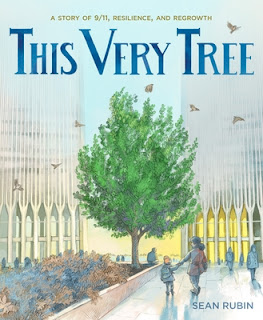
But some children’s books - for instance Sean Rubin’s beautiful and important This Very Tree (Henry Holt, 2021), help readers of all ages, especially when their world experiences a traumatizing hurt. Think: the events of September 11, 2001.

The book’s subtitle, though written above the title, says it all: A STORY OF 9/11, RESILIENCE, AND REGROWTH. 

The story is that of a Callery pear tree planted in New York City in the 1970’s.  Every year it ushered in the spring until September 11, 2001, when everything changed. Workmen uncovered one branch of the pear tree amidst the rubble in October.  One limb remarkably offering up leaves! A fighter tree if ever there was one, because, once moved to be nurtured, fed and cared for, nurserymen returned the tree to Vanquillen Park where it thrives today. This Very Tree tells the tree’s triumphant story, and how our nation continues to recover from this tragedy.

Two other children’s picture books published this summer paid tribute to the 20th Anniversary of 9/11: Charlesbridge’s Branches of Hope, written by Ann Maggee and illustrated by Nicole Wong, and Little Brown’s The Survivor Tree, written by Marcie Colleen and illustrated by Aaron Becker.

In This Very Tree, the pear tree tells her story.  Her voice grabbed me from the get-go.

 On a personal note, I began teaching my very first Picture Book Workshop at the Newberry Library, Wednesday, September 26, 2001, 15 days after that unforgettable Tuesday. Sadly, I was one of many who experienced a personal and indescribable loss that day, that of my young nephew, our family’s first-born grandchild – a much-loved husband, father, son, son-in-law, grandson, brother, cousin, friend, colleague, a loss that still tears at my heart. I was wobbly, to say the least. I remain forever grateful to my students that first year for blanketing me with their kindness that Fall.

This past September, the 20th Anniversary of my Newberry Library Picture Book Workshop, how could I not choose This Very Tree as my featured picture book for the semester?

  • In pure Show, Don’t Tell fashion, writers could see the important work children’s books do.
  • They could see me, Living Proof that, in time, healing happens.
  • By sharing other picture books that told the same story, they could see the infinite possibilities available when telling a story. Indeed, each successive week, I presented three picture books that came at the same story three different ways.
  • And what Writer, as well as Human Being, doesn’t need to know about Resilience and Regrowth?

The Callory pear tree, the first tree to blossom in Vanquillen Park, continues to inspire.

         “… everyone who sees my flowers knows that spring will come.

FYI: you can learn more about this Life-affirming pear tree here.

You can also click on this YouTube video.

Each year three communities that endured tragedy in recent years receive seedlings from the Survivor Tree, thanks to the Survivor Tree Seedling Program.

I offer sincere thanks to my fellow TeachingAuthors – and you, our TeachingAuthors readers – for helping me make it through yet another CrazyCrazy Year…with the knowledge, of course, that Spring will come again.

Let’s keep keepin’ on!

Esther Hershenhorn

P.S.

Thanks to Jone at Jone Rush Macculloch for hosting today’s Poetry Friday.


Friday, December 10, 2021

2 Picture Books That Will Change You. Forever.

Howdy, Campers, and Happy Poetry Friday! (my poem, the PF link, and a link to my upcoming Poetry for Children class are all below)

This round, we, in the towering TeachingAuthors' treehouse, are recommending a book (or two or three) we love. 

the renown TeachingAuthors' Towers

Zeena starts us off by introducing her fellow NCTE presenters and their books; Bobbi follows, recommending three wonderful books on the nuts and bolts of writing and the business of writing while inspiring us with well-chosen quotes; Mary Ann sings the praises of the most wonderful time of the year--book recommendations

And now it's my turn.

Man, oh, man. Just as Charlotte wove "some pig" in her web,

...this sure has been some year.  Err...some years.

I'm recommending two picture books that may not have even had a chance at publication a few years ago. Two books that changed me--and may change you--forever.

1.The first picture book, by Carole Boston WeatherfordUnspeakable: the Tulsa Race Masacre , pulled back the curtain on a history I knew nothing about. (Watch a YouTube reading of it here). 

(My book club paired that picture book with the beautifully presented, thoroughly researched Black Birds in the Sky by Brandy Colbert for ages 14 and up, which got six starred reviews.)

2. The second picture book, by Lee Wind and illustrated by Paul O. Zelinsky, Red and Green and Blue and White, has gotten four starred reviews and was featured in the New York Times as one of the best books of 2021.

It's a beautifully told story inspired by a true incident. We all know the phrase Show, don't Tell. Well, this picture book sure shows "how a community came together in response to an act of bigotry."

And there you have my book recommendations!

 =======================================
Here's a poem that has nothing and everything to do with this strange year we've traveled through:

WHAT HE DOES WHEN NO ONE IS LOOKING
by April Halprin Wayland

POTUS leans BACK under the OAK.

“Man-oh-man, this is the best.”

And it was: his CANOE,

the smell of BACON wrapped KABOBs

and corn on the COB.

No need to think about BANK rates

or snakes out to get him.

None of that.

Just ripples on the river

and their EBB and flow against the shore.

Nothing more.

 =======================================

How this poem came to be:

I was trying to come up with a poem for a live poetry reading. The topic for each poet was: VISIONS OF HOPE FOR THE FUTURE.

That day I read an opinion piece by columnist Robin Abcarian. The first two words in the title of her article were: "President Backbone."

I decided to write an In One Word poem [see how to write an In One Word poem] based on the word backbone.

Total Number of words made out of Backbone = 85. 

Of the 85, these words appealed to me the most--hence this was my playground:

 beacon  beckon  kabob   bacon  canoe   ocean  cone  cake  cane  once  bone  bake  bane  babe bank   beak  bean back  oak  nab ace  boa  can  cob  con  one  ebb  eon  ban  cab  bob1) on  ok  no  be

=======================================

So...maybe not everything has been horrid.

Maybe some things were even terrific. 
Maybe we just have to lean back against an oak
and not think about bank rates or snakes.
Just ripples on the river. Nothing more.

PS: One terrific thing in my life is teaching. I love teaching...and, much to my amazement, I love teaching via Zoom! So I'll be teaching my three-hour Writing Poetry for Children class (for rock bottom beginning poets) again through UCLA Extension via Zoom on January 15th at 12 noon PST. Come join us--I'd love to meet you!--enrollment is limited (to 30!)

Thank you, Cathy, of Merely Day by Day for hosting!


Poem (c) 2021 by April Halprin Wayland. All rights reserved.

Posted with love by April Halprin Wayland and the Procrastinate Fairy.

Thursday, December 2, 2021

It's the Most Wonderful Time of the Year--Book Recommendations!

The new book recommendations post is my favorite. There's nothing this former librarian enjoys more than sharing the best books of the year. (OK, admittedly, this is limited to the "best books that I read.") I've picked one from each of the age group: picture book, middle grade and young adult. Without intending to pick books with a "theme," it appears that I did anyway. The female protagonists of these books all struggle with self-acceptance.


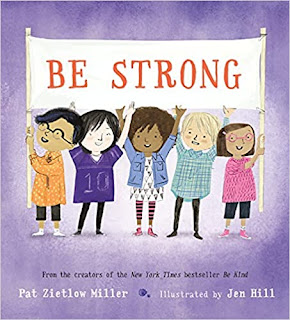
Be Strong
 by Pat Zietlow Miller (ill. by Jen Hill) the sequel to Be Kind, is my picture book choice. Tanisha is discouraged when her gym class takes on a rock wall. She barely has the strength to tote her backpack, let alone climb a wall. She learns that strength is not just a matter of muscles, but of perseverance, leadership and caring about others. I took heart from the advice Tanisha's family and friends offer--"Mama says...being strong means moving forward. 'Tiny steps are fine,' she says,"As long as they take you in the right direction." Yes! 


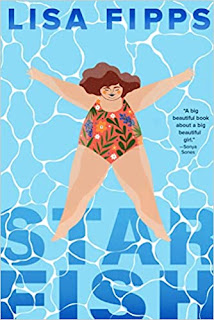
Starfish
 by Lisa Fipps, narrated by 11-year-old Ellie, is a novel-in-verse. Ellie hates her nickname, Splash. Her older sister gave it to her, after a five-year-old Ellie landed a memorable cannonball in the family pool. Ellie is labeled "fat" by her family, and almost everyone else. Her relationship with her mother, who  insists that Ellie have bariatric surgery (!!!) is especially harrowing. The reader encounters the many ways Ellie is bullied, shamed and ignored by her peers. The book is Ellie's journal where she lists her "Fat Girl Rules"--"You don't deserve to be seen or heard, to take up room, to be noticed. You make yourself small." Even worse, Ellie's best friend Viv moves away just as the two enter the Fearsome World of Middle School. Fortunately, Ellie has allies--her dad, a therapist and a new next-door-neighbor. With their help, Ellie learns to accept herself just as she is, and to throw away her "Fat Girl" rules. 


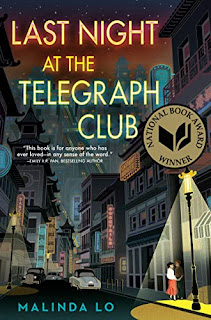
I had just finished reading Last Night at the Telegraph Club by Malinda Lo, when it was named a National Book Award winner. This is my kind of book, historical fiction, in which the author builds her world so well (in this case, San Francisco, 1954) you fall completely into a time and place with the protagonist. 17-year-old Lily Hu is the American-born daughter of Chinese immigrants. She tries her best to be a "good Chinese daughter,"--studious, industrious, modest and respectful-- but she knows she is different. She is fascinated by science fiction and aeronautics, and yearns to fly "space rockets." When she happens upon an ad for male impersonator Tommy Andrews, she doesn't understand her intense curiosity. Then Lily befriends classmate Kath, who not only likes all the same things as Lily, she has seen the mysterious Tommy Andrews perform at The Telegraph Club, a lesbian bar. When Kath challenges Lily to go with her to the club, Lily's life completely upends. 

I loved this book, but it does cram a lot of the 1954 world into the story--racism, McCarthyism, Lily's father's possible deportation (although he is a citizen), the criminalization of homosexuality, the Chinese Nationalist movement...not all of which are part of Lily's narrative. There are a ton of "walk-on" characters that add little. There are short sections sandwiched into Lily's story, flashbacks about Lily's parents and other relatives in which Lily does not appear. For me, they disrupted the mounting tension of Lily's story. However, these are small quibbles. The delicate, yet unflinching language of Lily and Kath's evolving relationship and the pull-no-punches plot is what made this my favorite YA of 2021.

Posted by Mary Ann Rodman


Friday, November 26, 2021

Writers Write

I hope you had a nice Thanksgiving, and celebrated the day exactly as you wanted. Let the holidays begin!

 Recently a friend and I were discussing the state of the business of writing. Publishing is a business, and a very dispiriting one. It’s external from the craft of writing, open to subjective opinions and the whims of trends. The dreadful truth is the odds are against us.

But, as once said by old friend long gone (and my own dear Dumbledore, Emma Dryden later reaffirmed, so we know it's true), writers write. Everything else -- everything external -- is beyond our control. However, writing is an internal process. As such, we focus on what we can control: ourselves. Take classes. Teach classes. Read books about the craft. Study mentor books. Adapt, rethink, refocus. Take chances. Leave your comfort zone. Write something new. Write something different. Submit, and submit again. Persevere. 

To cite another idiom: We do our best and leave the rest to the universe.  

 Or, as Neil deGrasse Tyson offers much more eloquently --  and really, who else knows more about how the universe works than the mighty Tyson:

“The problem, often not discovered until late in life, is that when you look for things in life like love, meaning, motivation, it implies they are sitting behind a tree or under a rock. The most successful people in life recognize, that in life they create their own love, they manufacture their own meaning, they generate their own motivation.” -- Neil deGrasse Tyson

Recently I discussed one source of motivation.  Considered “a master class in novel writing,” Story Engineering,  by Larry Brooks (Writer’s Digest Books, 2011), takes a deep dive into story architecture. As Brooks offers, “…in their execution, stories are every bit as engineering driven as they are artistic in nature.” In other words, the technicality (or criticality) of the story is as fundamental as the creative. As Brooks stated, 

“A story has many moods. It has good days and bad days. It must be nurtured and cared for lest it deteriorate. And it has a personality and an essence that defines how it is perceived. Just like human brings.”

Brooks is quick to admit that a writer can have all the right ingredients, perfectly stirred, and it turns out bland. Or, to put it another way, it’s possible to assemble in perfect order that perfect body. But without that creative spark, there is no life. Think Frankenstein’s monster. 

So enthralled with his Story Engineering, I picked up another of his books, Story Fix: Transform Your Novel from Broken to Brilliant (Writers Digest Books, 2015). He begins his discussion with this powerful statement that encapsulates my recent discussion with my friend: “This is a book about the writer within.” The book is like a bootcamp for writers, no matter what stage in their career, focusing on the revision process. He states: “When we approach revision with the idea of creating something more enlightened and empowered, rather than just making the writing itself technically better, truly wonderful things can happen.” 

According to Brooks, there are two essential realms of revision: the story idea, or concept; and the execution.  The story idea should offer a dramatic premise, a thematic stage upon which characters reveal themselves.  Revisions from this realm can be challenging because the writer must take a deep dive into the original premise. Too often, writers tweak the execution of the story, but ignore the raw material, the inherent nature of the story.  He offers the example, “It’s like polishing a Volkswagen to prepare for a NASCAR race. Shiny isn’t the point.”

Likewise, the story’s concept may be compelling, but the narrative may be too slow, bogged down by too much backstory, or the characters are too one-dimensional. Maybe there’s not enough tension, or the pacing is off.  Brooks identifies and examines twelve crucial elements that address these two revision realms. As one reviewer noted, the book isn’t just about revision, “it’s about resurrection.”

Turning my attention to the business of writing (because understanding how the business works helps to inform our strategies in surviving the challenges of the business), I read Law and Authors: A Legal Handbook for Writers, written by literary agent and lawyer, Jacqueline Lipton (University of California Press, 2020). This is an extremely reader-friendly book that decodes complex concepts such as copyright laws, the difference between copyright and trademark, the difference between public domain and Creative Commons, how much is Fair Use, and the difference between self-publishing, independent and hybrid authors. She takes a deep dive into contracts, both agent and publisher. Targeting the agent agreement, she highlights several questions the author needs to ask potential agents, such as if the agency contract is a book-by-book contract, or will it cover multiple projects (i.e. career building). Will the agent continue to represent you if they don’t sell your first book? How can you tell a good agent from a bad agent, and what happens if something goes wrong? 

She addresses the many, many minefields often found in a publisher’s contract, discussing the specific rights a writer is selling or licensing. And, of course, she explains royalties on a level that even an lumpish loggerhead  like myself can understand. Sorta. My takeaway: negotiating a contract is not for the faint-hearted.

Indeed, the odds of getting published are low. Some say 1000 to 1. Others say it’s less than 1%. Or, as Harold Underdown offers in his still-relevant 2010 article, the odds stink

But in the end, does it matter? Yes, somewhat. Be aware, but don’t let it define you.  In the end, the odds don’t matter. Because, as Harold explains, “Any editor can tell stories about times when they opened a submission and read a manuscript that they just couldn't put down and knew right away that they had to acquire. This may have been a manuscript that had been seen by dozens of editors, or they may have been the first one. That didn't matter.”

Writers write.

Find your jam and go with it, and leave the rest to the universe. 

-- Bobbi Miller

Writers Write clipart from Clipart Library. 


Friday, November 19, 2021

Introducing The Work of My Fellow NCTE Presenters


The National Council of English Teachers (NCTE) Conference began this past Wednesday, November 17th. 


I’m honored that the panel of 6 BIPOC (Black, Indigenous, People of Color) authors I put together was accepted as an On Demand Session at this year’s conference. The theme of the conference this year is Equity, Justice, and Antiracist Teaching.

Click here to register for the NCTE Convention

Click here to find our On Demand Session

Our panel titled, Normalizing Diversity and Decentering the Dominant Culture: Using Picture Books for Anti-Racist Teaching, will be available to NCTE Conference participants until February 19th.


I want to take this opportunity to introduce my 5 fellow authors and their amazing work. Please have a look at their websites and enjoy their picture books!


Traci Sorell


Here is are some of the other books we recommend for normalizing diversity.


Earlier in the year, Andrea J. Loney, Sharon Langley, Benson Shum, and I presented the same material at the American Federation of Teachers Biannual Conference.


In July, I wrote about how I am re-centering diversity and decentering white culture in my classroom, using picture books.


In 2022, Andrea J. Loney, Sharon Langley and I will present the material at 4 CTA (California Teacher's Association the state affiliate of the NEA) conferences.

Posted by Zeena M. Pliska

Author of :

Hello, Little One: A Monarch Butterfly Story Illustrated by Fiona Halliday  Page Street Kids

Egyptian Lullaby Illustrated by Hatem Aly Roaring Brook Press (coming Winter 2023)

For more info about me click here


Friday, November 12, 2021

Two New Books to Celebrate: Spies in the American Revolution for Kids and the 10.10 Poetry Anthology

[Note: I wrote the following before learning of the death of my friend, April Pulley Sayre. If you didn't see my post about her Wednesday, I hope you'll take a look.] 

This week I'm happy to celebrate two new book releases. The first, Spies in the American Revolution for Kids by former TeachingAuthor Carla Killough McClafferty, released on 11/2/21. The second, 10.10 Poetry Anthology: Celebrating 10 in 10 Different Ways, edited by Bridget Magee, includes three poems I wrote! You can read one of those poems at the end of this post. 

I invited Carla to share a bit about her new book. Here's what she had to say:   

My newest book Spies in the American Revolution for Kids (Rockridge Press), covers another facet of history that is little known by most people. I enjoyed the research of seeking out primary source documents like letters and codes to pull this true story together. To research spies is tricky. Most spies didn’t write down on a document that they are spies for fear of being arrested, tried, and hung as a spy. But still there is a paper trail. And as a researcher, I am a determined bloodhound for accurate source material. I followed the trail. And it was fascinating.

I’ve written about George Washington in several different books, and he is part of this story also. Washington is famous for many things. I think his role as spymaster should be one of them. He understood how nearly impossible it would be for American patriots to win a war against England, the most powerful military nation in the world. He knew America would need to find ways to gain advantages whenever possible. And that meant espionage.

Soldiers as well as civilian men and women volunteered to be spies. They secretly gathered information while hoping they didn’t get caught and killed by the British. They devised all sorts of methods to deliver vital information about troop movements, numbers, weapons, ships, and food supplies. They used clever ways to communicate including all sorts of codes. They used amazing gadgets like invisible ink, dead drops, intercepting mail, and secret messages of all sorts. Without exception, every single spy risked their lives over and over again.


In this book, I cover the Culper Spy Ring, made famous in the television series, Turn: Washington's Spies. Benjamin Tallmadge recruited a trusted circle of people he knew from his home town of Setauket, on Long Island. The ring created a complex system of gathering and sharing information right under the noses of the British army who occupied their town. Their vital information was forwarded immediately to General Washington. Tallmadge created a secret code system that kept their identities safe. Even after the war was over, and for the rest of his life, Tallmadge never revealed the identities of his friends who worked as spies.  Below are pages from the code book created by Benjamin Tallmadge for use by the Culver spy ring.


The stories I write about in Spies in the American Revolution for Kids give us glimpses of incredible bravery. Men like Enoch Crosby who worked as a double agent. Over and over, he infiltrated enemy groups, learned their secrets, and got word out which resulted in their arrests. Lydia Darrah eavesdropped on plans discussed by British officers’ and smuggled that information to the patriots under the buttons of her son’s coat. Allan McLean, a dashing leader, seemed to have no fear when he disguised himself and went into the enemy camp. McLean somehow escaped capture again and again. Some spies went deep under cover, like James Armistead Lafayette, an enslaved man who worked for General Cornwallis before the battle of Yorktown, and fed information to the patriots. And John Champe who joined the British army so he would capture Benedict Arnold-and the unexpected twist of fate which caused his mission to fail.   

My hope for those who read this book is that they are entertained and gain a deeper understanding of what it took to create this great nation. Many different types of men and women worked as American spies. Without their contributions to the war effort, perhaps the Revolutionary War would have taken even longer than eight years. Or maybe America would not have won the war at all.  

Congratulations, Carla! Your new book sounds intriguing, especially for readers who enjoy nonfiction.

And today, I'm also happy to celebrate Bridget Magee's recent release, 10.10 Poetry Anthology: Celebrating 10 in 10 Different Ways, which includes three of my poems. Some of you may recall that I mentioned in my last post that I've had poems accepted in TWO new anthologies. I don't know yet when the second will be released--I'll share more when I do.

The poems in the 10.10 Poetry Anthology are divided into ten categories, all tied to the word TEN:

  1. TENtative
  2. TENderness
  3. TENacity
  4. TEN More Minutes
  5. TENsion
  6. I Wouldn't Touch That With a TEN-Foot Pole
  7. TEN Little Fingers / TEN Little Toes
  8. Take TEN
  9. TENth _____
  10. I TENd To

  My first poem in the collection is in the TENacity section. 

The form for this poem is a variation on the “Definito” form invented by Heidi Mordhorst. My other two poems in the 10.10 Poetry Anthology include an Etheree in the TEN More Minutes section and a free verse poem in the TENsion section. I'm honored to have my work included with that of so many fine poets from around the world.

If you're looking for more poetry, check out this week's Poetry Friday roundup hosted by Matt Forrest Esenwine at Radio, Rhythm & Rhyme

Happy writing!
Carmela

Wednesday, November 10, 2021

April Pulley Sayre: Her Work Lives On

I am still reeling from the news of the recent death of April Pulley Sayre. April was a brilliant author and photo-illustrator, and an incredibly generous friend. She published over 70 books for young readers and adults, many of them nonfiction, nature-themed books. I wouldn't know where to begin to write a tribute that would do April justice. Instead, I'm writing this post to let everyone know that April's work in support of nature lives on, not only through her books, but also through the Fund for Nature she created with her husband, Jeff Sayre. You can learn more about their conservation foundation's goals on their GoFundMe page.  

April epitomized what it means to be a TeachingAuthor, which is evident in the Guest TeachingAuthor interview JoAnn Early Macken posted here in 2010. That post includes a writing exercise from April's book Unfold Your Brain: Deepen Your Creativity, Expand into New Arts, and Prosper as a Writer, Musician, or Visual Artist. I just discovered that the book was recently re-released on Amazon in both ebook and paperback.

I know April had other books in the pipeline, including Happy Sloth Day!, due out in 2022. You can get a sneak peak at the book's amazing photos and lyrical text on the Simon & Schuster website. There are also links to similar previews for some of April's other books at the bottom of that page.

This morning, I learned that we can still hear April's voice, too. In the video below, she reads Thank You, Earth: A Love Letter to Our Planet. Listening to it is both consoling and heartbreaking for me. 

(If the video doesn't work for you, you can watch it online here.)

At the beginning of this post, I described April as an incredibly generous friend. I mentioned in this blog post that we graduated together from Vermont College back in 2000. That post also includes a photo of our graduating class, known as the Hive. In many ways, April was our Queen Bee. She often provided insightful feedback on our works-in-progress. But even more, she encouraged and inspired us to be bold and brave in our writing and in our lives. 

We will miss her terribly. 

Carmela

Friday, November 5, 2021

Here’s to Corita Kent and PLORKING!

My website's beginning words declare,

“Lucky me! I spend my days doing what I love and loving what I do.”

Little did I know, until I read Matthew Burgess’ and Kara Kramer’s Make Meatballs Sing (Enchanted Lion Books, 2021), the picture book biography of Corita Kent, I was plorking!

For those unfamiliar with this artist, educator, nun and activist, as I was until I read this gorgeous and spirited biography, Sister Maria Kent of the Order of the Immaculate Heart of Mary was born Frances Elizabeth Kent. She served the church for 30 years, especially as an art teacher, and took the name Corita Kent at age 50 in 1967 when the Catholic church released her from her vows.

A new adventure beckoned.  New work awaited.

"Corita,” Burgess writes, “was serious about PLAY. She believed the best work is done when play and work are one. She even created a new word: PLORK.”

As in PLAY + WORK.

Corita believed makers – i.e. plorkers - are a sign of hope.

Indeed.

What could be more hopeful than the rainbow LOVE USA stamp the United States Postal Service commissioned her to make in 1986?

                       (UCLA Grunwald Center for the Graphic Arts, Hammer Museum)                                

I quickly learned, from visiting the website of the Corita Art Center in Los Angeles and reading the book Corita Kent co-authored with Jan Steward, Learningby Heart – Teachings to Free the Creative Kent (Bantam Press, 1992/Allsworth Press, 2008): Plorking and making are all about becoming and the Joy - with a deserved capital “J” – that process brings.

As Matthew Burgess shared in his Author’s Note, “Corita invites us to discover the spark of spirit within the most ordinary things.”

To do so while working can only bring play.

See and listen for yourself.

Lucky me to be a plorker!

Happy Plorking to YOU!

Esther Hershenhorn

PS.

I’d been reflecting on “play” in various and sundry ways, thinking on this post, when I fortuitously came upon Make Meatballs Sing and Corita Kent’s newly-invented word plork.

No wonder I find joy in what I do, I realized!

For most of my Little Girl Years, I played school and library.  I imagined my way into becoming a teacher, a librarian, a children’s book author. 😊

P.P.S.

Thanks to Tabitha Yaetts at The Opposite of Indifference for hosting today’s Poetry Friday.