Showing posts with label Bird by Bird. Show all posts

Friday, June 2, 2017

3 Terrific Quotes on Character Flaws and a Poem

.
Howdy, Campers ~ and Happy Poetry Friday! The link to today's PF host is below, as is my poem.

TeachingAuthors
' current topic is Creating Characters. Bobbi started this series, discussing characters' inner struggles. JoAnn gives us the questionnaire she uses to get to know her characters, Carla shows us concrete examples of how small details reveal character in nonfiction characters, and each Wednesday in May, Esther offered us Wednesday Writing Workouts.

And me? I need help pulling 3-D characters from the blank page.

One criticism of my W.I.P. novel in poems is that except for the narrator, the other characters are one dimensional. Ouch! As a teen, I saw everyone as black and white. It's still hard for me to see people as three dimensional, hard to accept the fact that they are/we humans are imperfect. But we all have flaws, darn it.

I'll never forget the example Barbara Bottner gave in a class at Otis Parsons in the 1980's. The gist of what she said is this:

Let's say you want to tell a story about three characters in search of buried treasure. 

Okay--that's fine. 

But what if you told a story about 

Richard Nixon

Lucille Ball 

and Godzilla 

searching for buried treasure? 
NOW you have a story.
(I've forgotten the specific characters Barbara suggested--insert your own favorites.)

Wow. Talk about flawed characters! That's the moment I began to understand the interconnectedness between real characters (with real bitten fingernails and real raspberry jam stains on their clothes, who sometimes stomp on their little brother's toe) and story.

illustration from my book, New Year at the Pier by Stéphane Jorisch (Dial)

Still I struggle--both on the page and in real life--to see flaws in those I love. Or alternately, I dismiss a person entirely if I do discover a flaw.

One evening at a memorial service, I realized that everything that annoys me about my friends will be exactly what I remember fondly when they die

Ann Whitford Paul agrees:
"We all have flaws. Our characters must have flaws, too....Think about your imperfections. Think about imperfections in others that annoy you or maybe tug at your heart...Often...the strength and weakness are two sides of the same issue. Think of Frances in Russell Hoban's Bedtime for Frances. Her great imagination is exactly what makes her so fearful. It's what makes her sure spiders and tigers and monsters lurk in her room...Whatever the specifics, the main characters in our picture books must be human, and that means imperfect." ~ Ann Whitford Paul in Writing Picture Books

Ann Lamott makes this point, too:
"[Characters] shouldn't be too perfect; perfect means shallow and unreal and fatally uninteresting...I like them to be mentally ill in the same sorts of ways that I am; for instance, I have a friend who said one day, 'I could resent the ocean if I tried,'and I realized that I love that in a guy." ~ Anne Lamott in Bird by Bird

As does Madeleine L'Engle:
"I like the fact that in ancient Chinese art the great painters always included a deliberate flaw in their work: human creation is never perfect." ~ Madeleine L'Engle

For today's poem I thought I'd describe a character by including a flaw and some eye-poppingly original details. But that's not exactly what turned out. The first line came to me immediately: "She takes out her teeth to chew on that." Hmm, I thought. We know who that must be.

But...you're a writer--you know how it goes. You fiddle and rearrange and think and unthink and finally that first line seems too cliche, so out it goes.
.
I didn't include a fatal flaw or raspberry jam on her skirt, but here's a draft that came from my tweedle-dee and tweedle-dumming today:

CLARICE
by April Halprin Wayland

Ding-a-ling-ding, the telephone rings.
Her cat bats away a spec on wings.
She doesn't answer that telephone call.
Forget them all,
forget them all.

She watches this brave day's afterglow
then picks up the cat, tunes her radio,
leans into the umpire's gritty call.
It didn't have to happen at all,
it didn't have to happen at all.

She stares into space, chewing on that.
Her cat jumps into her tired lap.
How can it be the sun still sets
since Daniel's death,
since Daniel's death?

poem (c) 2017 April Halprin Wayland. All rights reserved.


posted with love by April Halprin Wayland with help from an invisible bee named Spinach.

Friday, September 9, 2016

3 Insights Into Improving Writing Productivity


Our current series is about beginning a new writing career or jump-starting a stalled one. Carla shared 5 things she wished she’d known when starting out as a writer and JoAnn talked about coping with a lull in her enthusiasm for writing. My post today focuses more on the latter, but I think it's also of value to beginning writers. Before I get to that, I'd like to share two bits of news:
  • The revised edition of my middle-grade novel, Rosa, Sola, (originally published by Candlewick Press) is now available in both ebook and paperback, and includes a new "Discussion Questions" section for classroom use. I'm currently sponsoring a Goodreads giveaway, which I invite you to enter on this Goodreads page or via the widget below:  

Goodreads Book Giveaway

Rosa, Sola by Carmela A. Martino

Rosa, Sola

by Carmela A. Martino

Giveaway ends October 05, 2016.
See the giveaway details at Goodreads.
Enter Giveaway
  • Also, for those of you who live in the Chicago area: it's not too late to register for my class on "Finding Your Writer's Voice," which begins Tuesday, September 13, at the College of DuPage in Glen Ellyn. See my website for details. 
Now for today's post.

Like JoAnn, I’ve been stalled in my writing lately. The problem started back in April, when I was sidelined with a repetitive stress injury to my dominant hand. The injury has not only interfered with my ability to type and to write longhand, but it has also caused me to lose my enthusiasm for writing. Fortunately, though, I'm currently leading a small, private class on Julia Cameron’s The Artist’s Way. The timing of the class is perfect, as it’s helping me examine my writing process and the causes of my current lack of productivity. Here are three insights I’ve been led to recently, via Cameron’s book and other reading I’ve been doing:

1. “In order to do something well we must first be willing to do it badly.”

These are Cameron’s words in The Artist’s Way: A Spiritual Path to Higher Creativity (Tarcher Books), but they convey a concept I've found in other books on writing and creativity--think the “sh**tty first draft” in Anne Lamott’s Bird by Bird (Pantheon Books). Elizabeth Gilbert also touches on the topic in her book Big Magic: Creative Living Beyond Fear (Riverhead Books) when she talks about the necessity of accepting imperfection if we want to lead creative lives.


I’ve always been a perfectionist, and now that I’m a published author and a writing teacher, part of me thinks that I should be able to produce a polished draft right off the bat, with little or no editing. And when I don’t do that, I feel like a failure. So I was shocked when, in Big Magic, Gilbert confesses to publishing a novel she’d written without revising a major flaw that her beta readers had pointed out. I listened to the audiobook, so I can’t quote Big Magic directly. But I did find an interview in The Guardian where Gilbert is quoted as saying:
“Perfection murders joy. You cut yourself out of the game before you even start. You cut yourself out of the game because you’ve decided it’s never going to be as good as your ideal.”
I also found the following image, which I’ve printed out and posted in my office as a reminder that I will always be a beginner. I’m hoping that trying to keep an open, “Beginner’s Mind,” will help me overcome my perfectionism.

found here with caption "Image Source: Facebook user Elizabeth Gilbert"
2. If I can’t “find” time for my writing, I need to “make” the time.

My students often complain about not having enough time to write, and lately I’ve been using the same excuse. Julia Cameron addressed this recently in a blog post:
"Most of us think, 'If only I had more time, then I would work.' We have a fantasy that there is such a thing as a 'good' creative time, an idyll of endless, seamless time unfolding invitingly for us to frolic in creatively. No such bolts of limitless time exist for most of us. Our days are chopped into segments, and if we are to be creative, we must learn to use the limited time we have."
That's how I worked on this blog post, in little segments of time stolen between physical therapy appointments, lesson planning, household chores, etc. If I can make time to blog, I can make time for my own creative writing, too.

When I explain this to my students, they often reply that they can’t just sit down to write. They need to feel “inspired.” But, as M. L’Engle says in Walking on Water: Reflections on Faith and Art (Crosswicks):
“If the artist works only when he feels like it, he’s not apt to build up much of a body of work. Inspiration far more often comes during the work than before it, because the largest part of the job of the artist is to listen to the work, and to go where it tells him to go.”
3. My attitude has a profound effect on my productivity.

It’s not enough for me to “make time” for my writing. I need to bring the right attitude with me when I sit down to write. I’ve shared before about how research is showing that happy people tend to be more productive. But this is a lesson I need to constantly remind myself of.

In an excerpt from The Artist's Way posted on her blog, Julia Cameron says:
“Over any extended period of time, being an artist requires enthusiasm more than discipline. Enthusiasm is not an emotional state. It is a spiritual commitment, a loving surrender to our creative process, a loving recognition of all the creativity around us. 
Enthusiasm (from the Greek, 'filled with God') is an ongoing energy supply tapped into the flow of life itself. Enthusiasm is grounded in play, not work. Far from being a brain-numbed soldier, our artist is actually our child within, our inner playmate. As with all playmates, it is joy, not duty, that makes for a lasting bond.”
Hmm. There’s that word again: JOY.

For years I’ve been signing my posts here with “Happy writing!” I think I need a more expansive catch phrase. What do you think of this:


For more joy and inspiration, head over to this week's Poetry Friday round-up at The Poem Farm.
Carmela

Friday, January 13, 2012

Book Giveaway and Guest Teaching Author Interview with Barney Saltzberg (who shares his favorite exercise for picture book writers~)

.
Howdy Campers--and happy Poetry Friday!  Today's Guest Teaching Author shares a poem about bullies with us at the end of this post.

YAY!   We Teaching Authors are thrilled to have our dear friend and Guest Teaching Author Barney Saltzberg drop by for tea. To celebrate Barney’s appearance on our blog, we're giving away an autographed copy of his mind-blowing book, Beautiful Oops.
To enter the 
drawing, see the instructions at the end of this post.  
Author/illustrator extraordinaire, Barney Saltzberg,
Junebug (black and white) and shoulder-leaner, Arlo
Doesn't Barney look like someone you'd want to have a hot dog with? I met Barney,who was born in Los Angeles and has published nearly forty picture books, a gazillion years ago through our teacher Barbara Bottner (Her own Teaching Author interview is here). Barney's two kids live in Boston and New York, so he and his wife fill their home with art, toys, blazing colors and dogs.

Barney, who is smart and funny and...well, funny and smart, is also a musician. His songs have been on the PBS show Arthur, and he has recorded four children's music CDs. He teaches writing and illustrating picture books in UCLA Extension's Writers Program, and travels a ton, speaking about writing and illustrating and wowing the crowds with his toe-tapping and tender songs.

And here's where you have to sit up straight and be impressed: he was recently in China, as part of the US State Department's cultural exchange program, performing at schools, libraries and universities.
His latest book, BEAUTIFUL OOPSfrom Workman Publishing, is a one-of-a-kind masterpiece. Pop-ups, lift-the-flaps, tears, holes, and smudges show readers--young and old--how every mistake is an opportunity to make something beautiful. It demonstrates "the magical transformation from blunder to wonder."

Howdy, Barney--welcome!  How did you become a Teaching Author?
I was encouraged to teach by two friends who are both, teaching authors. They assured me that it would be a rewarding experience.  I was a bit reluctant, but I am so happy I jumped in.  I am now in my eighth year at UCLA, where I teach Writing and Illustrating Picture books.

Here's 1:41 minutes of Barney in a somewhat younger classroom.
(For a longer version, click here)

                          
What's a common problem/question that your students have and how do you address it?
So many of us were raised reading Dr. Seuss.  His rhymes are brilliant. I have so many students who assume that rhyming is easy.  I have to say that I fell into that category as well.  I've been a song writer since I was eight years old.  I know how to rhyme.  Writing poetry, on the other hand, is a different animal.  I can fudge meter and rhythm when I sing.  Out of close to forty children's books published, I've only made four books with poems.  Many first time students are very frustrated that I encourage them to write their stories first, without thinking of the rhymes.  My suggestion has always been to write the story so you have a road map, and if at some point you want to make a poem, you at least know where you're going.   Most new writers begin to rhyme and get backed into a corner without any regard as to where they want the story to go.  One of my jobs as a teacher is to help steer students away from rhyming 'for a while'. I'm more concerned with students finding their own voice in their writing.

Would you share a favorite writing exercise for our readers?
I borrowed a suggestion from Anne Lamott's wonderful book Bird by Bird. She reminds her readers that school lunch is something we all remember.  Given that I want to help my students find their voice for writing a picture book, one of the very first assignments I give is to write anything you want about your elementary school lunch.  Did you bring it in a bag or a lunchbox?  If so, did you draw on your bag?  Did someone else?  What kind of lunchbox?  What was in it?  Who made your lunch?  Did you even get to have lunch?  Did you eat in the cafeteria?  Maybe you went home for lunch? Maybe your parent packed a type of food that embarrassed you?  Maybe you participated in a food trading frenzy! Any memories of your school lunch are encouraged.  We just want to have you go back to that time in your life.  I'm always amazed at how many people have so much to say about their lunch!  It's a wonderful exercise to dig into a rich batch of memories.

What one piece of advice do you have for teachers?
Find and say at least one thing positive in every assignment before you give any feedback.
Character studies by Barney Saltzberg for his book Andrew Drew and Drew, Abrams 2012
Tell us how you sold your first book.   
I'd drawn a batch of cartoons with captions and went to New York.  I had no idea how the business worked, but if I saw a sign on a building with a publishing company, I would knock on doors.  Ultimately I came to McGraw Hill, who was publishing educational books.  I asked a security guard, "Where do I go to get a book published?"  He said, "You don't".  I said, "If you did, where would you go?"  He told me what floor the editorial department was on.  I rode the elevator to the 36th floor (I believe) and showed the receptionist my artwork.  She told me to sit down and she left through a door behind her desk.  Ten minutes later she asked me to call back the following morning, and that they liked my book idea.  The next morning I called in and found they wanted to publish a book of my cartoons.  A year later, my first book came out called, Utter Nonsense!

I am wild about your new book, Beautiful Oops--it's fabulous.  How did you get the idea for it?
In my school visits I talk about a dog of ours who was accidentally locked in my studio.  She attempted to climb out the window and stepped all over an illustration I had finished.  I thought the artwork was ruined.  After careful reflection, I found I could turn each paw print into a cloud. I also show a picture of a sketch book where I spilled coffee and turned the stain, into a monster.  Teachers asked me for years to write a book showing how I fixed my mistakes.  One day while sitting in my studio, I tore a piece of paper about half way across the page.  I realized it looked like an alligator mouth. I knew then I had a book and a year later, Workman published Beautiful Oops!

Finished drawing by Barney Saltzberg for his book Andrew Drew and Drew, Abrams 2012
What's on the horizon for you?
Lots!  I just sold a book called Chengdu Could Not, Would Not, Fall Asleep to Hyyperion based on photos my wife took when we were in China. (A panda in a tree, having a really squirmy time trying to sleep!)

I have an app called Nibbly's Nose, based on a lift the flap book. It also just became available as an iBook.

Would You Rather Be a Princess or a Dragon?, my first picture book app, will be available soon

And I have two books coming out in 2012: Andrew Drew and Drew (Abrams) and Arlo Needs Glasses (Workman)
Wow, Barney—we can't wait!  And finally, since today is Poetry Friday, do you have a poem you'd like to share with our readers?
Sure!  I was asked to write a poem about bullying.  I didn't want to write something neat and tidy. This is a sticky issue. Ultimately my poem was rejected because there was concern that kids would see the name Roy the bully boy and that would encourage them to make a sing-songy rhyme and tease someone. My thinking is, here's a chance to broach an uncomfortable subject and begin a dialogue.  See what you think.

That Big Bully Boy
by Barney Saltzberg

You know that big bully boy
In my class named Roy?
Well, he thinks I’m his personal toy
He twists both my wrists
And he calls me a goose
With his garlicy breath 
Roy smells like a moose
He’s making me nervous
He’s drinking my drink 
He’s eating my snack
He says that I stink
When the clock hits three
I am safe, I am free
I hope and I pray 
Aliens take Roy away
You know, that big bully boy
In my class named Roy
poem and drawings © Barney Saltzberg 2012

.
Thanks so much for stopping by, Barney!  

To enter our drawing for an autographed copy of Beautiful Oops, post a brief comment sharing an "oops" in your life and how you (or someone else) turned it into something beautiful. Be sure to include an email address (formatted like: teachingauthors at gmail dot com) or a link to an email address. OR...you can email your comment to teachingauthors at gmail dot com with "Contest" in the subject line. Entry Deadline is Wednesday, January 25th, 11 pm (CST). You must have a U.S. mailing address to win. The winner will be announced on January 27th.   Good Luck!
And thanks to Tara at A Teaching Life for hosting Poetry Friday!

Monday, October 3, 2011

First Drafts Stink So Just Do It.

     One of my big "Ah ha" moments in my never-ending quest of "learning to write," was reading Anne Lamott's book, Bird by Bird.  I know I have invoked Bird by Bird many times in this blog, but I can't help it.  When I am discouraged, bogged-down, or, as I mentioned in my last post, just plain "done" (as opposed to "finished") I call on Anne to get me out of whatever funk I am in.  Whatever it is, she's been there and done that a zillion times. Anne is a right-to-the-point kind of writer who isn't afraid to use four letter words and a little political rhetoric to get her ideas across. I know this bothers some people, so I mention it in recommending her book. If you skip past those occasional references, Anne is my right-hand-in-print-writing-guru.
    Anne was the one who gave me "permission" to write lousy first drafts (Anne uses a somewhat different word than lousy.) First drafts are for getting down the story, getting to know your characters and setting. When I sit down to a first draft, I don't agonize over word choices, character names or other details that don't come to mind immediately. Whatever doesn't come to mind immediately, I leave out by typing in XXXX. When I am revising, it alerts me that I know something is missing here, and hopefully, I now know what it is. If I still don't know, I leave it in until I do know. If that XXX is still around in the final draft it's usually a sign that I didn't need whatever it was in the first place.
    Unlike Jo Ann, I hate writing first drafts. Sometimes I feel like Moses wandering in the wilderness. Very often there are huge holes in my plot (like Jeanne Marie, plotting is my weakness). Right now I am going to break Esther's very sensible rule about not talking about what you are writing (the more time you spend time talking about it, the less energy you have to write it.) However, I am pushing my fiction envelope and writing a verse novel. For the record, I am not writing a verse novel because I am a poet ( I most definitely am not) or because verse novels are hot stuff right now. I just think it is the best and possibly the only way I can write this particular story, which is in three voices and so intense and occasionally gruesome, that it is too heavy to write as straight prose.
     The best thing about writing this first draft is that the verse format works really well with my particular way of writing. I don't write in sequence. I don't start with chapter one and then proceed to chapters two, three, etc. When I sit down to write, I write whatever is clearest in my mind that day. When I go back to write again, maybe I will continue with that scene, character, episode (pick one) or it sparks a chapter that I know will come before or after what I have already written. I don't worry where it will come. I just write. Backward, forwards, occasionally upside down (kidding). The only consistent thing is that whatever I think is going to be the last chapter, never is.
      When I go back for revision (the part of writing I love) I put my work into a preliminary order, sometimes shuffling chapter positions, but always discovering where there is a hole, or where I need a transition. Sometimes I find characters hanging around the edges of the story, not pulling their load. (They are fired.)
      This might not work for anyone but me. (I am ADD, and not the most organized person...at least not by organized person standards.) The point is to do what it takes to get out that first draft. This morning I've been writing a poem that I have no idea where it is going to fit in the book's trajectory. Maybe it will get the old heave ho in the final draft. But for right now, I feel pretty good about it. (I actually got the idea sitting in the skating rink parking lot last week, and wrote the notes for it on the deposit slips of my checkbook..I didn't have any paper.) I have also written on McDonald's napkins, air-sickness bags (empty ones) and of course, the writer's notebook I sometimes remember to carry with me. Right now I have two full notebooks, plus napkins, church bulletins, playbills and Wal-Mart receipts that I am transcribing into a first draft.
     I hate gathering all this stuff together (this is the first book I've ever written by hand first), but unless I want to lose some deathless piece of genius written on the back of a hockey schedule, I have to (excuse me Nike) just do it. 
    One more thing. Don't think too hard this first time around. Thinking turns into premature self-criticism which results in no drafts, first, second or final.
    Today I will remember to take my notebook to the skating rink.

Posted by Mary Ann Rodman

Friday, September 25, 2009

Books on Craft: How One Chapter Changed My Life

Hooray--it’s Poetry Friday! Today’s poem and lesson plan are at the end of this post.


I’ve always felt that that if nothing else, I’m good at being a portal. A conduit between what someone wants and how they can get it. That's what has given me the to courage to teach Writing Picture Books for Children through UCLA Extension’s Writer’s Program for over a decade. This class is for newbie children’s book writers--not for those who have read a lot, taken classes, submitted stories, or joined organizations.

To these toe-in-the-water beginners I assign two books. The first is

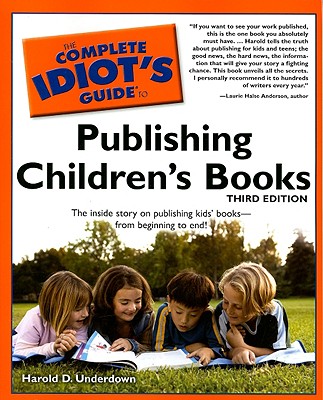
The Complete Idiot’s Guide to Publishing Children’s Books—3rd Edition by Harold Underdown.

This is a comprehensive, down-to-earth guide—worth reading cover-to-cover and easy to dip into as a reference. It presents a broad overview of the field but also gives specifics. As with all Idiot Guides, it's easy to browse and packed with extras like "Vocabulary Lists," which explain terms in the children's publishing industry; "Class Rules," which detail warnings and cautions; "Can You Keep a Secret?" which include tips and resources to help a children's writer or illustrator present him or herself as a pro; and my favorite, "Playground Stories," which are anecdotes from and profiles of children's authors and publishers, giving an insiders view of the children's publishing world.


The other required book is Bird by Bird: Some Instructions on Writing and Life by Anne Lamott.


Teaching Authors Jeanne Marie and Mary Ann have both talked about Bird by Bird...and I’m going to talk about again. Because yes, it’s that good.

My favorite chapter is the one on jealousy, which changed my life. I read it at least once a year to quell my burning heart.


Though I happily celebrate most friends' successes, some colleagues' successes cause me great agony and confusion.
Several years ago, someone gently suggested that perhaps I shouldn't read the book review section right before I went to sleep. She was right. When I'd see certain names, I'd toss and turn all night, feeling like I'd lost a race I didn't even know I was in.

I am a mean and tiny person with tight fists and a black heart.

This is really embarrassing to admit.

I've been more loving to myself about this in the last few years, and Anne Lamott's BIrd by Bird is a big reason why. She writes:
“But if you continue to write, you are probably going to have to deal with [jealousy], because some wonderful dazzling successes are going to happen for some of the most awful, angry undeserving writers you know—people who are, in other words, not you."

and later,

"It can wreak just the tiniest bit of havoc with your self-esteem to find that you are hoping for small bad things to happen to this friend--for, say, her head to blow up."


Who, me?

She writes about seeing a documentary on AIDS:

"You could see the amazing fortitude of people going through horror with grace...seeing that this is what you've got, this disease, or maybe even this jealousy. So you do as well as you can with it. And this ravaged body or wounded psyche...should...be cared for as softly and tenderly as possble."

Lamott has shown me that yes, I have this tendency to be jealous, yes, I have this green spot on my heart…and though I try each year to make it smaller, I may have to live with that little green spot, be amused by that part of me and love myself anyway.


I’m human. What a surprise.

Writing Workout / Lesson Plan—
Metaphor—Getting a Handle on a Really Uncomfortable Feeling

For ages 7 through adult (or younger, with individual help.)

Objective:
This lesson reminds us how writing can help us when we feel awful. (And if the feeling doesn’t go away, at least we’ve got a poem out of it!)

Instructions:

1. Think of someone or something that fills you with envy (or another awful feeling).

2. Close your eyes. Take a deep breath.

3. Feel this feeling in your stomach, in your bloodstream, filling every bone in your body.

4. Or instead, think about what helps drive this emotion from your body. Feel the relief as it leaves through the top of your head, through your finger tips, through the bottoms of your feet.

5. Brainstorm at least five metaphors for jealousy or for what makes jealousy go away. Are you a leaf and is your jealousy a worm chewing on you? Is your jealousy a ring in the bathtub being scrubbed clean with Ajax cleanser?

6. Write a poem using one of your metaphors.

7. Write honestly—even if it embarrasses you.

ANYTHING I CAN DO YOU CAN DO BETTER

or

CAN OF WORMS

by April Halprin Wayland

Varda once told us

that we were all cans on a shelf.

Cans of chili, kidney beans, split pea soup.

I decided that I was a can of apricot halves.

She said that the shelf was only one can deep

but that it stretched out forever

so there’s always room

for one more.

“You don’t have to be afraid that adding another can
means there isn’t enough room for you,”she said.

“You can even help a new can

onto the shelf next to you.”

And she never talked

about jealousy again.

© April Halprin Wayland

Out and About

I’m giving a short program and book signing at the fabulous

Children’s Book World in Los Angeles on Saturday, September 26th at 10:30 am.

If you can’t come, call 310-559-2665 (310-559-book) and they’ll send you your very own autographed copy of New Year at the Pier!


All drawings by April Halprin Wayland

Monday, September 21, 2009

"Crummy" First Drafts and Moving That Story Along

For the past week or so, you, Our Faithful Followers, have sent us your favorite books on writing for children and young adults. Now it's our turn (the Teaching Authors) to join the conversation with OUR favorite books.

I'm going to cheat an eensy bit here, because my absolute favorite book on writing is not about teaching OR writing for children. It is more of inspirational book, and geared for all writers, not just those of us who write for the 18-and-under crowd. I also have a favorite teaching book, so you are really getting a two-for-one-deal here.

My all-time-favorite-don't-leave-home-without-it book is Bird by Bird by Anne Lamott. Now I realize that Bird is not everyone's cup of tea. Anne Lamott is one highly opinionated writer, and her opinions in this book include hers on American politics, women's reproductive rights and religion, in addition to writing. If you pick past her mini-rants, you will find a lot of common sense on writing. Or, more specifically, in dealing with all the "garbage" your mind generates in the way of negative self-talk as you wrestle with your own prose. (Naturally, Lamott uses a shorter and less polite term for "garbage").

Negative self-talk is one of my big time problems that can stall me on a project for months at a time. "Who do you think you are? Karen Hesse?" (or my idol of the moment) "What makes you think you are a good enough writer to take on this story?" "So what if I've sold a book (or two or four or eight?) I got lucky. I'll never do it again." These are only some of the gems my mental radio station broadcasts to me in an "all-talk, all-negative, all the time" format. Lamott tells you how to pull the plug on this station, and other ways to kill your Inner Negative Writer.

Bird by Bird introduced me to the single most earth-shattering notion of my entire writing life; "permission" to write crummy first drafts. (Again, Lamott uses a far more colorful word than "crummy" to describe a first draft.) Perhaps this is just common sense to most of you, but the news that I did not have to hunt for just the right word or character name, or blitz through a transition scene, already knowing that it wouldn't work....just to get to the END of a first draft..why this was the best news ever! If given "permission," I will meander through a first draft, picking over my word choices like Forrest Gump with a box of chocolates. I will hunt through my "name books" for days, choosing and rejecting character names. All of which are good things to do...but not in a first draft. First drafts are for banging it out, getting it done, reaching the other side of the river.

My drawers are full of elegantly worded first chapters that have no second chapters, because I exhausted my original creative impulse by trying to make them "perfect" the first time. At some point, I became so frustrated with my imperfection, I gave up on them, or talked myself into thinking the whole idea was stupid.

Clearly, Anne Lamott and Bird by Bird had a lot to say to me.

But on to what I am supposed to be writing about...writing books to use with kids. My all-time recommendation is Marion Dane Bauer's What's Your Story? OK, I will admit up front that Marion Dane Bauer was one of my teachers in the Vermont College MFA program. However, I read this book long before I ever met her, and found it to be straightforward in explaining the writing process to a young writer. Without condescending, it starts with the basics of character, setting and plot, and shows the writer how to fashion a multi-dimensional character, make the setting another "character" in the story, and how to dovetail the plot events in so that each event builds on the previous. Bauer manages to convey all this for writers age ten and up, in less than 120 pages.

Plot is my weak point, and What's Your Story? reminds me not to include a single word that will not further the story. Bauer's mantra, "How does this move the story along?" is something I have to ask myself at the end of every page.

Marion Dane Bauer and Anne Lamott are my writing mentors, even though I personally know only one of them. It's sometimes crowded in my office, as the three of us plow on through my next "crummy" first draft, stifling the radio station in my head, and chanting HDTMTSA? (How does this move the story along?)

But it works.