Showing posts with label rhythm. Show all posts

Thursday, July 20, 2023

HOW TO END A...

Howdy, Campers and Happy Poetry Friday! (The link to PF is below)

Our topic this round is HOW DO YOU APPROACH ENDINGS?

How do we know the last chapter, last paragraph, last word is the right last piece of a puzzle?  

In ending my first picture book, TO RABBITTOWN, I took the advice of poet Maxine Kumin without realizing it.
Image of a large red speech bubble with the following quote in white lettering: "One way to end the poem is to turn it back on itself, like a serpent with its tail in its mouth." ~ Maxine Kumin

Here are the first two pages of TO RABBITTOWN by me, with beautiful watercolor illustrations by Robin Spowart (Scholastic):
 

I opened her rabbit-y cage
and while she nibbled celery
I asked her:
Where do the rolling hills go?
She said:
Beyond the wheat
to a pine forest
to the edge of it all
to Rabbittown

I snuggled her close
She told me:
Hop there
Ride the green waves
Find the cliffs
past the smell of the sea
There you’ll find
those brown rabbit eyes
And so I went

The child leaves home and joins a world of rabbits, slowly turning into one.  The last three pages read:

I said:
I miss them
I want to run back through the hills
to the tops of the cliffs
toward the smell of mown lawns
where I’ll find
those curious human eyes

And off I hopped
through the pine forest
over the rolling wheat hills
past the smell of the sea
back to mown lawns
and my family

To grow legs again
to grow arms again
to hold my pet bunny again
who holds memories
of Rabbittown.

That book was published in 1989. At the time, I knew nothing about serpentine endings or writing. Nothing. I just liked tinkering with words. And that's how I still feel. Every. Single. Day. (Except some days...keep reading.)

How DOES one write (and end) a poem about endings?  I began by brainstorming:

ENDINGS

the last cookie
the last episode
the last stop for four hours so you’d better pee now
the last words before the lights go down and the curtain comes up

the end of summer
the end of the year
the end of the meeting

the end of wearing diapers
the end of wearing braces

the end of the song
the end of Uncle Rob

the end of...
the end

============
A week or so after writing that, I threw everything into the pot (including the fact that my son's an ER doc) and messed around with end rhymes, without any organization or story:

HOW TO END...


A fire, a falsehood, a romance? (Swipe right.)

A concert, a friendship, a novel, a flight?

A sentence (that’s spoken), a sentence (for life)?


A shell game, a head trip, a story, a hike?

A hoax at a rally, a ruling, a right?

A swing shift, a bleeding, a day and a night?


A habit, an anthem, a bias, a fight?

A birthday, a luncheon, an obit, a rite?

A card: “may this new year be filled with bright lights”?


Wild rhyme, unhinged rhyme in this labyrinth?

Good night!
========

Clearly it needed some kind of organizing principle. Maybe the words in each line could be related? Or the lines could all march to a satisfying ending? I sent it to my best friend Bruce Balan, asking:

Dear Poem Repair Person, Please take my out-of-tune poem and make it sing in four-part harmony. 
===================== 
The suggestions he sent were supposed to go here: _________________________________. But I'm not going to tell you his suggestions because he's right and I'm tired and it'll take too much work and I don't wanna.

Well, okay, I will share one question he sent:  "My real question is, what are you trying to say?" I had no idea.  

Sometimes internal logic, metaphors and a perfect visual shape will emerge from the muck of the marsh. And since none of that happened, I was hoping he would just tell me what I was trying to say. Or just rewrite the whole thing for me. Isn't that what friends are for?
Image of the last piece fitting into a completely white puzzle with these words on the puzzle: "I was hoping that as I moved the puzzle pieces around, they would come together in a satisfying, cohesive click." ~ AHW

Though the poem above didn't have heart or logic or answer the title's question, it was a SO MUCH FUN to write!  

Breaking News:
 sometimes it's not fun.

Sometimes I have to let things "cook" for awhile and the answers appear. But I didn't have time for that--this post was due! 

I decided to admit to you, dear campers, that "I'm tired of trying to figure things out" (phrase from a song by Tom Hunter). I can't seem to write a poem about endings. So, I took Dory's advice. I just kept swimming. I thought about my favorite hike and how last week it was mysteriously much harder than usual. (I didn't know I was coming down with a cold.)

JUST KEEP SWIMMING

This gentle path along the bluff

becomes a trail up a hill

and now a trek up to the ridge...

that peak is far.

That peak is steep.

This hike is hard.

I hear it growl...

and then it steepens loud

at me.

============ 
all poems--or rough drafts of future Pulitzer Prize-winning poems (c)2023 April Halprin Wayland. All rights reserved.

Thank you for sticking with me to the bloody end! I'll leave you with one last thought and, of course, the link to Poetry Friday:

“Poems are short stories
with punctuation disorders”

Tom Cassidy 

Thank you, Margaret at Reflections on the Teche
for hosting Poetry Friday this week!

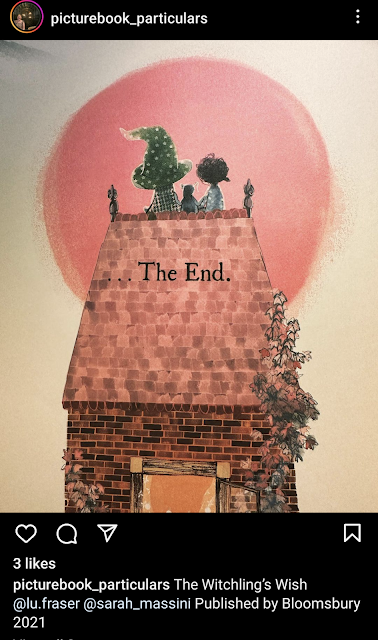
Image of the end papers from The Witchling's Wish
by Lu Fraser, illustrated by Sarah Massini
posted by Picturebook_particulars on Instagram 

posted with love by April Halprin Wayland with help from Bruce Balan and the infinite knowledge of poets everywhere.
_____________

PS from Carmela: Congratulations to the winner of our 2 for 1 Giveaway: A Set of Metaphor Dice and a copy of the Poetry by Chance Anthology 
Marcie F.

Friday, March 1, 2019

Getting the Rhythm with Picture Books

I didn't start out to be a picture book writer. My Best Friend was a gift from God, written in two hours (when I was boiling mad) for my four-year-old daughter.  My Best Friend was the first book I ever sold.

Now...how to do that again?
My first born picture book--and it's little friends.

I had no idea.

The picture books intimidate me. If you've been reading my posts awhile, you know I get wordy. How could I cram a story into a 1,000 words? (That was in 1999; today's word counts are more like 300 words and less.) I was (and still am) a novelist, who likes a lot of breathing space for my story to expand.

Picture books, unlike novels, are meant to be read aloud. They're a performance piece with several components. The art (which I don't do; I'm not an illustrator), the word choices and cadence of sentences all come together (hopefully) to tell the story.

Although I didn't know this was what I was doing, I used other picture books to "mentor" the birth of my next book, First Grade Stinks.


I picked my favorite books from my daughter's shelf.  What did they have in common?

Lots of picture books rhyme. Even in elementary school I couldn't string together six rhyming lines that made any sense. Forget about rhyming.

My mentoring books had other things in common. Words that were fun (and easy) to say. Lots of onomatopoeia. I love making up sound words. Click Clack Moo by Doreen Cronin is a book title that repeats in my brain when I am in "sound spinning" mode. 

Repetition of a catch phrase. Years of doing library story hours taught me that kids love to join in by repeating the expected phrase.  Carolyn Crimi's Don't Need Friends has the memorable phrase, "Don't need friends. Don't need friends at all."

Alliteration. I love alliteration, although a little will go a long way. One of my daughter's favorite books was Princess Prunella and the Purple Peanut by Margaret Atwood. (Yep...same person who wrote A Handmaid's Tale!) Literally every other word in that book began with the letter "P." I never knew whether Lily actually loved the story, or loved making her dad (who stutters a little) read it. (He tried hiding Princess Prunella. Lily found it.) Picture book words should roll off the tongue without being interspersed with the reader adding "crap" as all those P's pile up on the palate. (Oops!)

Most of all, the story should have rhythm. For me, the lines should have beats and pauses, ups and downs, like music. Music that doesn't rhyme.

Nailing down that rhythm was the grunt work of the mentoring process. I typed and typed out whole books. Then I printed them off, and read them aloud again. I marked off the beats in the line. How many? Was there a consistent beat to the whole story? Or just at the predictable catchlines? (Think of those as "the chorus" of a song.) How did the author achieve the rhythm without it sounding sing-songy?

My dad used to recite Poe's "The Raven" to me as a bedtime story (!!). When I think of sing-song writing, I think of "The Raven."  Once upon a midnight weary, while I pondered weak and weary/Over many a quaint and curious volume of forgotten lore.  I thought all poetry had to sound like "The Raven" which may have contributed to my childhood writer's block when it came to poetry. I had to erase Poe and his bird from my writing subconscious.

There is more to picture book writing than this. Character, motivation, structure and resolution don't give me much trouble. Making the story "sing" when read aloud--to me, that's what makes for a great book. The book that children want to hear over and over.

For the record, when I was writing First Grade Stinks my favorite picture book was Kevin Henkes' Julius, The Baby of the World, which introduces his inimitable mouse-child, Lilly. (Yes, my daughter Lily was in part, named for a fictional mouse.) This book uses the predictable catchphrase and certain repeated words perfectly.  Lilly's frequent description of baby brother Julius, "Disgusting!" inspired my character Hayley's oft repeated opinion, "First grade stinks!" 


Thanks to Doreen Cronin, Carolyn Crimi, Margaret Atwood and most of all Kevin Henkes (my secret author crush) for all they taught me...without charging a dime!.


Friday, July 27, 2018

Pause Politics With Poetry and Songs!

.
Howdy Campers, & Happy Poetry Friday! (The link to this week's PF host, my poem, and a reminder of our latest book give away are below.) 

Today, we in the TeachingAuthors treehouse begin tackling the topic: If/how the season affects our writing/work plans/schedule.

Hmm. For me, it's not about how the season of summer affects my writing, but how campaign seasons affect it.

photo by April Halprin Wayland 2007
In 2004, Bruce Balan and I co-founded a PAC (political action committee), AIC. Every four years since, we've put aside much of our lives to help make our country kinder and more civilized towards children. After the election, we settle back into our lives to volunteer, to play, to parent, to be a friend, to write and to teach.

That's how it used to be. But after the November 2016 election, AIC members asked us to keep working for our children's futures.

What does this mean for my writing? I still write a poem a day, but now, just 100 days from November 6th,  my books have gone "to the back of the bus." Argh.

But there's good news, too. To combat my fury/fear/foreboding while working for change, I've been reading Alison McGhee's inspiring and poetic blog posts, reading the marvelous book, World Enough & Time: on Creativity and Slowing Down by Christian McEwen (actually listening tothe author narrates it in a soothing voice with an English accent), listening to less news and more music.

Ah, music! As a longtime folk music fan, I've discovered and fallen in love with this anthem to peace by Woody Guthrie, which his son Arlo Guthrie put to music as Woody was dying:


MY PEACE
Words by Woody Guthrie, Music by Arlo Guthrie 

My peace my peace is all I’ve got
that I can give to you
My peace is all I ever had
that’s all I ever knew
.
I give my peace to green and black
to red and white and blue
my peace my peace is all I’ve got
that I can give to you
.
My peace, my peace is all I’ve got
it's all I've ever known
My peace is worth a thousand times more
than anything I own
.
I pass my peace around and around
‘cross hands of every hue;
my peace, my peace is all I’ve got
that I can to give to you
...........................................................................................................

I decided to imitate this song for my daily poem. "How hard can it be?" I thought, "It's so dang simple."

So I broke it down to figure out what form Woody used (the letters at the start of each line indicate the rhymes):

A My peace my peace is all I've got
B that I can give to you
C my peace
B
.
D xx my peace
B
A my peace my peace is all I’ve got
B that I can give to you
.
A My peace, my peace is all I’ve got
E
F My peace
E
.
G xx my peace
B
A my peace, my peace is all I’ve got
B that I can to give to you

I have a new appreciation of Woody's songs that often sound simple. 

As writer Lillian Ross said: The act of a pro is to make it look easy. Fred Astaire doesn't grunt when he dances to let you know how hard it is. If you're good at it, you leave no fingerprints.

Soooo...here's my imitative poem—still a muddy draft. (originally the last line was in winter, spring and fall  I wrote this note to myself about it: The repeated line does not deserve to be the last line.)

THIS PIECE I'VE WRITTEN (after Woody Guthrie's THIS PEACE)
by April Halprin Wayland
.
This piece, this piece is all I've made
but I must heed its call
this piece has taken all my days
although I know it's small
.
this piece is gathered from the fields
and from a waterfall
This piece, this piece is all I've made
but I must heed its call
.
This piece, this piece is all I've made
it's raw, uncivilized
this piece I wrote, then put away
it hadn't crystalized
.
I'm feeling brave I'll share it now
(if I can read my scrawl)
this piece, this piece is all I've made
but I must heed its call
.
poem (c)2018 by April Halprin Wayland. All rights reserved.

And so, while fighting the good fight, I am led to listen to, read books by, and try to emulate people who are kind, civilized and articulate.

photo by April Halprin Wayland 2017
And that's how this season has affected my writing.

Thank you for reading this, Campers. And what about you? Do you have looser/different goals in certain seasons, or are you pretty consistent year-round?

And don't forget TeachingAuthors' drawing for a chance to win an autographed copy to HP? WHO'S HE? by Patricia Karwatowicz, which ends August 3rd! Details on Carmela's post.

Thank you, Catherine, for hosting today at Reading To The Core!

posted with hope by April Halprin Wayland with help from Monkey, Eli and everyone who does good work.

Friday, April 29, 2016

Final Poem in Your Pocket for Poetry Month 2016

.
Howdy Campers!

Well...how was your Poetry Month?  We TeachingAuthors celebrated our 7th (!) Blogiversary (with a book giveaway--details in that link).

Mine was a blur of activity because my new Passover picture book came out, I'm teaching this quarter, and there were a gazillion other things I was going to tell you but that I can't actually remember right now. But they were important. And they were right here a minute ago...

Photo of me from Morguefile.com
Poetry Month is ending for me this weekend in a cheerful house by a dreamy creek with a bit of yoga. That, right there, is a poem, don't you think?

Although Poem in Your Pocket Day was officially April 21st this year, I'm offering one more to close out this delicious month.

I was looking through bird poems I've written, and this one made me want to tap dance. And I am not a tap dancer.

So here's my tap dancing thank you to every bird in the Kidlitosphere-and-beyond who've splashed into this poetry pond intending to stay only a minute or two...and who have now built cheerful homes here.

A Kidlitosphere Poetry Friday selfie

CROW TALK
by April Halprin Wayland


There's a sound crows make when they gather in a crowd.
It's a woody kind of note and it's not very loud

like knuckles that are rapping on the front porch door
or a tap dancer tapping on the cracked dance floor.

When one crow makes it, the whole crowd stops.
I wonder what it means, this woodland knock?

There's a hawk in the clouds? There's a hunter on the ground?
I watch them and I practice, teach my tongue to make that sound.

Listen—I can do it! Now my mouth knows how to knock.I'm a smooth feathered bird-- I can talk crow talk.

poem (c) 2016 by April Halprin Wayland. All rights reserved.

This is actually true: I know one word in crow.      


And another thing that's true: you still have time to enter TeachingAuthor's 7th Blogiversary Giveaway to win the newest edition of  Carmela Martino's new edition of  Rosa, Sola (which got a starred review in BookList)! Read all about it and enter our giveaway here.

Thank you for hosting PF today, Buffy!

posted by April Halprin Wayland, tick-tock-clocking with her tongue

Friday, March 11, 2016

MORE THAN ENOUGH (behind-the-scenes) ~ A Passover Story


Howdy, Campers!

I'd like to present my newest picture book.

Book, say hello to everyone.

More Than Enough ~ A Passover Story
by April Halprin Wayland, illustrated by Katie Kath (Dial 2016)
You can see that it's still a bit shy, so here's the elevator pitch:

it's a story for 3-5 year olds
about being grateful
for having more than enough each moment
as a family prepares to celebrate Passover.

Would you like to hear the crazy, rollercoaster tearing-out-my-hair behind-the-scenes story of how a seed of an idea became this published book?

Thank you for nodding yes.

It all began in 2009, as I was hiking with my family in Kauai, Hawaii. There were a lot of steep hills. But the leaves were glistening from the morning rain, the soil was a rich red, and I was with the ones I love most. I thought of my favorite Passover song, Dayenu.  

Dayenu means "it would have been enough." We sing about being grateful even if we'd only been freed from slavery; grateful even if we'd only been led out of Egypt, etc.

To me, it's what all great religions and philosophies teach: be aware of and grateful for the blessings of the moment.

As I sang the song, I was keenly aware of the blessings of each step of the hike:

If I only hike up this rich, red dirt, that's enough;

if I only see the blue and green ocean from the top of this hill, that's enough;

if I only dive into the warm waves, that's enough...

My husband  hiking Kauai
I flew home and wrote this as a free verse poem, based loosely on the form of the original song, and read it aloud at a friend's Seder (Passover meal).  They liked it!

So I rewrote it as a picture book and submitted it in May of 2009 to my editor at Dial, who I'd loved working with on my last picture book, New Year at the Pier.  

Here are the first four stanzas of the manuscript as first submitted:

If we had driven along the jungley road
And had not found the hiking trail
Dayenu

If we had found the hiking trail
And had not reached the hill overlooking the ocean
Dayenu

If we had reached the hill overlooking the ocean
And had not gone swimming
Dayenu

If we had dived into those deep blue waves
And had not built cairns when we got out of the water
Dayenu

My editor liked it. She liked it!

But...would I change the setting of the story?

Take it out of Hawaii? I harrumphed to myself.  The whole idea was that this concept is universal.  And wasn't Hawaii rich with illustrative possibilities?

But, okay. I took it out of Hawaii.

Great, she said.  And she really liked the farmers market at the end of the hike. So...could I expand on that...and shorten the hike?

Shorten the hike? Argh. I guess...

I did.

Fine, fine, she said, when she got that version.  Now--could you write this for three to five year olds?

Well, I can...but I don't want to.  I did, working closely with my critique partner and friend, poet and author, Sonya Sones, on the rhythm of each stanza. 

Wonderful, she said. And...could the family buy Passover foods at the farmers market?

Passover food? But the whole idea was to take the concept of Dayenu--of gratitude for each moment-- out of the holiday and into a regular day, I thought ferociously, pounding the carpet.

But I did. I deleted the fresh ahi tuna, avocado and mangoes and loaded the family's market bags with apples and walnuts, lilacs and honey. 

Terrific, she said. And...could you have them getting ready to go to a family Seder after the market?

...okay.

Good, good!  And could you cut out the hike altogether?

 *  *  *  *  

April?

 *  *  *  *

April, are you there?

*Sigh.* Yes, I'm here. And yes, I said weakly, climbing down from the proverbial cliff with the support of my agent, Marietta B. Zacker--yes, I can cut out the hike.

Fabulous!, she said. We're nearly done!

Between 2009 and 2014, I worked with experts in Judaism, checking every detail and writing and rewriting the glossary. (You may know the expression, "Whenever there are two Jews in a room, there are three opinions."  It's true--every fact is a matter of interpretation...)

I rewrote this 200-word story more than 34 times.

And finally, the skies cleared!  Now I love this story.  Thank you, Jessica Garrison, clear-eyed editor--Dayenu!

Now first four stanzas read:

We wander the market
surrounded by colors—
Dayenu

We buy apples and walnuts,
lilacs and honey—
Dayenu

We reach through the bars
to lift one purring kitten—
Dayenu

He licks Mama’s nose
so she says we can keep  him—
Dayenu

*  *  *  *
Dayenu!  Passover is April 22nd-April 30th this year.


Here's the 37 second book trailer my son and a friend's daughter made...be sure to watch all the way to the end:


Aren't those illustrations delicious? For more, click the following:

 And congratulations to, Irene Latham and Charles Waters for winning the National Book Award!


                                                  Illustrator Katie Kath, who you will meet
                                                in the next post, holds our newborn book